摘要 (Abstract)
Background
Glucagon-like peptide-1 receptor agonists (GLP-1RAs) are increasingly prescribed for diabetes and obesity management. The medication-driven weight loss (mdWL) induced by GLP-1RAs may lead to facial hollowing, laxity, and wrinkle accentuation. Minimally invasive strategies are needed to restore facial harmony in this population.
Purpose
To evaluate the effectiveness of poly-L-lactic acid (PLLA-SCA) and hyaluronic acid fillers for facial rejuvenation in women undergoing GLP-1RA–induced mdWL.
Patients and Methods
This retrospective, multicenter, real-world case series included 15 women (aged 30–50 years) from four Latin American countries who used GLP-1RAs for mdWL and were treated with PLLA-SCA and hyaluronic acid filler injections. Outcomes were assessed through clinical photos at baseline and around 85–100 days (D90) using the Facial Laxity Rating Scale (FLRS), Wrinkle Severity Rating Scale (WSRS), Global Aesthetic Improvement Scale (GAIS; participant and investigator assessments), and a satisfaction questionnaire. Safety events were recorded.
Results
Participants achieved 17.9% weight reduction from baseline. At D90, FLRS scores decreased from 4.5 (SD 2.2) to 2.6 (SD 1.8; p<0.001), and WSRS scores from 3.1 (SD 1.5) to 1.9 (SD 1.0; p=0.003). Eight patients (53%) reduced FLRS by ≥2 points, and 11 of 13 patients (85%) with baseline WSRS >1 showed improvement. All participants reported aesthetic improvement (pGAIS), with 40% rating “exceptional improvement”. Investigator GAIS confirmed improvement in 100% of cases. At D90, 87% were satisfied or very satisfied. No serious adverse events occurred; transient ecchymoses and edema resolved spontaneously within 72 hours.
Conclusion
The combined use of PLLA-SCA and hyaluronic acid fillers is an effective strategy to correct facial skin laxity, volume loss, and smooth nasolabial fold and wrinkles following GLP-1RA–induced mdWL with a satisfactory safety profile. These findings suggest that a combined injectable approach may be beneficial to address the aesthetic impact of mdWL in real-world clinical practice among Latin Americans.
关键词:hyaluronic acid / poly-L-lactic acid / PLLA-SCA / face / weight loss / obesity / semaglutide / liraglutide / Latin America / GLP-1 receptor agonists
正文 (Full Text)
Introduction
Obesity has become a significant public health challenge in Latin America, mirroring a global trend of increasing prevalence, especially in developing countries.1–6 Overweight (BMI 25–30 kg/m2) is estimated to affect 58–65% of adults, while obesity (BMI ≥30 kg/m2) is estimated at 24–30%. Mexico, Chile, Argentina, and Brazil have the highest prevalence rates on the continent.1,7 This overburdens healthcare systems, as obesity is a major risk factor for type 2 diabetes, hypertension, dementia, malignancy, and cardiovascular disease.4,8 Effective management of obesity is crucial for reducing these health risks and improving overall quality of life.6,9,10
Glucagon-like peptide-1 receptor agonists (GLP-1RAs), eg, semaglutide, liraglutide, and tirzepatide, have emerged as a transformative pharmacological option for diabetes and obesity management. The STEP (Semaglutide Treatment Effect in People with Obesity) trials have reported average weight losses of 10–15% of initial body weight in the first four months, surpassing the efficacy (and safety) of other pharmacological agents.11–13 Since 2021, prescriptions of semaglutide have exhibited an exponential trend worldwide.14 In Denmark, one-third of new users are not type-2 diabetics, and the off-label prescriptions for overweight are expected to increase.15 In the US 46.3% of physicians support prescribing it off-label.16 Notably, in 2022, 22% of US patients prescribed semaglutide received it for off-label use, highlighting the increasing trend in off-label prescriptions, including non-obese but overweight people. This has led to shortages in some US states.14,17,18
Nevertheless, the rapid weight loss due to mdWL can result in a stigmatizing condition often referred to as “hollow face”.19–21 This phenomenon primarily results from the reduction of fat in the subcutaneous tissues of the face, particularly in areas such as the temporal region, cheeks, and periorbital zones. Muscle loss, combined with fat loss, significantly undermines facial structural support, resulting in decreased skin tension, volume depletion, and a less defined facial contour. The reduction in underlying muscle mass further exacerbates sagging by weakening soft tissue anchorage, thereby increasing skin laxity and deepening facial folds. Collectively, these changes contribute to a hollowed, even unhealthy appearance and a more aged facial profile.21
GLP-1RAs can influence dermal white adipose tissue (DWAT), impairing its functionality.22–24 Additionally, GLP-1RAs can impact hormonal signaling through dermal estrogen, which is linked to skin elasticity and collagen integrity.25–27 Moreover, GLP-1RAs exert effects on human adipose cell precursors by inhibiting their proliferation and differentiation, while simultaneously stimulating the expression of insulin-sensitizing adipokines.16,28
The upper face may exhibit temporal hollowing and increased prominence of the lateral orbital rim, while the midface and lower face may develop pronounced laxity and sagging. Loss of volume in the buccal and deep medial cheek fat compartments contributes substantially to the gaunt appearance observed after rapid medication-driven weight loss. The resulting volume loss and skin laxity can create an aged and bony appearance, even in younger individuals, as the structural support and fullness that confer a youthful look diminish.21,28 Addressing these changes often requires a multidisciplinary approach, combining weight management strategies with plastic surgery procedures and/or minimally invasive interventions, such as dermal fillers and collagen biostimulators, to restore facial balance and improve overall aesthetic outcomes.29,30
The combination of hyaluronic acid fillers and PLLA-SCA in treating facial laxity caused by the rapid body mass reduction due to mdWL following GLP-1RAs can offer synergistic benefits, leveraging the unique properties of both aesthetic injectables.31 This case series aimed to assess the effect of the aesthetic outcomes of PLLA-SCA and injectable hyaluronic acid in mdWL based on the authors’ clinical practice.
Materials and Methods
Study Design
A multicenter case series from four countries, in seven Latin American sites, documented patients who received aesthetic injections with PLLA-SCA and hyaluronic acid fillers for facial treatment following GLP-1RA-induced mdWL.
Study Population
Fifteen women aged 30–50 years who have started GLP-1 medication in the last 6 months, have experienced wrinkles and skin laxity, and are seeking improvement in their wrinkles and skin laxity, as well as improvement in nasolabial folds and facial volume, voluntarily sought dermatologic treatment for facial aging following mdWL within 160–180 days of the procedure, between February and April/2025, were included in this analysis. These participants did not receive energy-based therapy during the follow-up period.
Pregnant or lactating women, individuals using anabolic steroids, current smokers, postmenopausal women, and those who have undergone facial lifting or received facial collagen biostimulators within the past 12 months were not considered in the study.
Procedures
The standardized pictures were taken before the procedure and after approximately 85–100 days. Injection treatment sessions using PLLA-SCA and hyaluronic acid fillers were determined by the specialists, in accordance with their clinical practice, following individual assessment and the patient’s needs. A second treatment session was performed around 45–60 days apart.
Although no predefined treatment algorithm was used, participating physicians followed common clinical principles. Patients with predominant skin laxity were preferentially treated with higher PLLA-SCA volumes, whereas those with localized volume depletion received greater hyaluronic acid correction. Combined treatment was favored in patients exhibiting both facial deflation and soft-tissue sagging. The number of PLLA-SCA vials (1–3) was determined according to the extent of facial volume loss and laxity severity assessed clinically at baseline.
Clinical and social-demographic data from the fifteen subjects are presented in Table 1. In addition, the rationale for the device used (cannula vs needle), the number of syringes of hyaluronic acid filler, the injection points, and volume per injection point were shown in Table 2 and Supplementary Table 2.
| Variable | Values |
|---|
| Age (in years), mean (SD) | 42.9 (9.8) |
| Skin Phototype, n (%) | |
| II | 5 (33%) |
| III | 9 (60%) |
| IV | 1 (7%) |
| Self-reported ancestry, n (%) | |
| European | 9 (60%) |
| Admixed Latin American | 6 (40%) |
| Country of origin, n (%) | |
| Brazil | 7 (47%) |
| Mexico | 4 (27%) |
| Argentina | 2 (13%) |
| Chile | 2 (13%) |
| Time from GLP-1RA onset and injectables treatment (months), mean (SD) | 3.5 (2.6) |
| Adherence to restrictive diet, n (%) | 5 (33%) |
| Physical exercise (≥3 days/week), n (%) | 8 (54%) |
| Type of GLP-1RA, n (%) | |
| Semaglutide | 13 (87%) |
| Liraglutide | 2 (13%) |
| Weight loss (in kg), mean (SD) | 15.5 (10.4) |
| Percentile of weight loss, mean (SD) | 17.9% (10.2%) |
| Body composition at GLP-1RA onset, n (%) | |
| Overweight (BMI 25 to 30 kg/m 2 ) | 5 (33%) |
| Obesity (BMI ≥30 kg/m 2 ) | 8 (54%) |
| NA | 2 (13%) |
| Anatomical Regions | Hyaluronic Acid Filler |
|---|
| Volume (mL)/per side | Product |
| Anterior Temple | 0.5 |
| Pre-jowl | 0.3 |
| Mandible angle | 0.5–1.0 |
| Zygomatic* | 0.5–1.0* |
| Pyriform aperture | 0.25–0.6 |
| Tear through | 0.2–0.5 |
| Nasolabial fold | 0.2 |
| Chin | 0.5 |
| Chin (superficial fat pad) | 0.5–1.0 |
| Upper lip** | 0.4 |
| Lower lip | 0.2–0.4 |
All the participants gave written consent for data and image publication. All procedures in the study were conducted in accordance with the Declaration of Helsinki (as revised in 2013). This study was approved by Unesp IRB (#95573526.2.0000.5411).
Outcomes
The main outcomes were the Facial Laxity Rating Scale (FLRS)32 and the Wrinkle Severity Rating Scale (WSRS)33 evaluated by the physicians using standardized photographs taken before and 85–100 days after the injections.
The 5-point GAIS (Global Aesthetic Improvement Scale) was graded at D90, in comparison with D0, by asking the participants (pGAIS) and by the comparison of the standardized pictures (iGAIS). The categories of improvement were: −1 – “Worsened”, 0 – “Unaltered”, 1 – “Improved”, 2 – “Very Improved”, and 3 – “Exceptional Improvement”.34
Based on their photos, the participants were asked about their overall satisfaction with the treatment at approximately 90 days (D90).35
Safety Assessment
The safety data was collected by recording adverse events related to the product or the injection procedure, and the need for aesthetic corrections to the treatment.
Data Analysis and Sample Size Calculation
Statistical analysis was conducted using IBM SPSS software version 29. Continuous variables were presented as means and standard deviations (SD), and categorical or ordinal variables as their percentages.36–38
The comparison of the data from the baseline and post-treatment sessions was tested using the Wilcoxon test,39 and significance was set at p<0.05.40 The correlations between changes in FLRS or WSRS scores and age, absolute and percentage weight loss, time since GLP-1 RA initiation, GAIS, and baseline FLRS/WSRS scores were tested using Spearman’s rank correlation coefficient (ρ).41
Results
A total of 15 women were treated with PLLA-SCA and hyaluronic acid filler on GLP-1 treatment for weight loss. Their main clinical and demographic characteristics are presented in Table 1. Caucasian and Latin admixed women were enrolled. The interval since the initiation of GLP-1RAs ranged from 0.5 to 6 months, with weight reduction between 6% and 34% of baseline. Seven women achieved a eutrophic status (body mass index <25 kg/m2) at the last visit. Although weight loss varied substantially among participants, treatment planning was individualized according to facial volume depletion, laxity, and wrinkle severity rather than weight loss magnitude alone. Patients with greater volume loss generally required larger amounts of PLLA-SCA and/or hyaluronic acid filler; however, no statistically significant association was observed between weight-loss percentage and clinical improvement scores.
The individual regimens of applications varied among the participants and are reported in the Supplementary Table (Stable 1). Still, participants were subjected to the injection of one to three vials of PLLA-SCA and up to four syringes of hyaluronic acid fillers per session. Sterile water was used as the diluent in all cases, with a dilution volume of 8 mL in thirteen cases and 9 mL in the remaining two. In every instance, 10 mL as final volume was achieved by adding 2% lidocaine without epinephrine immediately before the injection to ensure adequate anesthesia, in alignment with physician practice. The PLLA-SCA vial was injected right after its dilution.
Figures 1–3 illustrate the follow-up of women who underwent injectable aesthetic treatments on the face after starting GLP-1RAs for weight loss, demonstrating the restoration of facial volume, improvement of nasolabial fold, and reduction of skin flaccidity.
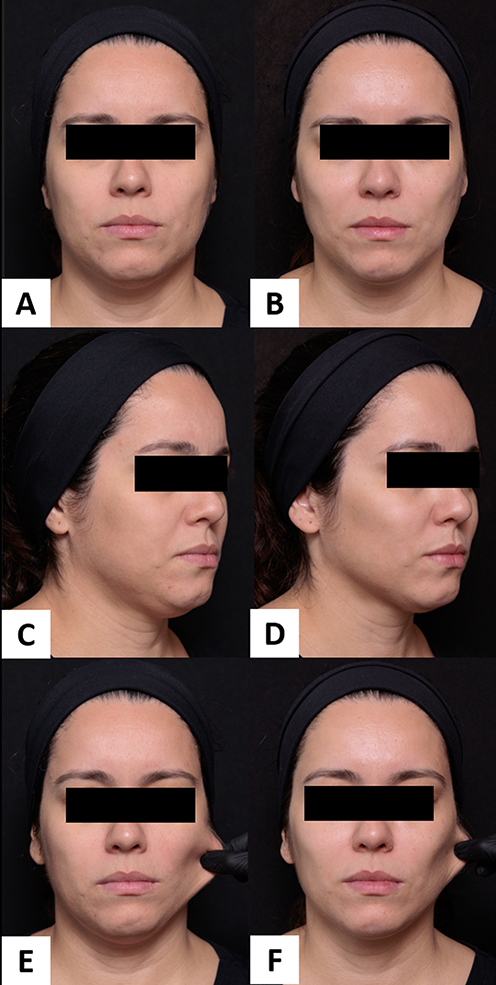
图注:图 1. Participant 8. 38-year-old female, two injection treatments right after initiating GLP-1RAs11,2 kg weight loss (91.2 kg pre-injection treatment–80 kg post-treatment). (A, C, E) baseline assessment. (B, D, F) Approximately 95 days after treatments performed with the aesthetic injectables. See Supplementary Table S1.
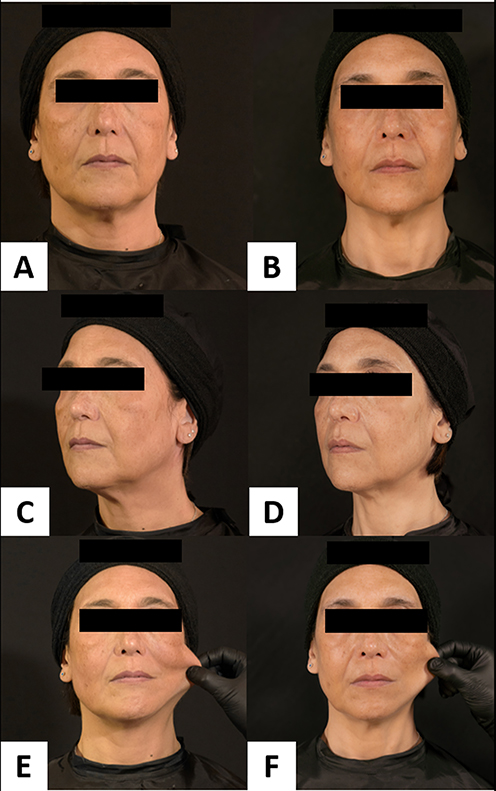
图注:图 2. Participant 1. 50-year-old female. Initially presented with a body weight of 124 kg before liraglutide therapy. After two months of treatment, its weight had decreased to 101 kg, at which point injectable aesthetic procedures were initiated. At the 2nd treatment session with PLLA-SCA and hyaluronic acid, the weight was recorded at 84 kg, reflecting a total weight loss of 40 kg since the beginning of the therapeutic protocol. (A, C, E) baseline; (B, D, F) approximately 90 days after treatments performed with the aesthetic injectables. See Supplementary Table S1.
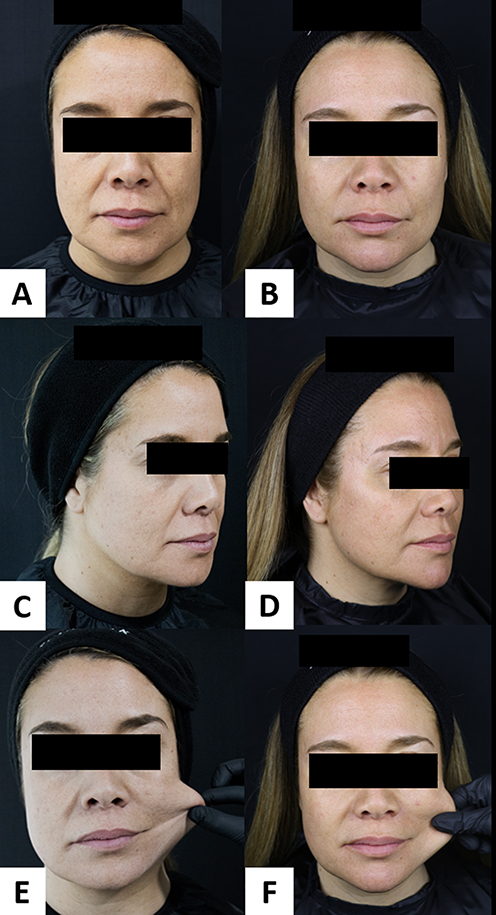
图注:图 3. Participant 14. 47-year-old female. Initially presented with a body weight of 77 kg before pharmacological therapy with Liraglutide. After 2.5 months of treatment, its weight had decreased to 70 kg, at which point injectable aesthetic procedures were initiated. At the 2nd treatment session with PLLA-SCA and hyaluronic acid, the weight was recorded at 69 kg, reflecting a total weight loss of 8 kg since the beginning of the therapeutic protocol. (A, C, E) baseline; (B, D, F) approximately 100 days after treatments performed with the aesthetic injectables. See Supplementary Table S1.
All participants showed a reduction in baseline FLRS scores (p<0.001): mean (SD) decreased from 4.5 (2.2) at baseline to 2.6 (1.8) at D90, with eight women (53%) achieving a reduction of two or more points (Figure 4).
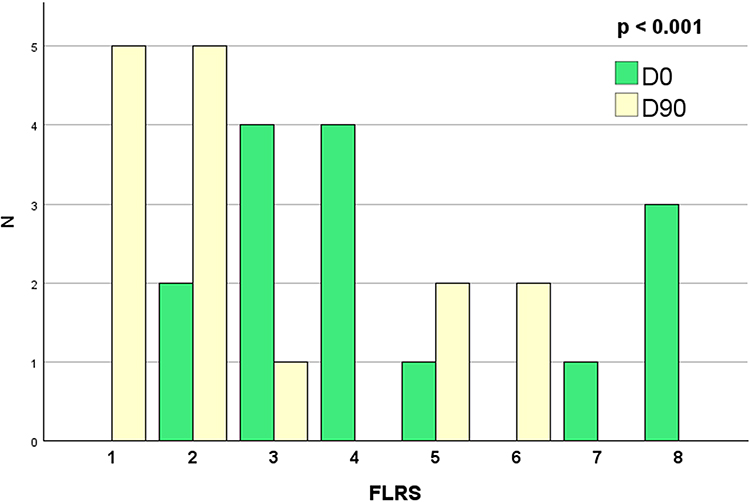
图注:图 4. Facial Laxity Rating Scale (FLRS) scores at baseline (D0) and approximately 90 days after the first application. (N) Number of individuals.
Of the 13 participants with WSRS scores >1, 11 (85%) showed a reduction (Figure 5). Mean (SD) WSRS scores decreased from 3.1 (1.5) at baseline to 1.9 (1.0) at D90 (p = 0.003).
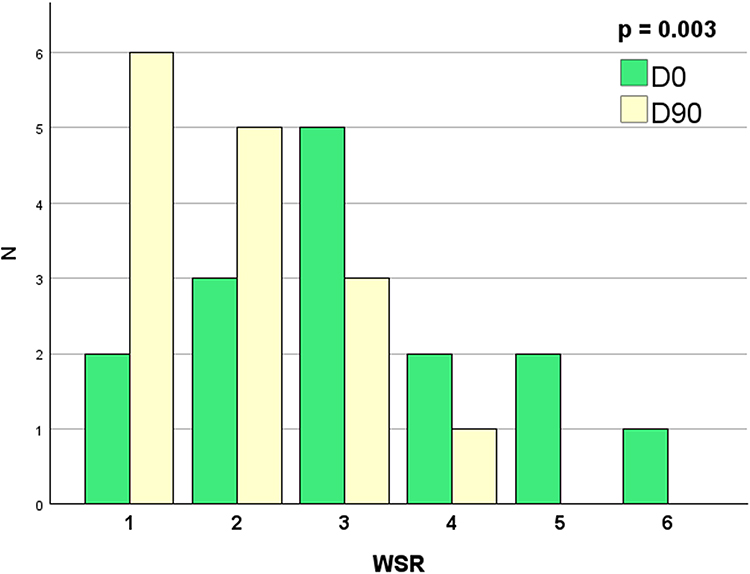
图注:图 5. Wrinkle Severity Rating Scale (WSRS) scores at baseline (D0) and approximately 90 days after the first application. (N) Number of individuals.
The reduction in FLRS was correlated with the reductions of WSRS (ρ = 0.63), baseline FLRS values (ρ = 0.64), pGAIS (ρ = 0.54), and the final BMI (ρ = 0.65). However, neither the reductions in FLRS nor WSRS were significantly correlated with age, absolute or percentage of weight loss, time since GLP-1RA initiation, iGAIS, or baseline scores (FLRS/WSRS). Given the limited sample size inherent to this case series, we interpreted these findings cautiously and discussed them as hypothesis-generating observations.
At D90 (Figure 6), all participants reported some degree of aesthetic improvement (pGAIS), with six (40%) rating the outcome as “exceptional improvement”. Investigators also observed aesthetic improvement in all participants, including four (27%) rated as “exceptional improvement”.
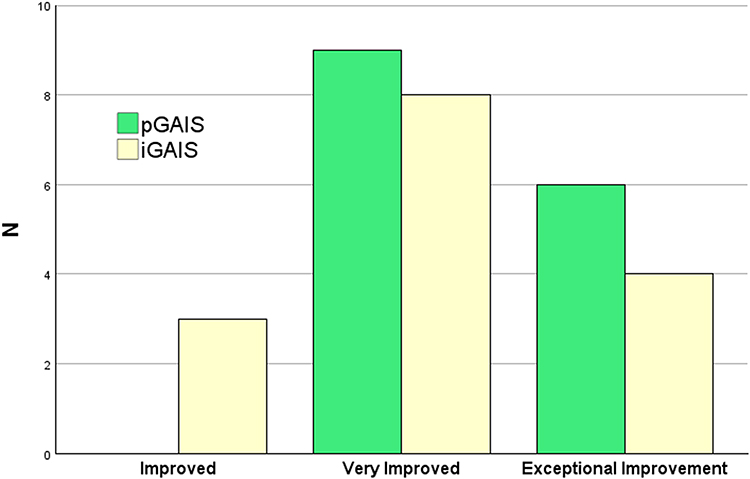
图注:图 6. Global Aesthetic Improvement Scale (GAIS) at D90, as assessed by the participants (pGAIS) and investigators (iGAIS). (N) Number of individuals.
Regarding satisfaction, at D90, 13 participants (86.7%) reported being satisfied or very satisfied with the results, one participant (6.7%) was neutral, one was satisfied, and one was dissatisfied.
No TRAEs (treatment-related events) were reported with the aesthetic injectables themselves, but with the injection procedure. Reported events included transient ecchymoses, local pain, and edema, all of which resolved spontaneously within 72h. There were no facial asymmetries or need for adjustments after the procedures.
Discussion
This case series presents real-world evidence on the use of two sessions of PLLA-SCA and hyaluronic fillers in addressing facial changes induced by mdWL following GLP-1RAs therapy. It explores a beneficial, clinically relevant intersection between metabolic pharmacotherapy and Aesthetic Medicine. The findings highlight not only the growing demand for aesthetic interventions in this population but also the feasibility, safety, and patient satisfaction of combining biostimulatory and volumizing approaches to restore flaccidity and wrinkles after pharmacologically induced weight reduction.31,42
PLLA-SCA43,44 is an implant and a new collagen biostimulator. Its particle plays a pivotal role in stimulating the skin’s structural regeneration, which triggers a foreign body reaction (FBR) through mechanotransductional signalling pathways, which activate macrophages and fibroblasts within the dermal layer. Macrophages initiate the inflammatory cascade, while fibroblasts are responsible for synthesizing new collagen and elastin fibers. This process gradually restores the skin’s structural foundation, improving elasticity, firmness, and overall texture. By promoting neocollagenesis and elastogenesis, PLLA-SCA serves as an effective biostimulatory agent for long-term skin rejuvenation.45–47 Experimental evidence suggests that PLLA-SCA may influence cellular pathways involved in extracellular matrix remodeling and adipose tissue homeostasis, providing a regenerative mechanism of action through its role in influencing adipocyte function, which leads to a better positioning of facial fat volume. The dual approach, PLLA-SCA and hyaluronic acid fillers, thus addresses both the acute volumetric deficit and the delayed regenerative requirements. Interestingly, the collagen and elastin-stimulating and also regenerative effects of PLLA-SCA are particularly valuable in mdWL patients, in whom dermal white adipose tissue dynamics may be impaired.31 By promoting fibroblast activation and extracellular matrix remodeling, PLLA-SCA may counteract some of the metabolic and structural deficits induced by pharmacologic weight reduction.47,48
The treatment strategy integrated the regenerative effects of PLLA-SCA with the volumizing properties of hyaluronic acid fillers. PLLA-SCA was used to promote progressive improvement in tissue support and skin firmness, while hyaluronic acid fillers provided immediate correction of localized volume deficits. The combination was tailored to individual facial anatomy and the severity of volume loss and laxity associated with medication-driven weight loss.49 This dual strategy enhances contour and firmness with both immediate and progressive effects. Recent reports in semaglutide patients further suggest that initiating PLLA-SCA early during weight reduction may mitigate laxity progression and optimize contour at 90 days, a hypothesis consistent with our series.31 Targeted treatment regions for addressing facial flaccidity due to mdWL are presented in Figure 7, and comprise the areas prone to sagging and volume loss, such as the malar region, jawline, and lateral midface, providing structural support, improved contour, and a natural lifting effect. In this series, aesthetic treatment was generally initiated within 0.5–6 months after GLP-1RA initiation and after clinically evident facial volume loss or laxity became apparent.
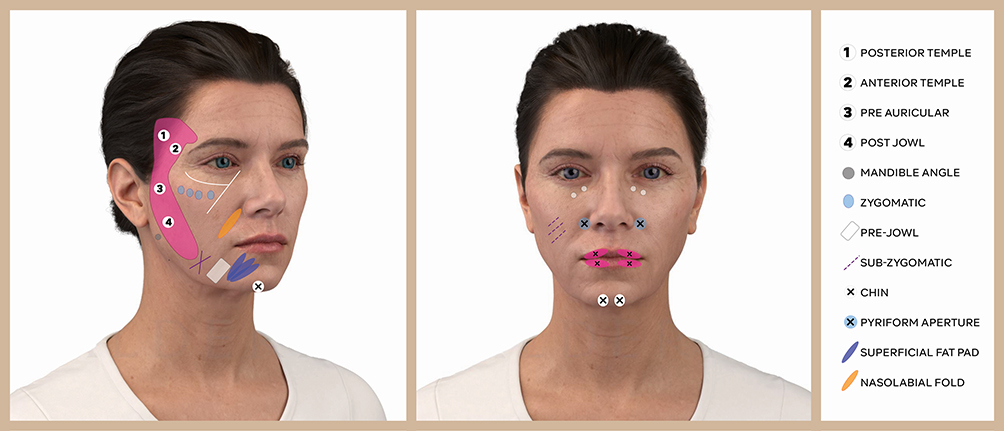
图注:图 7. Overarching schematic representation of targeted treated areas for addressing skin flaccidity, wrinkles, folds, and volume loss due to medication-driven weight loss.
The improvements observed in this study: reductions in FLRS and WSRS scores, high rates of GAIS-rated improvement, and overall satisfaction exceeding 85%, are consistent with the expected efficacy of hyaluronic acid filler and PLLA-SCA in Aesthetic Medicine.46,49,50 Importantly, the magnitude of improvement occurred simultaneously on flaccidity, wrinkles, and folds, but it was not correlated with baseline weight loss parameters, time from GLP-1RAs therapy onset, or treatment variables, suggesting that dermal filler and regenerative biostimulation response in this setting is robust across a heterogeneous population. Interestingly, higher final BMI was associated with better FLRS outcomes, suggesting that maintaining a minimum level of DWAT is beneficial for clinical improvement. Otherwise, extremely low body weight following mdWL may be more challenging to improve. In addition, the minimally invasive treatment with injectable treatment can contribute to diminishing the stigmatization caused by rapid mdWL.19
Our findings align with the recent international Delphi consensus on managing the aesthetic needs of mdWL patients, which emphasized the impact of rapid mdWL on superficial and deep fat pads, the importance of multimodal injectable strategies, and the need for validated outcome measures such as GAIS and objective scales. By demonstrating that PLLA-SCA and hyaluronic acid fillers safely restored facial harmony within 85–100 days, our series provides real-world evidence that complements and reinforces these global consensus recommendations.51
Adverse events associated with injectable treatments are typically non-specific and related to the injection procedures, which may include pain, bleeding, erythema, edema, papules, among others. Late complications, such as chronic inflammation and nodule formation, can occur, often attributed to improper product reconstitution or injection technique.52,53 The lack of significant adverse events beyond transient ecchymosis and edema further reinforces the safety profile of these interventions, even when applied to metabolically dynamic patients.
The expectation of increased prescriptions for GLP-1RAs raises concerns about their potential impact on overall fat and muscle loss, particularly when used at high doses by non-obese individuals (eg, those with a body mass index <30 kg/m2).6,54
This series is limited by its retrospective analysis, the absence of a control group, and a follow-up period of less than 100 days. However, PLLA-SCA yields progressive results beyond 120 days post-injection.55 In addition, these results cannot be generalized to other rapid weight loss conditions, such as bariatric surgery. The customization of the injection protocols (volume/points) according to the patient’s needs increases real-world applicability despite introducing operator bias. Prospective studies with control groups and objective data from three-dimensional volumetric imaging are warranted to investigate optimal treatment regimens and injection techniques for hyaluronic acid fillers and poly-L-lactic acid to enhance their effectiveness in addressing facial laxity and volume loss resulting from the mdWL associated with the use of GLP-1RAs.
Conclusion
This real-world Latin American case series demonstrates that combining NASHA/OBT hyaluronic acid fillers and PLLA-SCA is an effective strategy and aesthetic treatment option for optimizing facial volume loss, addressing facial skin flaccidity, fine wrinkles and folds, following GLP-1RA-induced weight reduction, with a satisfactory safety profile. Prospective studies are warranted to optimize treatment regimens and injection techniques.