三氯乙酸治疗萎缩性痤疮瘢痕的范围综述:方案、浓度与联合治疗证据图谱
2026年9月28日24 min read
Journal of Cosmetic Dermatology
结论与实践要点
萎缩性痤疮瘢痕形态多样(冰锥型、箱车型、 rolling 型),单一手段难以覆盖全部类型。本范围综述系统梳理了 TCA 在其中的应用证据,包括化学剥脱与 CROSS(皮肤瘢痕化学重建)两种路径。
证据地图显示:CROSS 以高浓度(50%–100%)点状作用于瘢痕底部,对冰锥型与深箱车型这类「窄而深」的皮损选择性较好,其机制在于局部诱导新生胶原与真皮基质重排,同时相对保留周围正常皮肤;化学剥脱则依浓度分层——10%–20% 偏质地改善,25%–50% 用于较浅的萎缩性皮损;近半数研究采用联合方案(TCA 15%–20% 联合微针或皮下分离术),体现「分型而治、多手段叠加」的趋势。
安全性方面,报告的不良事件以一过性为主,但炎症后色素沉着(PIH)与持续性红斑是关键风险。对以 Fitzpatrick III–IV 型为主的中国求美者而言,PIH 风险尤需前置评估:术前应充分防晒与必要时预处理,术后严格防晒与修护,并避免在活动期痤疮、近期暴晒或瘢痕体质人群上贸然施治。
需注意的是,范围综述旨在描绘证据版图而非给出效应量结论,纳入研究在设计、浓度与终点上异质性较大;因此本文更适合作为方案选择的参考框架,而不是某一浓度或组合的确定性依据。
BackgroundAtrophic acne scars represent a significant aesthetic and therapeutic challenge due to their multifactorial nature and morphological diversity. Trichloroacetic Acid (TCA) stands out as a versatile option, either through chemical peels or the Chemical Reconstruction of Skin Scars (CROSS) technique.
AimTo map scientific evidence regarding clinical protocols, concentrations, and efficacy of TCA, alone or in combined therapies, for atrophic acne scars.
MethodsThis scoping review followed the Joanna Briggs Institute (JBI) methodology and PRISMA‐ScR guidelines. Search strategies were applied across nine databases using the PCC strategy. Thirty‐four studies published between 2002 and 2025 were included.
ResultsThe CROSS technique was the most evaluated protocol (58.8% of studies), with concentrations ranging from 50% to 100%; it demonstrated high selectivity and efficacy, particularly for ice‐pick and deep boxcar scars. Chemical peels accounted for 41.2% of studies, with superficial concentrations (10%–20%) used for texture improvement and medium concentrations (25%–50%) for shallow atrophic lesions. Combined therapies (52.9%) highlighted the synergy between TCA (15%–20%), microneedling, and subcision. Reported adverse events were primarily transient, including post‐inflammatory hyperpigmentation (PIH) and prolonged erythema.
ConclusionTCA is a versatile, cost‐effective, and evidence‐backed tool. The findings highlight a definitive shift toward personalized multimodal approaches, where the CROSS‐technique's precision and the synergistic effects of combined therapies optimize dermal remodeling and patient outcomes.
Keywords: acne scars、chemical peeling、CROSS technique、scoping review、trichloroacetic acid
1
Acne vulgaris is a chronic inflammatory condition whose most persistent sequelae comprise atrophic scars, resulting from inadequate collagen synthesis during healing process [ 1 , 2 ]. The clinical management of these scars represents a relevant therapeutic challenge [ 3 , 4 ] and generally involves minimally invasive approaches, such as microneedling, subcision, lasers, dermal threads, and chemical peels, with search for effective and safe protocols being a central objective in clinical practice [ 5 , 6 ].
In this context, trichloroacetic acid (TCA) stands out as a versatile agent capable of inducing neocollagenesis and dermal thickening, whether applied alone or through the CROSS (Chemical Reconstruction of Skin Scars) technique [ 7 , 8 ]. Considering its multifactorial nature, as well as clinical manifestations of different depths and morphologies that rarely respond to a single intervention modality [ 5 , 9 , 10 , 11 , 12 , 13 ], there is an increasing use of TCA for atrophic acne scars aiming to enhance tissue remodeling and optimize clinical results [ 9 , 14 ], primarily in combined protocols that explore distinct mechanisms of action [ 3 , 12 , 15 , 16 ].
Despite its wide clinical use, there is still significant heterogeneity in protocols, including variations in TCA concentrations and application regimens, as well as distinct therapeutic combinations [ 1 , 5 , 17 ]. Therefore, this scoping review aims to systematically map the evidence regarding use of TCA in atrophic acne scars, identifying the most used clinical parameters and knowledge gaps to support development of standardized and evidence‐based protocols.
2
This scoping review was conducted according to methodology proposed by Joanna Briggs Institute and reported following PRISMA‐ScR guidelines. The research question was: “What are the clinical protocols and available evidence regarding the use of TCA, alone or in combined therapies, for treatment of atrophic acne scars?”
A search was performed in PubMed/MEDLINE, Embase, Scopus, Web of Science, LILACS, SciELO, Cochrane Library, ClinicalTrials.gov, and Google Scholar databases, without restrictions of language or year of publication, with search strategy adapted according to each database: (“Acne Scars” OR “Atrophic Acne Scarring”) AND (“Trichloroacetic Acid” OR “TCA” OR “TCA CROSS” OR “Chemical Reconstruction of Skin Scars”).
Were included randomized and non‐randomized clinical trials, comparative studies, cohort studies, and case series, as well as laboratory or experimental studies that evaluated TCA at different concentrations and application techniques, alone or in association with other therapies. Reviews, studies that evaluated other treatment modalities, duplicate records, or studies with insufficient methodological information were excluded.
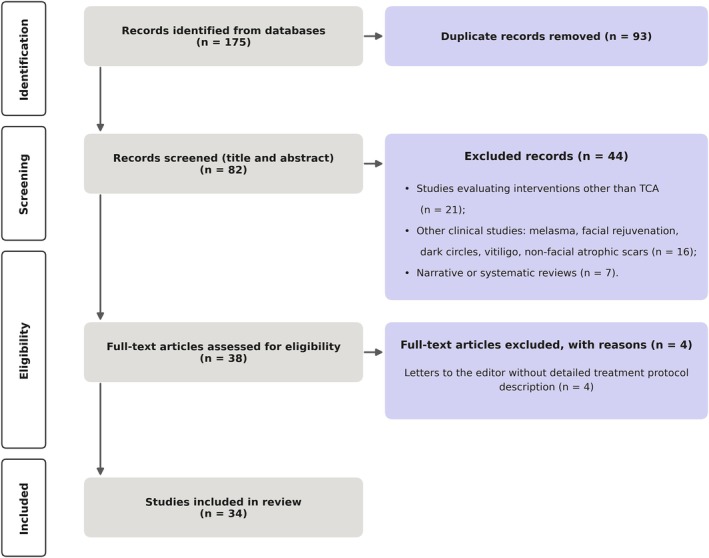
Study selection and data extraction were performed independently by two reviewers and 34 were incorporated into this review (Figure 1 ; Table 1 ).
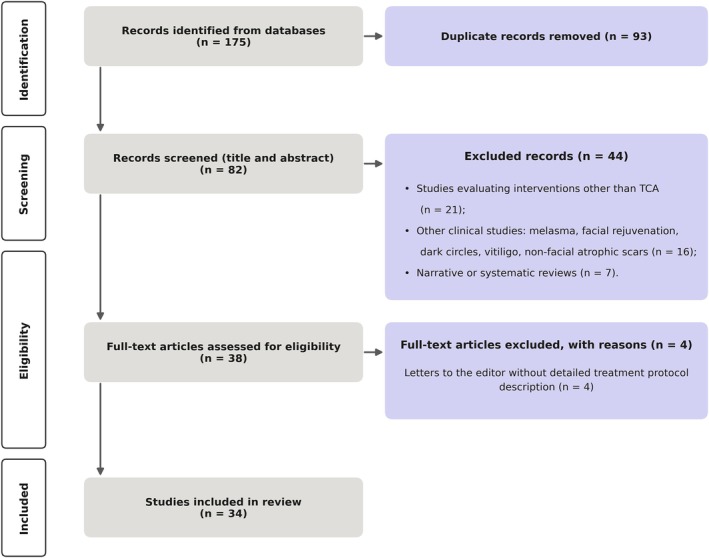
FIGURE 1 PRISMA‐ScR flow diagram of study selection. The diagram illustrates the identification, screening, eligibility, and inclusion phases of this scoping review according to PRISMA‐ScR guidelines. From 175 initial records, 93 duplicates were removed and 82 screened by title and abstract. After assessing 38 full‐text articles, four letters to the editor were excluded, resulting in a total of 34 included studies. Source: Authors' own illustration.PRISMA-ScR 文献筛选流程图:初始 175 条记录、去重 93 条、标题摘要筛选 82 条、全文评估 38 篇、排除 4 篇致编辑部来信,最终纳入 34 项研究。TABLE 1 Characteristics of studies evaluating trichloroacetic acid‐based protocols for treatment of atrophic acne scars.
| Author (year) | Country | Study type | n | Protocol/intervention | TCA concentration | Main findings | Adverse events |
|---|---|---|---|---|---|---|---|
| Soysal (2025) | Turkey | Clinical trial | 40 | CROSS (70% vs. 100%) | 70%, 100% | 100% more effective; 70% better tolerated | Intense burning; prolonged frosting (100%) |
| Manjhi (2024) | India | Clinical study | 30 | TCA vs. glycolic peel | 30% | TCA deeper and more effective for remodeling | Intense peeling |
| Roy (2024) | India | Comparative | 60 | CROSS (TCA vs. glycolic acid) | 65% | TCA 65% superior to glycolic 50% | Transient PIH; mild erythema |
| Solanki (2023) | India | RCT | 30 | MN + TCA peel | 15% | Safe in high phototypes; 3 sessions needed | Mild erythema; fine peeling |
| Al‐Hamamy (2023) | Iraq | Clinical study | 10 | CROSS + MN | 100% | High efficacy in grade III/IV scars | Mild PIH |
| Jangir (2023) | India | Prospective | 50 | Chemical peel | 20% | Consistent atrophic scar reduction | PIH in 12% (resolved) |
| Ghassemi (2022) | Iran | RCT | 45 | CROSS + topical timolol | 100% | Timolol reduced duration/severity of PIH | PIH (47%–80% across groups) |
| Dayal (2022) | India | RCT | 40 | MN + TCA peel | 15% | Comparable efficacy to glycolic acid (GA showed added texture benefit) | Mild erythema; edema |
| Horovitz (2022) | Israel | Case series | 6 | Painting CROSS | 85% | 26.3% average volumetric reduction in scars | Mild erythema; PIH |
| Pakla‐Misiur (2021) | Poland | RCT | 120 | MN + peel (PRX‐T33) | Combined | Combination superior to isolated methods | No major adverse effects reported |
| Zayed (2021) | Egypt | Comparative | 20 | Subcision + peel/MN | 35% | Effective in boxcar and rolling scars | Pain and edema (subcision‐related) |
| Al‐Hamamy (2021) | Iraq | Clinical study | 13 | Peel + dermasanding | 25% | Safe for superficial remodeling | Persistent erythema ( n = 2) |
| Mumtaz (2021) | Pakistan | Controlled trial | 92 | CROSS vs. PRP | 50% | PRP significantly superior to CROSS | Not reported (safety not assessed) |
| Bahl (2020) | USA | Retrospective | 25 | CROSS + NAFL | 70%–100% | Moderate to excellent improvement in majority of patients | None permanent |
| Abdel‐Magiud (2020) | Egypt | Clinical study | 15 (TCA arm; 70 total study) | CROSS + biochemistry | 80% | Decreased serum collagen III (correlates with clinical improvement) | Crusts; transient PIH |
| El‐Domyati (2018) | Egypt | Split‐face RCT | 24 | MN + TCA | 15% | Histology: higher new collagen content | Mild erythema; edema |
| Agarwal (2015) | India | Clinical study | 53 | Focal CROSS | 70% | Significant clinical improvement | Transient PIH in 15% |
| Dalpizzol (2016) | Brazil | Comparative | 16 | TCA vs. phenolic acid | 90% | Both effective; phenol had fewer severe complications than TCA | Mild edema; PIH ( n = 1) |
| Puri (2015) | India | RCT | 50 | Jessner + TCA vs. TCA | 20% | Greater but not statistically significant improvement vs. TCA alone | Intense stinging; deep peeling |
| Garg (2014) | India | Original study | 50 | Subcision + MN + TCA | 15% | Success in grade 2; improv. in 3–4 sessions | Erythema, edema (post‐dermaroller); PIH in 6% |
| Ahmed (2014) | Egypt | RCT | 28 | CROSS vs. CO 2 laser | 100% | CO 2 laser significantly more effective than CROSS | Itching; infection (6/14); PIH (64%) |
| Leheta (2014) | Egypt | RCT | 39 | MN + TCA vs. 1540 nm | 20% | 78.3% reduction with combined laser+PCI + TCA (vs. 59.8%–61.8% for individual modalities) | Transient erythema |
| Leheta (2014) | Egypt | RCT | 24 | MN + TCA vs. phenol | 20% | Similar efficacy to phenol; safer profile | Mild stinging; erythema |
| Aamir (2013) | Pakistan | Clinical study | 9 | CROSS monotherapy | 35% | Safe, effective, low‐cost for rolled/atrophic scars | Prolonged erythema ( n = 3) |
| Garem (2013) | Egypt | Prospective | 30 | CROSS | 50% | Significant improvement (ice‐pick/boxcar) | Mild erythema; transient PIH |
| Khunger (2011) | India | Prospective | 30 | CROSS (Phototypes IV‐V) | 100% | > 70% improvement; priming is essential | PIH in 2 patients |
| Leheta (2011) | Egypt | RCT | 30 | PCI vs. CROSS TCA | 100% | Both protocols showed high efficacy | Transient erythema; crusts |
| Kang (2009) | S. Korea | Pilot study | 10 | Triple therapy a | 100% | All patients showed clinical improvement | None significant |
| Kim (2009) | S. Korea | Split‐face RCT | 20 | CROSS vs. Er:Glass laser | 100% | Laser superior for rolling scars; comparable to CROSS for ice‐pick scars | Prolonged erythema (CROSS side) |
| Fabbrocini (2008) | Italy | Clinical study | 5 | CROSS for ice‐pick | 50% | 50% sufficient for Grade 3 scars | None reported |
| Cho (2006) | S. Korea | Experimental | 5 | Histometric (Animal) | 100% | Significant fibroblast activation | Expected crusts/edema |
| Yug (2006) | USA | Histological | 3 | Histological CROSS | 95% | Increased Collagen I; fragmentation of elastic fibers | None relevant |
| Carniol (2005) | USA | Prospective | 9 | Laser + TCA peel | 30% | TCA enhanced laser resurfacing effect | None reported |
| Lee (2002) | S. Korea | Cohort study | 65 | Original CROSS study | 65%–100% | Established dose‐dependent efficacy | Erythema; transient PIH |
3
This scoping review identified 34 studies (2002–2025) on TCA‐based treatments for atrophic acne scars, predominantly from Asia and the Middle East, comprising diverse study designs, including randomized clinical trials, comparative studies, and case series (Table 1 ).
3.1
Fourteen studies (41.2%) evaluated TCA as a single chemical peel, employing different concentrations according to scar type and desired depth [ 5 , 11 , 12 , 13 , 18 , 19 ]. Protocols ranged from 10% and 20% [ 5 , 11 ] to superficial peels and 25% to 50% to medium and deep peels [ 19 , 20 ], showing efficacy for improving skin texture, superficial irregularities, residual hyperpigmentation, and shallow scars (Figure 2 ; Table 2 ). Use of 15% TCA combined with microneedling resulted in improvement in skin texture, with efficacy comparable to glycolic acid peeling combined with microneedling [ 5 ] and 20% TCA alone demonstrated promoting gradual clinical improvement of superficial scars [ 11 ]. Medium peels (35%–50%) were mainly described in older studies, with more efficacy in moderately deep scars [ 19 ].
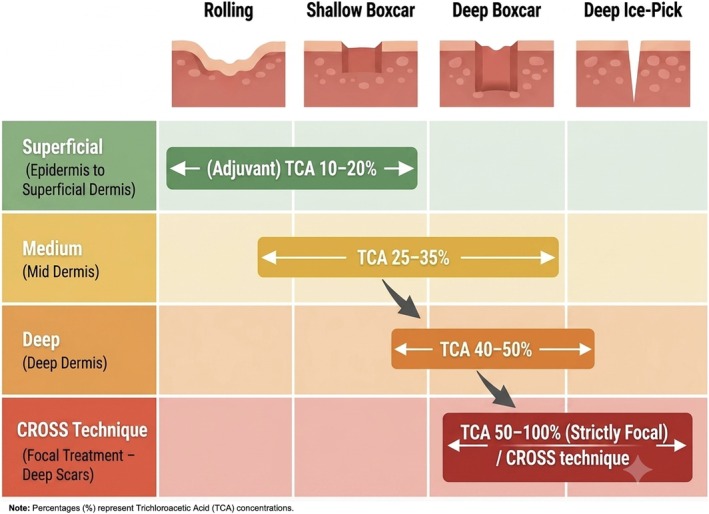
FIGURE 2 Schematic representation of atrophic acne scar morphologies and corresponding trichloroacetic acid (TCA) therapeutic protocols. This schematic diagram provides a practical algorithm for selecting appropriate TCA‐based interventions based on scar morphology, anatomical depth, and technical approach. Horizontal arrows indicate the TCA concentrations most used for each subtype. While lower concentrations (10%–35% superficial‐to‐medium peels) are shown alongside rolling and shallow boxcar scars, their use in rolling scars is typically recommended as an adjuvant tool within combined therapy protocols rather than monotherapy. Deeper boxcar scars may benefit from 40% to 50% deep peels, whereas deep ice‐pick scars strictly require focal, high‐concentration applications (50%–100%) via the CROSS technique to avoid widespread dermal damage. Source: Authors' own illustration.萎缩性痤疮瘢痕形态与对应 TCA 治疗方案示意图:按瘢痕形态、解剖深度与技术路径给出浓度选择,横向箭头标示各亚型最常用的浓度区间。TABLE 2 Classification of TCA therapeutic modalities according to depth and technique.
| Technique | Histological depth | TCA concentration | Clinical indications |
|---|---|---|---|
| Superficial peel | Stratum corneum to granular layer | 10%–20% | Superficial scars, rolling scars, texture irregularities |
| Medium peel | Full epidermis to papillary dermis | 25%–35% | Shallow atrophic scars, superficial boxcar, and ice‐pick scars |
| Deep peel | Papillary to superficial reticular dermis | 40%–50% | Moderately deep scars, deep boxcar scars |
| CROSS technique | Papillary to mid‐reticular dermis a | 50%–100% (focal) | Deep ice‐pick scars; focal atrophic remodeling |
CROSS technique was investigated in 20 studies (58.8%), corresponding to the most frequently evaluated protocol, especially in ice‐pick and boxcar scars [ 7 , 18 , 19 , 20 , 21 , 22 , 23 , 24 ] (Table 2 ). CROSS, with TCA concentrations from 50% to 100%, demonstrated dose‐dependent dermal remodeling, offering advantages in cost and accessibility compared with ablative laser technologies [ 1 , 7 , 19 ]. Although the 100% concentration was associated with a slightly superior clinical response, 70% TCA presented shorter frosting time, less intraoperative discomfort, and better overall tolerability [ 1 ]. A case series conducted in Israel described an interesting technical modification called “painting CROSS”, with measurable volumetric reduction through three‐dimensional (3D) analysis and, consequently, greater control of scar edges [ 14 ].
3.2
Multimodal approaches (52.9% of protocols) were a consistent trend for complex scar morphologies [ 3 , 5 , 9 , 10 , 12 ] (Table 3 ). Combinations of TCA with microneedling (MN) and subcision being used predominantly in boxcar and rolling scars [ 3 , 5 , 9 , 12 ]. The combination of TCA + MN promoted greater neocollagenesis and superior clinical improvement when compared to MN alone [ 9 , 12 ]. The combination of TCA with subcision was associated with a higher incidence of transient pain and edema; however, these adverse effects were attributed to the mechanical nature of the procedure rather than the chemical action of the acid itself [ 25 ]. Furthermore, multimodal protocols integrating TCA, subcision, and energy‐based devices demonstrated superior outcomes for complex and mixed scars when compared to monotherapies [ 15 , 26 ].
TABLE 3 Modalities of combined therapies with trichloroacetic acid for the treatment of atrophic acne scars.
| Combined therapy | Studies/total (%) | Scar types | Synergy rationale | Main clinical findings |
|---|---|---|---|---|
| TCA + Microneedling (MN) | 9/34 (26.5%) | Ice‐pick, boxcar, rolling | Microchannels enhance TCA transepidermal permeation | More homogeneous improvement; increased neocollagenesis |
| TCA + Subcision | 4/34 (11.8%) | Boxcar, rolling | Mechanical release of fibrous bands + chemical remodeling | Reduction in scar depth; improved texture in deep lesions |
| TCA + Subcision + MN | 2/34 (5.9%) | Mixed scars | Trimodal approach: mechanical, microperforation, and chemical | Consistent improvement in Grade II–IV scars |
| TCA + Energy‐based devices | 2/34 (5.9%) | Mixed scars | Combined thermal and chemical stimuli | TCA acts as a complementary dermal modulator to laser/RF |
| TCA + Other chemical agents | 1/34 (2.9%) | Mixed scars | Keratolysis (e.g., Jessner's) for uniform acid penetration | Deeper penetration; superior efficacy to TCA monotherapy |
3.3
Histopathological and biochemical evidence from a subset of studies (4; 11.8%) confirmed TCA's role in inducing neocollagenesis, with significant increases in type I and III collagen and elastic fibers, especially in studies with higher concentrations [ 12 , 13 , 27 , 28 ]. An experimental murine model identified significantly more intense fibroblast activation, greater extracellular matrix deposition, and a more localized and controlled inflammatory response in group treated with focal application of TCA by CROSS when compared to conventional chemical peeling [ 28 ].
Safety in high skin phototypes (IV to VI) was addressed in 10 studies (29.4%), confirming efficacy with appropriate protocols and strategies to mitigate post‐inflammatory hyperpigmentation (PIH) [ 1 , 2 , 20 ]. PIH was the most adverse event reported, present in about 20%–25% of studies that detailed complications, especially in studies that employed high concentrations (≥ 65%–100%) and in populations with higher skin phototypes [ 20 ]. However, it was described as transient, with complete resolution in a period of 3 to 6 months, particularly when associated with rigorous photoprotection and use of topical depigmenting agents [ 7 , 8 , 20 ].
Other described adverse events were persistent erythema, local edema, and burning sensation, particularly in the first days after the procedure or in protocols that involved subcision [ 10 , 25 ] and were described as predominantly mild to moderate, self‐limited, with no serious permanent complications [ 16 , 25 , 26 , 29 ]. Crust formation was considered an expected finding in CROSS protocols with high concentrations, with average time for spontaneous detachment between 5 and 10 days, without negative impact on final outcomes when post‐procedure guidelines were properly followed [ 7 , 13 , 21 ]. Less frequent adverse events included intense peeling, prolonged pain, and ecchymosis, especially in studies that combined multiple techniques, such as chemical peeling, microneedling, and energy‐based technologies [ 16 , 26 , 29 ]. Still, these events were described as temporary and manageable through conservative measures [ 16 , 25 , 26 , 29 ].
4
The analysis of 34 studies demonstrates that TCA remains a relevant therapeutic pillar in the management of atrophic acne scars, especially through the CROSS technique, which was the most frequently investigated protocol over the last two decades [ 1 , 7 , 19 , 20 , 21 , 22 , 24 ]. The focal chemical application of TCA, particularly in ice‐pick scars, promotes localized induction of neocollagenesis and reorganization of the dermal matrix, preserving adjacent skin. This mechanism explains the clinical efficacy achieved with this technique, which in comparative studies has shown outcomes ranging from comparable to inferior relative to ablative technologies such as fractional CO 2 and Er:Glass lasers, while maintaining lower cost, lower operational complexity, and a broader accessibility profile [ 7 , 22 ].
The efficacy of TCA is based on well‐characterized biological mechanisms. Experimental and histological evidence demonstrates that its action is not restricted to chemical cauterization but involves activation of reparative biological responses, including intense fibroblast stimulation, increased collagen deposition, and reorganization of extracellular matrix, culminating in consistent dermal remodeling [ 13 , 27 , 28 ]. The increase in type I collagen, along with reorganization and fragmentation of elastic fibers observed after repeated applications of CROSS technique, as well as the significant decrease in serum type III collagen levels following TCA treatment reinforce the biological plausibility of this technique as a focal, selective, and effective intervention in improving skin texture and reducing scar depth [ 13 , 27 ].
This evidence helps to contextualize the natural and progressive transition observed in literature toward combined protocols in management of atrophic scars, especially in complex presentations, which tend to respond limitedly to isolated therapies [ 10 , 12 ]. The incorporation of TCA into multimodal strategies, particularly in association with microneedling and subcision, emerges as a consistent trend, especially in treatment of boxcar and rolling scars [ 5 , 9 , 10 , 12 , 25 , 30 ]. Microneedling, when associated with TCA, creates microchannels that facilitate acid penetration and promote a more diffuse inflammatory stimulus, enhancing neocollagenesis [ 5 , 12 , 30 ]. Subcision acts by mechanical release of deep dermal adhesions, allowing TCA to complement tissue remodeling process, evidencing clear synergy between mechanical and chemical stimulant [ 10 , 25 ]. Protocols that associate TCA with other chemical peels follow a similar rationale, using superficial keratolytic agents as a preparatory peel to reduce stratum corneum resistance and uniformize acid's action [ 8 , 11 , 19 , 31 , 32 , 33 ]. Therefore, while the isolated use of TCA provides clinical benefits, its multimodal combination enhances active delivery and dermal action, thereby yielding superior therapeutic outcomes.
Therefore, although TCA monotherapy offers significant benefits, multimodal protocols optimize its delivery and intra‐epidermal action, explaining the superior clinical results observed. Based on the synthesized evidence, a practical framework is proposed to guide clinical decision‐making (Figure 3 ). Most studies highlight that concentration selection is directly associated with penetration depth and patient tolerability, which is further supported by recent evidence reinforcing TCA's favorable safety profile [ 31 , 33 , 34 ]. This reforce the importance of a personalized approach tailored to scar morphology, skin phototype, and individual expectations.
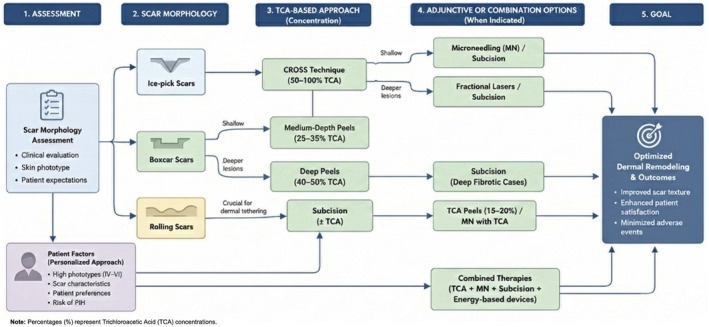
FIGURE 3 Clinical decision‐making framework for atrophic acne scar treatment with trichloroacetic acid (TCA). The flowchart illustrates a stepwise, personalized approach based on scar morphology (ice‐pick, boxcar, and rolling) and individual patient factors, including Fitzpatrick phototype and risk of post‐inflammatory hyperpigmentation (PIH). It guides the selection of TCA concentrations and application techniques (CROSS technique or chemical peels) as monotherapy or in combination with adjunctive modalities. TCA concentrations indicated (15%–20%, 25%–35%, 40%–50%, and 50%–100%) reflect the protocols most frequently reported in the included studies. CROSS, chemical reconstruction of skin scars; MN, microneedling; PIH, post‐inflammatory hyperpigmentation; TCA, trichloroacetic acid. Source: Authors' own illustration.TCA 治疗萎缩性痤疮瘢痕的临床决策流程:依据瘢痕形态(冰锥型、箱车型、rolling 型)并结合患者个体因素(Fitzpatrick 光型与 PIH 风险)分步选择浓度与施用方式。In ice‐pick scars, the CROSS technique (50%–100% TCA) is the gold standard for focal dermal remodeling, with fractional lasers or subcision indicated for resistant cases [ 7 , 19 ]. Boxcar scars are effectively managed with medium‐depth peels (25%–35% TCA) for shallow variants, while deeper lesions require deep peels (40%–50% TCA) or adjunctive microneedling/subcision to break fibrous septa [ 5 , 10 ]. Regarding rolling scars, subcision is essential to release dermal anchoring, typically followed by superficial TCA peels (15%–20%) or microneedling with TCA to promote neocollagenesis [ 25 ]. For complex or mixed types, multimodal strategies combining TCA with subcision or energy‐based devices outperform monotherapies by addressing multiple pathogenic targets simultaneously [ 3 , 5 , 9 ]. Lastly, for high phototypes (IV‐VI), TCA can be safely used, provided that lower concentrations (e.g., 50%–70% for CROSS, 10%–15% for peels), meticulous skin priming (retinoids, hydroquinone), and strict photoprotection are employed to minimize PIH risk [ 2 , 20 ].
This scoping review, while comprehensive, is subject to certain limitations. The heterogeneity in study designs, TCA concentrations, application protocols, and outcome measures across the included studies posed challenges for direct comparison or quantitative analysis. The predominance of studies from Asia and the Middle East, while highlighting regional expertise, may limit the generalizability of findings to other populations with different skin types and genetic predispositions. Furthermore, the long publication period (2002–2025) also means that some older studies may not reflect the most current practices or technological advancements. Finally, as a scoping review, the primary aim was to map the existing evidence rather than to critically appraise the quality of individual studies, which is a limitation inherent to this methodology.
In conclusion, TCA remains a fundamental and cost‐effective tool in contemporary clinical practice for the treatment of atrophic acne scars. The evidence suggests a transition from monotherapies to personalized multimodal protocols, where the precision of the CROSS technique and the synergy of combined therapies optimize dermal remodeling while maintaining a high safety profile. The versatility of TCA, whether applied in different concentrations or application techniques, allows for its adaptation to different scar morphologies and skin phototypes, consolidating its role as a versatile agent in clinical practice.
Mariana Garcia da Ponte Melo, Joyce Magalhães de Barros: conceptualization, methodology, investigation, formal analysis, and writing, original draft. Ramille Araújo Lima: conceptualization, methodology, writing, review and editing, supervision, and project administration.
This study was supported by an internal research fellowship from Christus University. No external funding was received.
The authors have nothing to report.
The authors declare no conflicts of interest.
声明:中文精读 · 仅供学术参考。内容来自公开文献检索,不代表本人观点,不构成诊疗建议。 医疗美容需在正规医疗机构由执业医师实施。
基于相同主题推荐 · 继续深挖