手持静电纺丝原位制备可溶性 PVP/蜗牛黏液纤维面部膜
2026年9月24日35 min read
Scientific Reports
Recent trends towards preservative-free and sustainable formulation have stimulated demand for natural, biocompatible, and eco-friendly skincare products. Traditional wet facial masks moisturize and nourish the skin, but at the same time, they need a preservative system, have a short shelf life, and plastic-based packaging. In comparison, dry-type masks provide an environmentally compatible option; however, traditional drying methodologies can lead to instability of bioactives and are scale-limited. Therefore, this study introduces a novel, soluble fibrous facial mask fabricated via handheld electrospinning, enabling mild, energy-efficient, and personalized production directly adaptable to the facial to overcome the limitations of conventional masks. The facial mask was fabricated by using polyvinylpyrrolidone, a water-soluble and biocompatible polymer, with snail mucus, a natural ingredient containing glycoproteins, mucopolysaccharides, and bioactive peptides for hydration and skin regenerative action. The findings showed that optimization of electrospinning parameters yielded homogeneously distributed fibers. Light microscopy and scanning electron microscopy were done for the characterization of fabricated facial masks, referred to as SpunMasks. Additionally, dissolving analysis, moisture permeability, pH compatibility, cell viability of dermal fibroblast cells, in vitro scratch, chorioallantoic membrane, sirius red, and hemolysis assays were carried out to evaluate the skin compatibility and biosafety of the SpunMasks. The result revealed that SpunMasks exhibit favorable moisture permeability, appropriate pH for skin and anti-aging potential, while biosafety analyses confirmed the non-irritant and hemocompatible characteristics of SpunMasks. Overall, this eco-friendly, fast-dissolving, and preservative-free fibrous SpunMask shows potential of handheld electrospinning in biotechnology and cosmetic innovation to generate personalized and environmentally sustainable skin care products.
Supplementary InformationThe online version contains supplementary material available at https://doi.org/10.1038/s41598-026-51633-5.
Keywords: PVP、In-situ electrospinning、Facial mask、Snail mucus、Skincare、Biotechnology、Materials science
There has been a significant increase in interest in natural, biocompatible, and environmentally friendly ingredients in skincare products recently 1 – 4 . Although conventional wet facial masks are effective in moisturizing and nourishing the skin, they have several drawbacks, such as the need for preservatives, risk of microbial contamination, limited shelf life, and reliance on plastic-based packaging. With the increasing awareness of skin health and eco-friendliness, not only locally but also worldwide, cosmetics have experienced a considerable move towards natural, biocompatible, preservative-free formulations. Recently, facial masks have been the preferred delivery method for bioactive materials since application on the face is convenient and topical administration offers high efficacy 2 , 3 , 5 . The other common wet mask form, conventional pre-soaked serums (or extracts), hydrates instantly but requires long-term preservatives to prevent microbial infection that may irritate and even cause allergic reactions 6 . In addition, they rely on plastic-made packaging that adds to production costs, which is not sustainable for the environment 7 , 8 . Also, conventional cosmetic sheet masks are not compatible with all types of skin anatomy. By comparison, dry masks (i.e., fibrous- or film-based matrices) can overcome these limitations and offer a green pathway in which preservatives are not required, with long-term stability. Accordingly, tailor-made preparation of dry facial masks is increasingly important in cosmetic material fabrication 9 – 12 . Therefore, the development of new-generation mask systems that are preservative-free, rapidly dissolvable, and biodegradable has gained increasing importance in the cosmetics industry.
Electrospinning has become a versatile and effective platform to fabricate fibrous structures endowed with a high surface area, porosity, and controllable fiber morphology 13 – 15 . These properties allow for the incorporation of functional biomolecules. Although benchtop electrospinning setups are common in the field of biomedicine and pharmaceuticals, their size, cost, and complexity prevent them from being transferred to the cosmetic domain. In recent years, portable electrospinning devices have received much interest as a new generation of fiber fabrication tools enabling in situ deposition 11 , 16 , 17 . In comparison with stationary ones, a handheld system is more flexible, comfortable to handle, and real-time tailored for directly spinning the fibers onto facial lines. This system enables the development of personalized, custom-fit masks that perfectly fit face shape and skin condition.
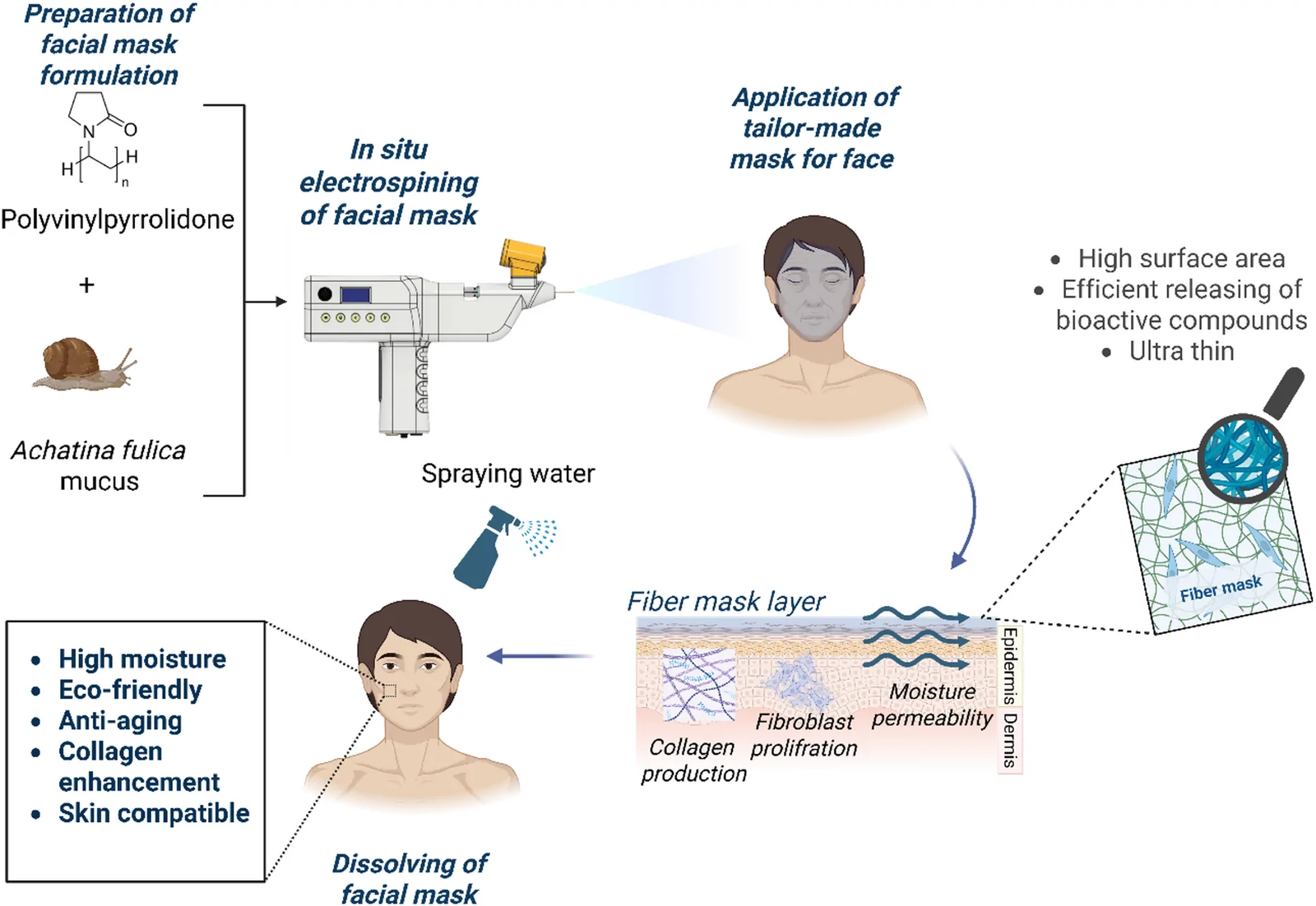
Natural product utilization in skincare products has been elevated owing to biocompatibility, including active ingredients and eco-friendliness. Snail mucus is one of the most popular natural ingredients used in skin care. Snail mucus maintains skin moisture through its glycoproteins and mucopolysaccharides 18 , providing long-lasting hydration and forming a protective barrier on the skin surface 19 . It also supports tissue regeneration by enhancing the activity of fibroblast and keratinocyte cells, offering a major advantage for skin repair and wound healing, which was clinically shown in burn management 20 – 22 . Allantoin, glycolic acid, collagen, and elastin-like peptides in snail mucus content enable skin elasticity and snail mucus also supports the production of collagen 19 , 23 , 24 . Natural products are commonly combined with a support polymer to facilitate electrospinning-based processes. Polyvinylpyrrolidone (PVP) is a polymer that is commonly used in both cosmetics and medicinal products because it dissolves easily within water, ease of removal upon contact with water, while also being safe for the body and exhibiting ideal film-forming ability 25 . Electrospinning of PVP results in a large surface area and a porous structure 26 . These characteristics make PVP especially suitable for electrospinning. Although a limited number of studies have reported the use of handheld electrospinning devices for the fabrication of cosmetic facial masks 11 , 27 , none of these studies have incorporated snail mucus as an active component within facial masks produced via a handheld electrospinning approach. Therefore, this research integrated soluble PVP-based fibrous structures with snail mucus, a natural skin-regenerating component, to generate a novel mask formulation that rapidly dissolves upon contact with water (Fig. 1 ). Anti-aging potential and moisture ability of snail mucus were investigated systematically in this study. For this purpose, the electrospinning parameters for PVP were optimized to produce fibers that were distributed uniformly. Then, snail mucus with a varied concentration was introduced to PVP to obtain the final facial mask. The comprehensive characterization of facial masks was carried out by several techniques. The fiber morphology of the facial mask was monitored by light microscopy and Scanning Electron Microscope (SEM). Additionally, dissolving property, moisture permeability, pH of SpunMasks were tested over time to determine skin compatibility. The biosafety of the SpunMasks was further evaluated by chorioallantoic membranes (CAM), in vitro scratch, cell viability, sirius red, and blood hemolysis analyses. The result demonstrated that SpunMasks represent an eco-sustainable, fast-dissolving, preservative-free fibrous mask that dissolves upon minimal contact with moisture, releasing active compounds on the skin, with anti-aging potential. Moreover, the developed facial mask is biocompatible and non-irritant, exhibiting favorable skin compatibility and biosafety profiles. Overall, this study indicated that handheld electrospinning has great potential as an innovative tool for personalized cosmetics production, bridging biotechnology, fibrous materials, and sustainable skincare innovation.
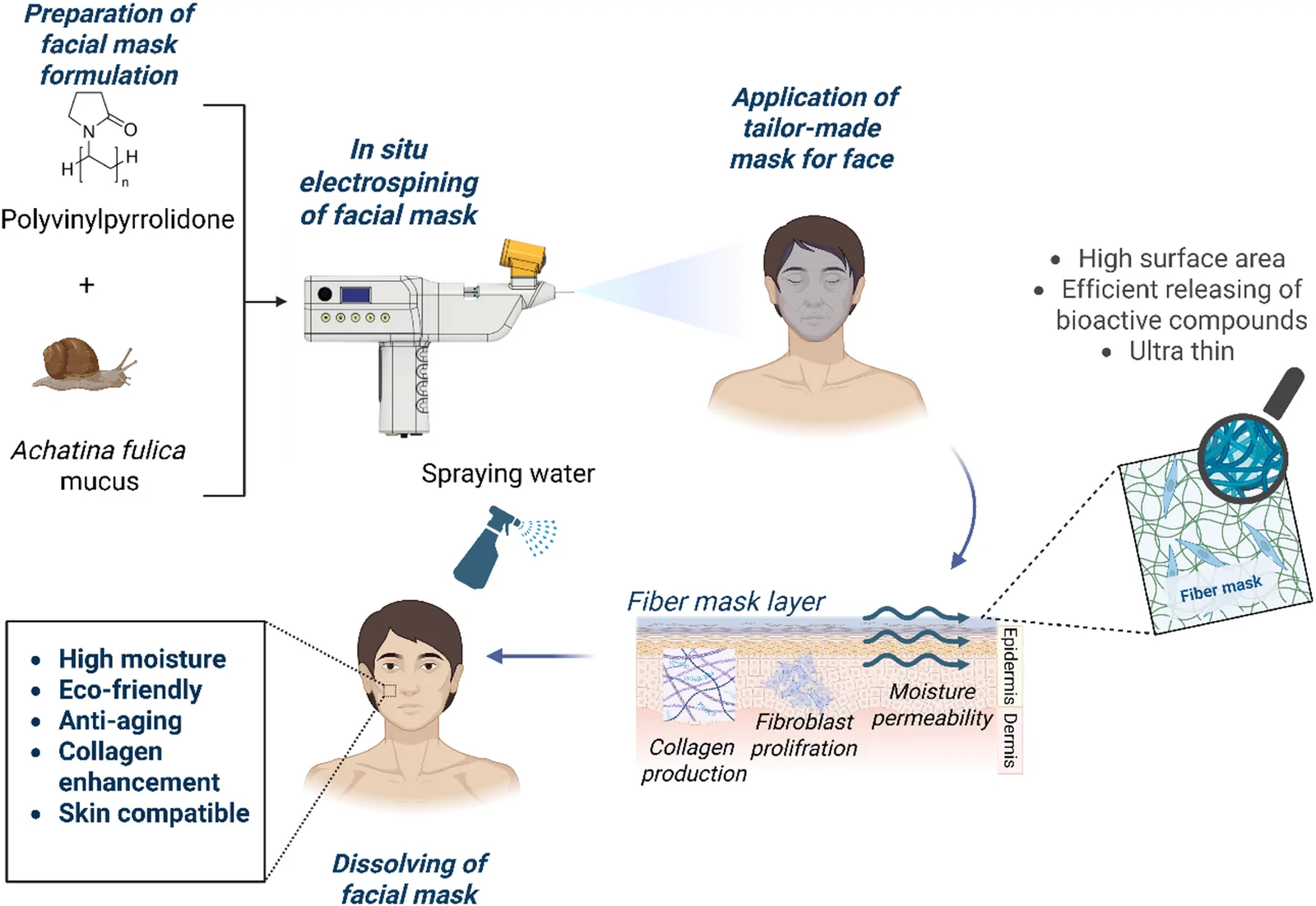
Fig. 1 Schematic illustration of the preparation, in situ electrospinning, and application of a tailor-made fibrous facial mask. PVP is blended with Achatina fulica snail mucus to formulate the facial mask solution, which is directly electrospun onto the face using a handheld device. Upon hydration with water spray, the fiber mask gradually dissolves, providing enhanced moisture permeability and collagen production (Created with Biorender).示意:PVP 与蜗牛黏液混合,经手持静电纺丝在面部原位制备并贴合纤维膜。
The formulation of SpunMasks was prepared with different concentrations of snail mucus to determine the optimal concentration for cosmetic application. Initially, the content analysis for each formulation to detect the presence of snail mucus was assessed by FTIR (Fig. 2 a). The band observed at 3283 cm⁻¹ corresponds to the O–H stretching groups in amino acids 28 , while the peaks at 1639 and 1535 cm⁻¹ are attributed to amide bonds, confirming protein and proteoglycans in the SpunMasks 28 , 29 . Additionally, the peak at 2926 cm⁻¹ is assigned to C–H stretching, suggesting the presence of vitamin E 30 . This observation indicated that snail mucus was successfully integrated into the PVP matrix. Next, the rheological analysis of mask formulations was performed to evaluate the flow behavior and viscoelastic properties of a formulation, which are critical for understanding its processability, stability, and performance during application. The viscosity–shear rate profiles of all spinning solutions are presented in Supplementary Fig. 1. All formulations exhibited pronounced non-Newtonian, shear-thinning behavior, as evidenced by the continuous decrease in viscosity with increasing shear rate over the investigated range 31 , which is consistent with the general rheological response of polymer spinning solutions used in electrospinning, where chain alignment and progressive loss of transient structure occur under increasing deformation. At low shear rates (1–10 s⁻¹), significant differences among the formulations were observed, reflecting distinct levels of structural organization within the spinning solutions. SpunMask10 exhibited the highest viscosity, reaching approximately 10³ mPa·s at 1 s⁻¹, indicative of a highly structured, entangled network, attributing to enhanced intermolecular interactions and increased chain entanglement. In comparison, SpunMask2 displayed the lowest viscosity and the weakest structural response, indicating that low mucus concentrations were insufficient to form a continuous network 32 . This result is lined with study, where the incorporation of mucin into PVP-based matrices leads to increased low-shear structuring and viscosity, as well as improved mucoadhesive characteristics 33 . As the shear rate increased, the viscosity of all formulations decreased rapidly, and the differences between samples progressively diminished. At shear rates above approximately 10 s⁻¹, the viscosity values converged to a narrow range (120–160 mPa·s), regardless of mucus concentration. This convergence indicates that under high-shear conditions, the internal structures of the solutions are largely disrupted, leading to similar flow behavior across all formulations. Such behavior is consistent with electrospinning frameworks emphasizing the importance of chain entanglements in supporting continuous fiber formation 34 . However, the observed viscosity convergence should not be interpreted as evidence of identical electrospinning behavior, because during electrospinning, the jet behavior is controlled by the balance between electrostatic forces generated by the applied electric field, viscoelastic forces arising from polymer chain entanglement, and surface tension. These forces are further influenced by charge density and Coulombic repulsion along the jet, solvent evaporation dynamics during electrospinning Therefore, the rheological results are useful for distinguishing differences in formulation structuring behavior, but they should not be used alone to define the optimal electrospinning formulation without also considering the fiber morphology results. The elevated low-shear viscosity of mucus-containing solutions, particularly SpunMask10, contributes to enhanced solution stability, while the strong shear-thinning response ensures sufficient flowability and jet continuity under high shear at the needle tip. These findings suggest that mucus concentration primarily governs solution structure at rest or low shear, whereas under electrospinning conditions, all formulations exhibit comparable rheological performance. Then, parameters for in situ electrospinning application were optimized to determine the formulation that produces bead-free fibers prior to facile mask fabrication. Initially, PVP solutions with concentrations ranging from 5% to 15% (w/v) were prepared to determine the optimal formulation for facial mask production ( Supplementary Fig. 2 ). Optical microscopy images revealed droplet formation at 5% PVP and bead-containing fibers at 10% PVP, indicating insufficient chain entanglement at these concentrations. Therefore, 15% (w/v) PVP (SpunMask0) was selected as the optimal concentration for fabricating fibrous facial masks incorporating snail mucus. Figure 2 b and d demonstrated that homogenous and bead-free fibers were produced from SpunMasks formulations, obtained by light microscopy and SEM analysis. The histogram graphics showed that the fibers were distributed homogeneously and ranged between 1 and 2 μm for all formulations with high surface area (Fig. 2 c). The mean fiber diameter of SpunMask0 was 0.74 μm, and it increased upon the incorporation of snail mucus, reaching 1.74 μm for SpunMask5, where it decreased to 1.54 μm for SpunMask10. The mean diameter of SpunMasks is still thinner than snail crawling, which is ranging between 10 and 20 μm 35 , 36 , indicating increased surface area after electrospinning process of snail mucus. The incorporation of mucus increased the fiber diameter, likely due to the adhesive property of mucus content 22 , leading to the fusion of fibers. This can also be attributed to the increasing viscosity of the solution after incorporation of snail mucus 37 . However, decreasing mean fiber diameter for SpunMask10 can be attributed to that solution homogeneity may be compromised when high concentrations of biological additives is used, leading to localized viscosity variations and electrospinning jet instability, which can result in irregular fiber morphologies and deviations from the expected.
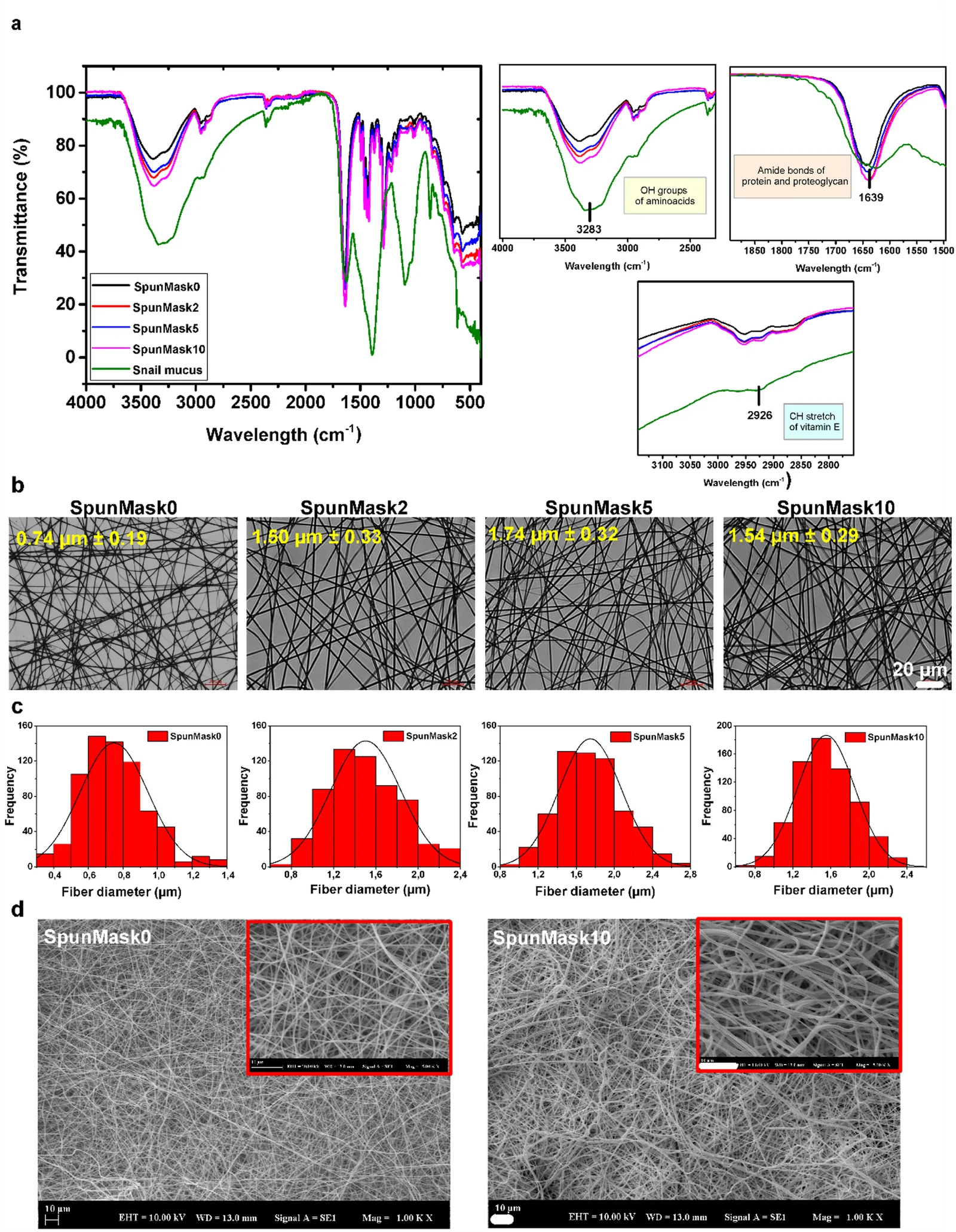
Fig. 2 Physicochemical and morphological characterization of electrospun facial SpunMasks (a) FTIR spectra showing characteristic functional groups of SpunMasks (b) Optical microscopy images illustrating homogeneous, bead-free fibrous networks for all formulations (Scale bar: 20 μm) (c) Histograms for fiber diameter distribution, demonstrating changes in average fiber diameter across snail mucus concentration (n = 100) (d) SEM micrographs of representative samples (SpunMask0 and SpunMask10) revealing fiber morphology (Scale bar: 10 μm).SpunMask 的理化与形貌表征:(a) FTIR 特征官能团;(b) 光学显微镜显示均匀纤维。
In-situ application of SpunMask was simulated on the model to show its ability to rapidly deposit on the face by covering curved facial geometry to show its applicability in a real scenario (Fig. 3 a). SpunMask could be successfully generated and encompassed the face area within just 10 min. This result shows rapid in situ application of SpunMask by full coverage of the face and adaptation to facial anatomy, indicating customizability for a person’s face.
Traditional commercial nonwoven facial masks usually rely on essence solutions that contain functional additives and preservatives. These can cause skin irritation or allergic reactions upon prolonged use. Therefore, the dissolution property of SpunMasks was investigated to determine their suitability as an eco-friendly cosmetic system that does not require additional packaging. The result showed that SpunMask starts dissolution upon contact with deionized water and disperses in the solution rapidly, as shown in Fig. 3 b. SpunMask5 and SpunMask10 dissolved in deionized water within 24 s. Most of the fibrous network completely disintegrated with only slight traces remaining in suspension within seconds. This fast-dissolving behavior can be ascribed to several important reasons. First of all, the PVP-matrix is polar due to the high-polar character of carbonyl groups, which easily form hydrogen bonds with water, thereby facilitating excellent water solubility 3 . Secondly, the large surface area-to-volume ratio and interconnected pore structure of the electrospun fibers can facilitate interaction effects between water molecules and fibers for faster dissolution 38 . Moreover, snail mucus naturally consists of hydrophilic glycoproteins and mucopolysaccharides 39 . This fast-dissolving action owing to PVP not only makes it easy to use and effective but also results in better bioavailability of the bioactives for rapid penetration and hydration. Thus, the SpunMasks are a green and rapid dissolving-free preservative alternative to traditional wet masks for better performance and ecological sustainability in advanced skincare formulations.
The skin compatibility of SpunMasks was assessed to determine the optimum formulation that is suitable for skin. Therefore, the pH value of the developed SpunMask was measured after complete dissolution of the samples in deionized water. Figure 4 a and b shows that the pH values of the dissolved SpunMasks were between 5.7 and 7.1 after including snail mucus. Incorporation of the snail mucus shifted SpunMasks to the basic pH range, which can be attributed to the alkaline content of snail mucus 19 . The pH of SpunMask2 is 5.7, while SpunMask5 is 6.2 with a non-significant difference, however, SpunMask10 exhibited 7.1 with a significant difference between SpunMask2. Therefore, SpunMask2 and SpunMask5 are within an ideal pH range for human skin (4.0–6.0) and does not affect the natural acidity of human skin 40 . Then, the wettability of the SpunMasks was evaluated by WCA measurement (Fig. 4 c). A sharp decrease in WCA was observed within the first second, and all SpunMask formulations exhibited WCA values below 25°, consistent with the highly hydrophilic nature of PVP-based electrospun matrices and the rapid wetting typically reported for PVP-containing nanofibrous membranes 41 . No significant variation in WCA was observed as a function of mucus concentration, indicating that the surface wettability of the SpunMasks is primarily governed by the PVP matrix rather than the mucus content. Since the moisture permeability of fibrous facial masks is primarily governed by the coupled effects of pore architecture (effective pore size and porosity), membrane thickness, and the hydrophilicity of the base material, the strong hydrophilicity evidenced by the low WCA is expected to facilitate rapid hydration and promote efficient moisture transport across the porous structure 42 .
The moisture permeability of facial masks is primarily determined by the pore size, thickness, and hydrophilicity of the base material. As shown in Fig. 4 d, the SpunMasks have remarkable moisture permeability, ranging between 151.21 and 142 g·m⁻²·h⁻¹, with a non-significant difference. The literature reports a different range of WVTR values for electrospun and non-woven polymeric membranes intended for skin-contact applications. The WVTR values obtained in this study (142–151 g·m⁻²·h⁻¹) fall within the range reported for electrospun polymeric facial mask in the literature, which vary widely from 13 to 22 g·m⁻²·h⁻¹ 2 , 85.12–110.0 g·m⁻²·h⁻¹ 43 to approximately 250–325 g·m⁻²·h⁻¹ 44 , and above 300 g·m⁻²·h⁻¹, depending on material composition, structure, and testing conditions 3 . This showed that SpunMasks facilitate moisture permeability, which is crucial for the hydration of skin. This can be attributed to the PVP matrix, rich in hydrophilic carbonyl groups, which readily interacts with atmospheric moisture, absorbing and transferring water molecules toward the skin surface to sustain hydration 45 , 46 . Meanwhile, the snail mucus, containing glycoproteins and mucopolysaccharides, reinforces this effect by forming hydroactive layer that helps maintain moisture balance and strengthens the skin barrier 47 , 48 . This finding suggests that SpunMasks achieved balanced moisture exchange, promoting skin hydration, which may also be possible due to the water and hyaluronic acid content of snail mucus 24 . The combination of high surface area, porous fiber structure, and hydrophilic natural additives results in uniform moisture distribution and improved comfort during application. Overall, these results show that the SpunMask facial mask is safe, skin-friendly, and well-tolerated. This is a clear advantage over regular wet masks that use synthetic preservatives, which can irritate the skin.
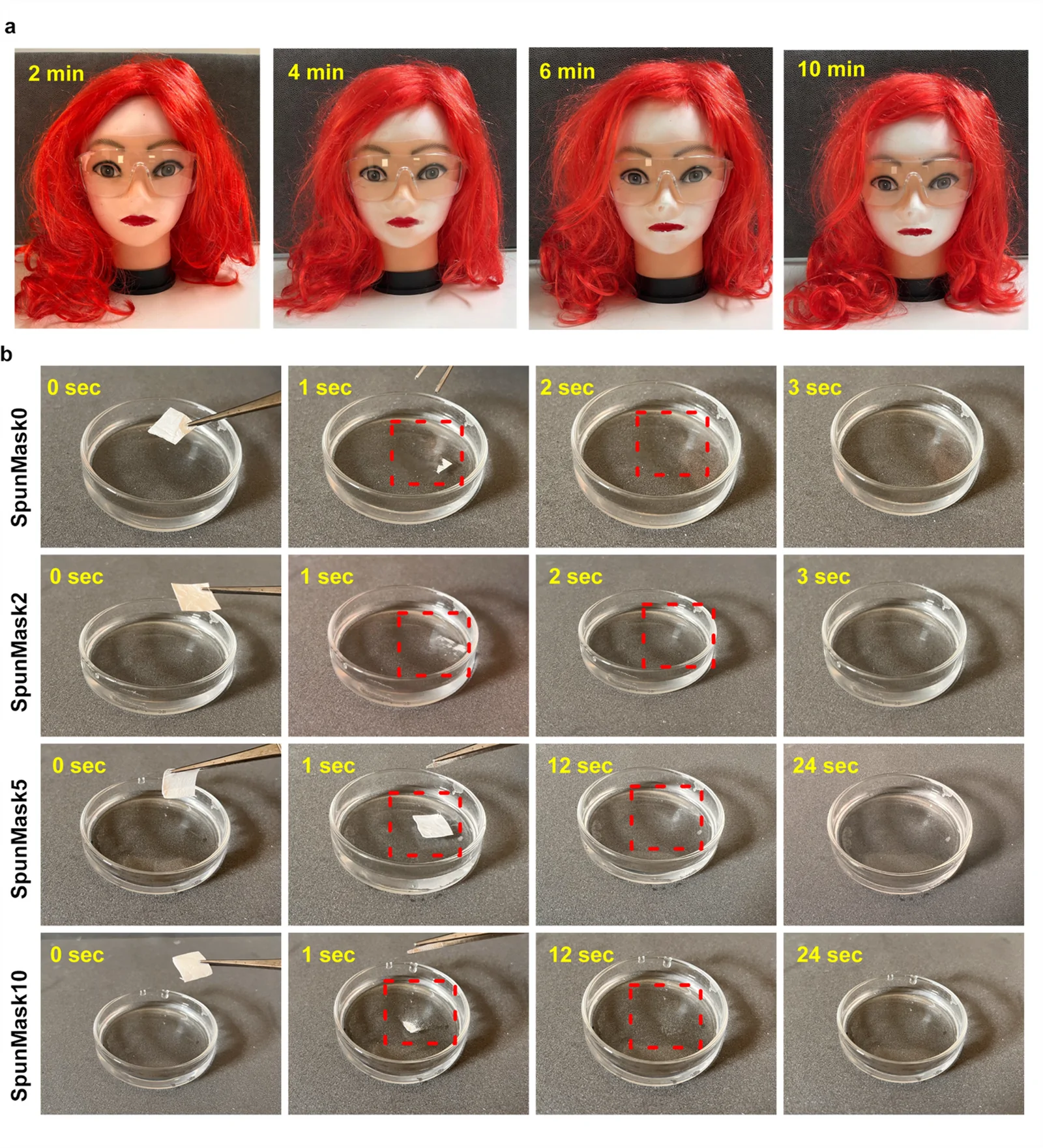
Fig. 3 Dissolution behavior of electrospun SpunMasks (a) In situ application of SpunMask onto a mannequin face (b) Images demonstrating rapid dissolution of SpunMasks, showed within dashline for 1 s and 12 s, depending on time.溶解行为:(a) 模型面部原位贴合;(b) 数秒内(1s/12s 虚线)快速溶解。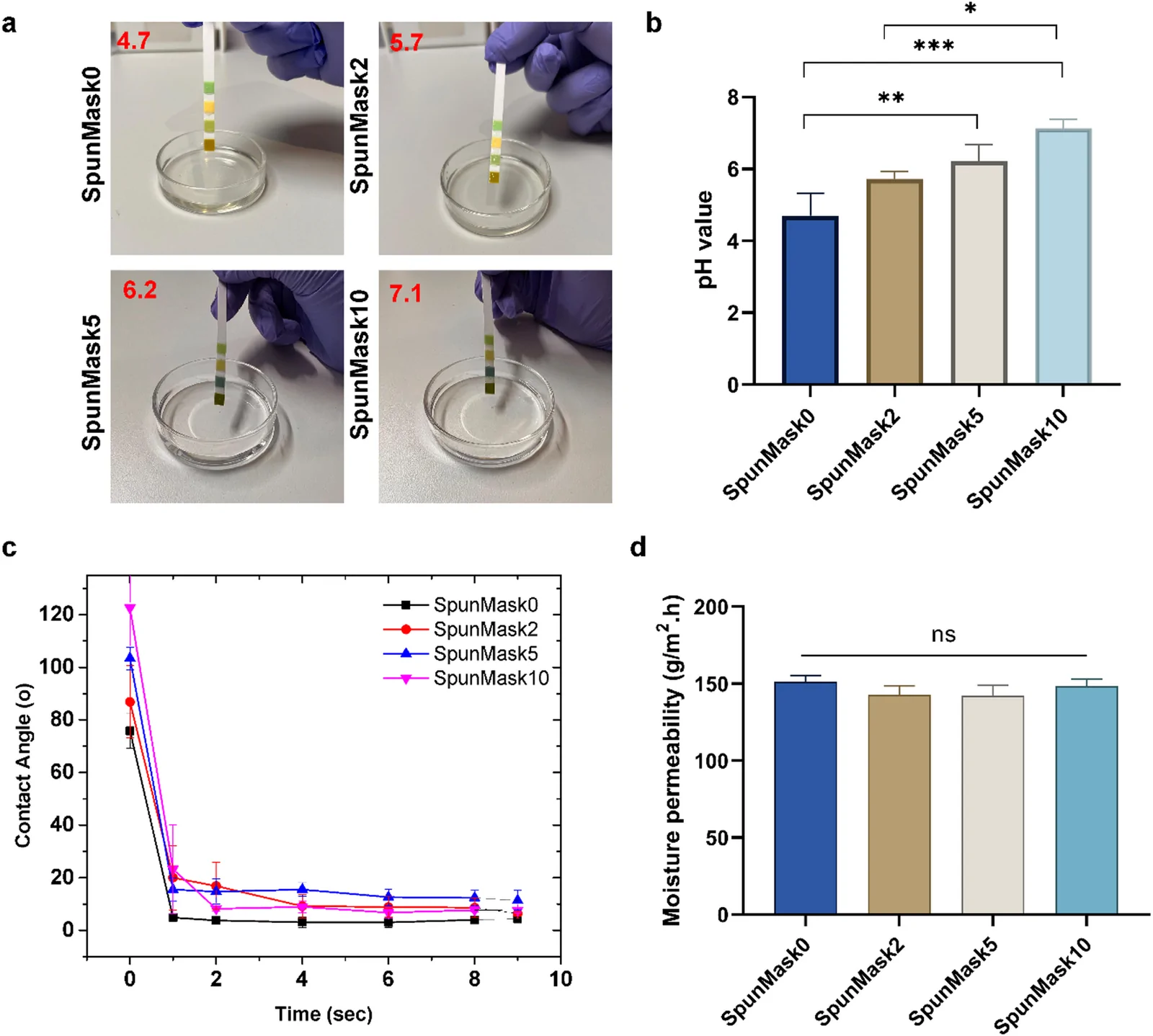
Fig. 4 pH characteristics and wettability behavior of electrospun facial SpunMasks (a) Representative images of pH indicator strip measurements of (b) Quantitative comparison of pH values for SpunMasks (n = 3, *p < 0.05, **p < 0.01, *** p < 0.001, analyzed by one-way ANOVA) (c) WCA measurements indicating fast wetting behavior and high hydrophilicity of SpunMasks (n = 3) (d) Moisture permeability values of the different formulations (n = 5, no statistically significant differences (ns), analyzed by one-way ANOVA).pH 与润湿特征:(a) pH 试纸;(b) SpunMask 的 pH 定量比较。
One of the most essential biological requirements for cosmetic formulations is their local compatibility of skin with facial masks. Hence, hen’s egg chorioallantoic membrane (HET-CAM) assay was applied to SpunMask to evaluate irritation potential 49 . It is a well-established method for assessing toxicological safety and has been validated by the European Centre for the Validation of Alternative Methods (ECVAM) as an alternative test for predicting the irritation potential of cosmetic and pharmaceutical products 50 – 52 . In this study, HET-CAM result showed that the negative control (normal saline, 0.9% NaCl) showed no visible effects on the vascular network of CAM (Fig. 5 a). On the other hand, the positive control (1% sodium dodecyl sulfate, SDS) induced considerably severe hemorrhage, coagulation, and vessel lysis, indicating acute toxicity (shown with arrows). There was no bleeding, coagulation, or any other damage to the delicate membrane when SpunMasks were placed on the surface of CAM. The vascular structure remained intact and was not affected during the exposure period. This clearly shows that the SpunMasks formulation does not irritate skin and is highly skin-compatible. The lack of a vascular response shows that the SpunMask is biosafe to use on sensitive areas of the face, such as the periorbital region, where the skin is thinner and more reactive. These results confirm that the developed formulation is toxicologically safe and does not contain any additives that can irritate skin. Furthermore, the biosafety of the masks was investigated by scratch assay using dermal fibroblast cells by monitoring migration behavior (Fig. 5 b). The results revealed a clear concentration-dependent enhancement in cell migration, with increasing mucus concentrations significantly accelerating wound closure. Compared to the control group, cell migration and wound healing rates were approximately twofold higher, reaching 97.1% wound closure at 48 h for SpunMask 10 without significant difference between SpunMask groups, but significant difference between control group (Fig. 5 b and c). This enhancement suggests that bioactive components present in the mucus promote cellular migration and proliferation 22 , 28 . In vitro studies were carried out by MTT to assess the biocompatibility of the developed fibrous facial mask on dermal fibroblast cells. It was observed that SpunMask with all formulations exhibits high cell viability, ranging between 98.81 and 87.77% (Fig. 5 d) and there is no significant difference observed between SpunMask groups, especially between highest concentration of snail mucus such as SpunMask5 and SpunMask10, indicating increasing mucus concentration beyond SpunMask5 does not yield additional biological performance. It demonstrated that the mask exhibited no cytotoxic effects on fibroblast cells, maintaining high cell viability across all tested SpunMask groups. This result is in line with other studies that demonstrated cytocompatibility and triggered proliferation of snail mucus on various cell types 19 , 30 . Overall, these findings indicate that the fibrous structure and mucus-containing formulation are biocompatible and suitable for skin-contact applications. This supports its use as a biocompatible, preservative-free, and eco-friendly fibrous facial mask that can be used daily for cosmetics.
In addition, sirius red staining was employed to evaluate collagen production by dermal fibroblast cells, a critical factor in skin regeneration and tissue repair, as well as showing anti-aging potential (Fig. 6 a and b). The staining, indicated by red color, results demonstrated a marked increase in collagen production, which can possibly be type I 30 , in fibroblast cultures treated with higher mucus concentration, especially for SpunMask5 (Fig. 6 a). In addition, collagen production of fibroblast cells was quantitatively measured using images. There is a significant increase for SpunMask2 and SpunMask5, which were 93.79% and 94.07%, respectively (Fig. 6 b), which overlapped with a study that also observed collagen production by Saos-2 cells 30 . This increase in collagen production can be attributed to glycolic acid content in snail mucus that has a triggering effect 39 , 53 , 54 , showing anti-aging potential 48 , 55 . This result showed the potential of SpunMask as a beauty mask that provides collagen production, which can have an anti-aging effect on skin 55 . This increase in collagen synthesis correlates well with the observed enhancement in cell migration, indicating that the fibrous mask not only accelerates fibroblast cell migration but can also contribute ECM regeneration. On the other hand, RBC interactions of SpunMasks were determined by hemolysis assay to evaluate hemocompatibility (Fig. 6 c and d). Positive control was close to 100%, while all SpunMask formulations were under 5%, indicating hemocompatibility and suitability of SpunMasks for in situ application. Overall, these findings confirm that the developed fibrous facial mask is biocompatible and exhibits significant regenerative properties by enhancing fibroblast viability, migration, and collagen production. Such multifunctional behavior highlights its strong potential as an advanced biomaterial for cosmetic applications.
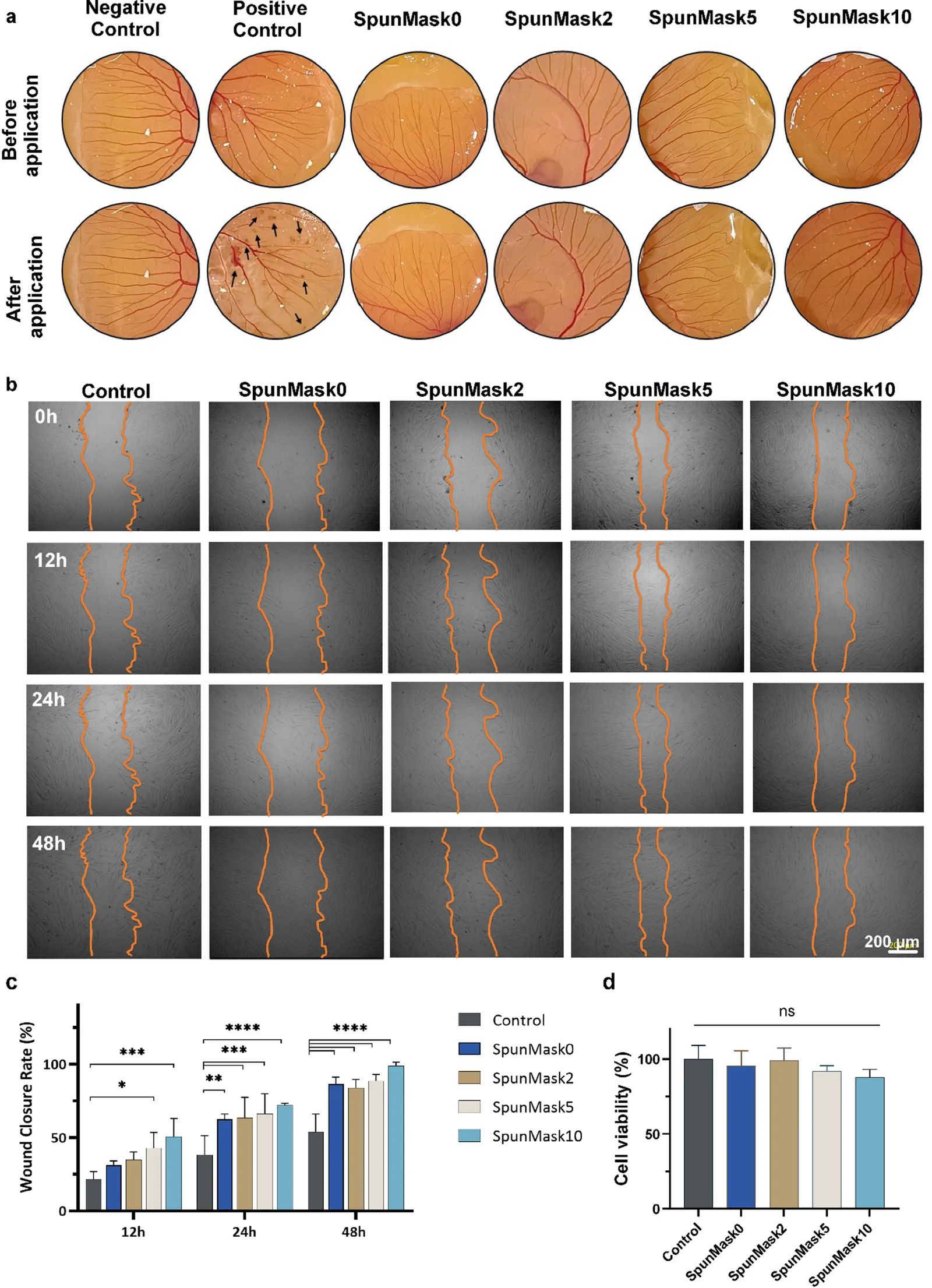
Fig. 5 In vitro and irritation evaluation of electrospun facial SpunMasks (a) Representative HET-CAM assay images before and after application for evaluating irritation potential of SpunMasks (b) In vitro scratch assay images at 0 h, 12 h, 24 h, and 48 h of dermal fibroblast cells tested with SpunMasks (c) Quantitative analysis of in vitro scratch assay at 12 h, 24 h and 48 h (n = 5, *p < 0.05, **p < 0.01, *** p < 0.001, ****p < 0.0001, analyzed by two-way ANOVA) (d) MTT assay result of dermal fibroblast cells for 24 h culturing with SpunMasks, (n = 8, no statistically significant differences (ns), analyzed by one-way ANOVA)体外与刺激性评价:(a) HET-CAM 试验前后图像;(b) 体外划痕实验。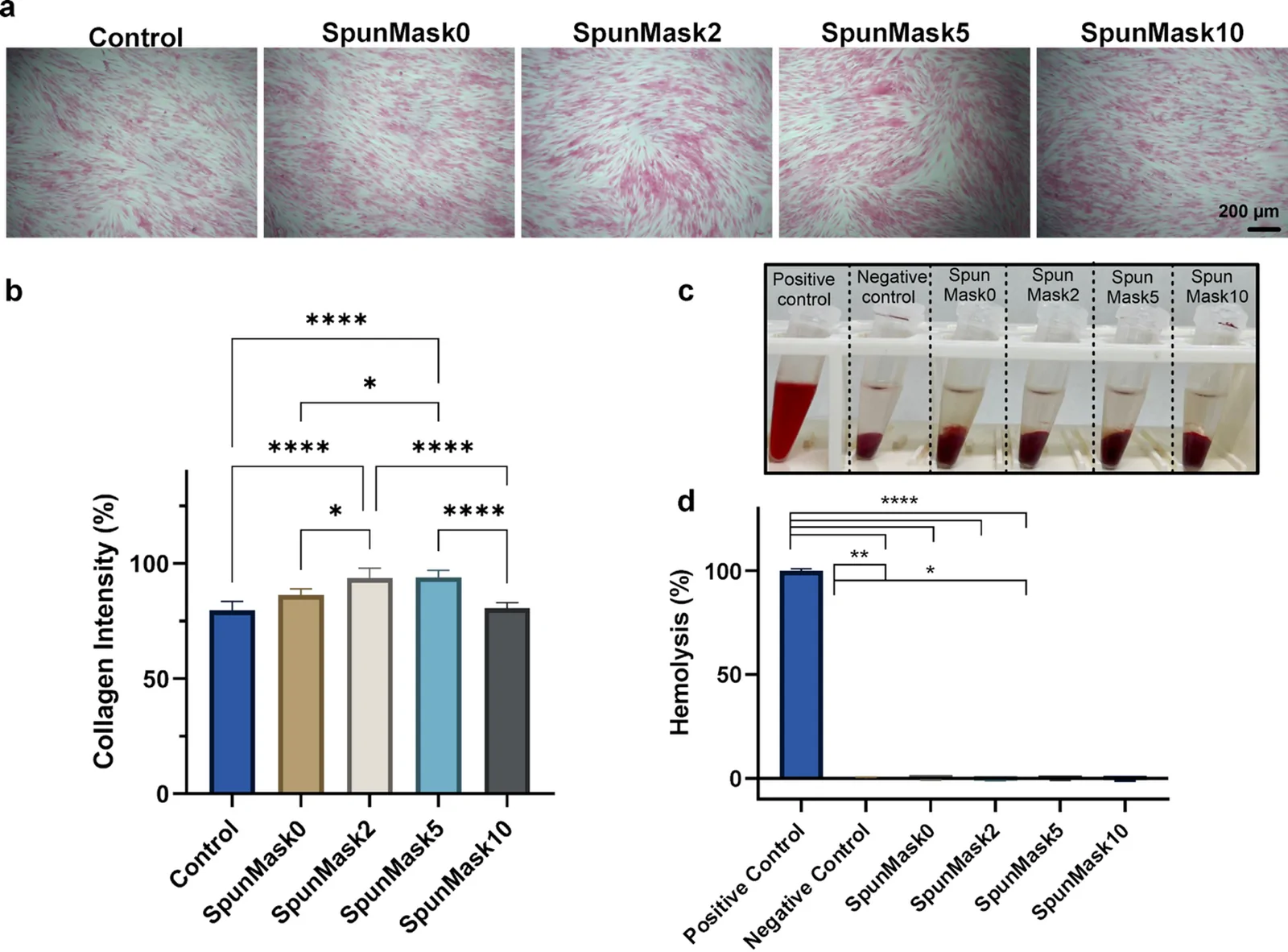
Fig. 6 Evaluation of collagen production of dermal fibroblast cells and hemocompatibility of SpunMasks (a) Collagen production of dermal fibroblast cultures after treatment with SpunMask for 24 h by analyzing Sirius red staining (b) Collagen intensity produced by dermal fibroblast cells after exposure to SpunMasks for 24 h (n = 5, *p < 0.05, ****p < 0.0001, analyzed by one-way ANOVA) (c) Representative images of RBC hemolysis assay (d) Quantitative result of RBC hemolysis assay for SpunMasks compared to the positive control (n = 6, *p < 0.05, **p < 0.01, ****p < 0.0001, analyzed by one-way ANOVA).真皮成纤维细胞胶原生成与血液相容性评价。
This study successfully developed a novel preservative-free, fast-dissolving, and eco-friendly fibrous facial mask, namely SpunMask, using PVP and snail mucus via handheld in situ electrospinning. The study enables on-demand fabrication of tailor-made facial masks that conform precisely to facial anatomy, overcoming the limitations of conventional wet and sheet-type cosmetic masks related to preservatives, packaging waste, and poor anatomical fit. The fabricated SpunMasks were comprehensively characterized through physicochemical, structural, and biological analyses. Optimization of electrospinning parameters resulted in homogeneous, bead-free fibers with diameters ranging between 1 and 2 μm. The fiber structure provided high surface area and interconnected porosity, facilitating rapid hydration and efficient release of bioactive compounds. The incorporation of snail mucus did not compromise fiber morphology and contributed positively to the hydrophilicity. Upon minimal contact with water, the SpunMasks dissolved rapidly within 24 s without leaving residues, ensuring immediate delivery of bioactives while minimizing waste generation. Physicochemical evaluations demonstrated high moisture permeability, rapid wettability, and pH values (4–6) within the physiological skin range, indicating excellent suitability for cosmetic applications. Comprehensive biological assessments, including cell viability, HET-CAM irritation, hemolysis, and scratch wound assays. Cell viability was obtained between 98.81 and 87.77%, while HET-CAM resulted in no irritation, blood hemorrhage, or coagulation. The hemolysis result was under 5% with a significant difference between positive controls. Furthermore, dermal fibroblast cell migration exhibited significant differences when compared to the control group, resulting in 97.1% wound closure at 48 h. Sirius red staining demonstrated a remarkable increase in collagen production in SpunMask-treated dermal fibroblast cells, indicating a strong potential for anti-aging–related activity, with collagen levels reaching up to 94.7%. These findings confirmed that SpunMask formulations are non-irritant, cytocompatible, and hemocompatible, supporting their safe use on sensitive facial skin. Overall, the combination of handheld electrospinning, water-soluble polymers, and snail-derived bioactives represents a promising strategy for personalized, sustainable, and high-performance skincare products. Beyond cosmetics, this approach holds significant potential for broader applications in biotechnology and skin-related biomedical fields, highlighting handheld electrospinning as a transformative tool for next-generation functional skincare manufacturing.
The present research focused on the isolation of mucus from Achatina fulica (white jade snails). The snails were fed with vegetables such as carrots, zucchini, cucumbers, and peppers to eat, and they were kept in clean, humid conditions with conditions similar to those in their native environment. The protocol was adapted from the study from the literature 19 . First, the snails were rinsed with tap water, and then they were washed with distilled water to ensure that they were sufficiently clean. Mucus was collected by physical stimulation utilizing a glass rod. The collected mucus was centrifuged for 5 min at 5000 rpm to remove solid particles. This was subsequently frozen at − 20 °C for 24 h and lyophilized for 48 h, thereby obtaining a powder.
The electrospinning process was carried out using a handheld device provided by AdBioInk Biosystem Technology Inc. Optimization of the electrospinning process for PVP (Polyvinylpyrrolidone, MW: 1.300.000, Sigma, USA) was investigated to establish the optimum parameters for fiber formation. In this research, a 15% (w/v) PVP solution was prepared using ethanol. Subsequently, snail mucus was incorporated into the mixture at 0, 2, 5, and 10 mg/mL, named SpunMask0, SpunMask2, SpunMask5, and SpunMask10, respectively. For the production of fiber masks, 15 kV, a flow rate of 2.5 mL/h, and a tip-to-collector distance of 10 cm were utilized 3 , 56 . In situ application of SpunMask on a life-size facial mannequin was applied to show practical feasibility for 10 min.
The fiber morphology and diameter of the fibrous SpunMasks were monitored using light microscopy and SEM (Quanta Feg 450, USA). The fiber diameter was measured from 100 fibers utilizing ImageJ software (NIH, USA). The fiber distribution graph was processed by OriginPro Software (Version 2026, Northampton, MA, USA).
The functional groups in the resulting mask were characterized using FTIR in the range of 4000 –200 cm⁻¹. The graph was plotted utilizing OriginPro Software.
Rheological properties of SpunMask formulations were measured using an Anton Paar Physica MCR 301 rheometer (Anton Paar, Graz, Austria) equipped with a plate temperature-controlled base (Viscotherm VT2) and a hood using a CP25 measuring plate. The samples were tightly sealed to prevent material loss, and a solvent trap was utilized to prevent solvent evaporation during the measurement. Steady-state shear viscosity measurements were performed by applying a logarithmically increasing shear rate ranging from 1 to 100 s⁻¹, covering both low-shear conditions representative of solution behavior at rest and high-shear conditions relevant to the electrospinning process 56 . The apparent viscosity was continuously recorded as a function of shear rate for all formulations, namely SpunMask0, SpunMask2, SpunMask5, and SpunMask10. To ensure measurement reliability and reproducibility, each rheological test was carried out at least three times using independently prepared samples, and consistent trends were confirmed across repeated runs.
Water contact angle (WCA) measurements were conducted utilizing a KSV CAM200 goniometer (KSV Instruments, Finland) to evaluate the surface wettability of the electrospun SpunMasks. A 5 µL droplet of distilled water was gently placed onto the surface of each membrane, and the WCA was recorded 1 s after droplet deposition to capture the initial wetting behavior. All measurements were performed at room temperature, and each sample was measured at four different locations ( n = 3) to ensure reproducibility, with the reported values representing the average of the measurements.
The solubility of the mask was also evaluated with mask samples, where cut into squares with 2 cm. The 1 g samples were immersed in petri dishes containing 10 mL distilled water at room temperature and 7 pH, and the dissolution times of the masks were recorded 57 .
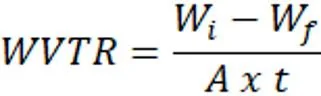
The water vapor permeability rate of SpunMask samples was determined based on Water Method Procedure B of ASTM E96 standard. The standard procedure has been modified to be performed at a temperature of 37 °C in order to simulate the physiological conditions of mask use. For the experimental setup, glass test tubes with a 13 mm mouth diameter were used, and 7 mL of distilled water was added to each tube as the evaporation source. The open ends of the tubes are covered with SpunMask and tightly sealed at the edges. After the initial weights of the prepared setups were recorded as W i , the samples were placed in an oven at 37 °C. After a 24-hour incubation period, the tubes were weighed again to determine their final weights, W f . The water vapor transmission rate was calculated using the following formula based on the time-dependent weight loss 58 , 15 .
Where WVTR represents the water vapor transmission rate (g/m 2 .h), W i is the weight at the beginning of the experiment, W f is the weight after 24 h, A is the sample area (m 2 ), and t is the incubation time.
The fibrous SpunMask with 1.0 g of the sample was dissolved in 10 mL of deionized water. A pH meter (Hanna Instrument, USA) was used to measure the pH of the solution after 20 min of dissolving.
Chorioallantoic membranes (CAM) assays were performed on embryonated chicken eggs on embryonic day 10 (E10). Under Directive 2010/63/EU and the Turkish Regulation on the Working Procedures and Principles of Animal Experiments Ethics Committees (Official Gazette No. 28914, 15 February 2014), embryonated chicken eggs at this stage are not considered protected experimental animals requiring prior ethics committee approval. Therefore, no separate animal ethics approval was required for this study 59 . All procedures were terminated before hatching and were conducted in accordance with the applicable regulatory framework. Within this framework, the solutions were produced with a concentration of 50 mg/mL. These solutions were applied to CAM from 10-day-old chick embryos that were still intact and undamaged. 0.3 mL of each sample solution was dropped onto the CAM surface and remained for three minutes. After that, the membrane surface was gently rinsed with distilled water to remove residual solution. Once the liquid was removed, the degrees of hemorrhage, coagulation, and hemolysis were observed and evaluated using a digital camera. For control experiments, 1% (Sodium dodecyl sulfate) SDS solution was used as positive control, while a 0.9% NaCl solution served as the negative control. Each test sample was evaluated on three separate chick embryos 52 , 59 .
Cell viability was quantitatively assessed by the (3-(4,5-dimethylthiazol-2-yl)-2,5-diphenyltetrazolium bromide (MTT) assay (Sigma-Aldrich, St.Louis, MO, USA) using CCD1064Sk (ATCC ® CRL2076™) dermal fibroblast cells. Prior to cell culture, both sides of SpunMasks with 3 × 3 cm size were sterilized for 30 min. SpunMasks were dissolved in cell culture medium at 37 °C for 24 h. The dissolved samples were subjected to filtration and incubated with cells for 24 h. MTT solution was introduced to the cell culture medium following 24 h of culture of the SpunMasks, and the samples were incubated at 37 °C for 4 h to enable formazan crystal formation 60 . Following the incubation, the MTT-containing medium was discarded, and 100 µL of DMSO was applied to each well to solubilize the formazan crystals. The plates were then agitated for 5 min, and absorbance was measured at 570 nm utilizing a microplate reader (BMG LABTECH SPECTROstar ® Nano).
The impact of the produced fibers on cell migration rates was assessed using a standard in vitro scratch assay 60 , 61 . For this test, the extract medium was obtained by incubating fibrous facial masks with a 3 × 3 cm size, sterilized with UV, in Dulbecco’s Modified Eagle Medium (DMEM, Capricorn Scientific, Ebsdorfergrund, Germany) High Glucose containing 5% fetal bovine serum (FBS, Capricorn Scientific, Ebsdorfergrund, Germany) for 24 h. CCD1064Sk (ATCC ® CRL2076™) human dermal fibroblasts were seeded into 24-well plates (1 × 10⁵ cells/well) and incubated until 90–95% confluency was reached. Once confluence was achieved, a “wound zone” was created in the center of each well using a sterile 200 µL pipette tip. The cells were washed with PBS, and then the extract was transferred to a well plate. Fresh DMEM High Glucose medium containing 5% FBS was used as a control. Images of the scratch areas were captured at 0, 12, 24, and 48 h using an inverted microscope (Zeiss Axio Observer) to evaluate cell migration. The percentage of wound closure was quantified using ImageJ software according to the following formula 62 :

A colorimetric assay utilizing Sirius Red (Direct 80 dye) was implemented to measure collagen production by dermal fibroblast cells, exposed to the developed facial mask 63 . To prepare the extract medium, UV-sterilized 3 × 3 cm fiber SpunMasks were incubated in phenol-red-free DMEM High Glucose medium without FBS (0%) for 24 h. CCD-1064Sk human dermal fibroblasts were seeded into 96-well plates. Following adhesion, the medium was substituted with phenol-red-free DMEM supplemented with 1% FBS. Once the cells reached confluence, they were treated with the previously prepared SpunMask extracts. Cells incubated in FBS-free (0%) medium served as the control group. After the cells became confluent in phenol-free DMEM High Glucose medium containing 1% FBS, they were treated with the extracts. Following a 48-hour incubation in the extract medium, the medium was aspirated, and the wells rinsed with PBS, then, fixed in Kahle solution (26% ethanol, 3.7% formaldehyde, and 2% glacial acetic acid) for 15 min at room temperature. Subsequently, the wells were treated with 0.1% Sirius Red solution (Sigma-Aldrich, St. Louis, MO, USA) diluted in 1% acetic acid and incubated at room temperature for 1 h. The wells were rinsed with 0.1 M HCl to remove excess stain. Then, 100 µL of 0.1 M NaOH solution was added to one well to release the stain. The collagen staining was visualized by an inverted microscope. The intensity of the red staining on the images was quantitatively measured using ImageJ to evaluate collagen production.
A hemolysis assay was performed using sheep blood obtained from a local slaughterhouse to assess the hemocompatibility of the fabricated SpunMasks 64 . Hemolysis assay was employed on diluted (10% v/v) erythrocyte (RBC) suspension at 37 °C for 1 h. Whole blood was subjected to three washes with PBS during preparation. PBS served as a negative control, whereas distilled water as a positive control in the experiment. Following incubation, the samples were centrifuged at 3500 rpm for 10 min, and the supernatants were transferred to a 96-well plate and examined at a wavelength of 540 nm. The hemolysis % was determined using the formula shown below:

All measurements were conducted in at least three independent replicates. The statistical analysis performed via one-way and two-way ANOVA and p values below 0.05 are considered statistically significant.
Below is the link to the electronic supplementary material.
该研究提出以手持静电纺丝技术在面部原位直接制备可溶纤维膜(SpunMask):以水溶性、生物相容的聚乙烯吡咯烷酮(PVP)为基材,复合含黏蛋白、黏多糖与活性肽的蜗牛黏液,省去防腐剂与塑料包装,且可贴合个体面部轮廓。
表征显示纤维分布均匀(光学显微镜/SEM),FTIR 证实 PVP 与蜗牛黏液组分共存;该膜可在数秒内于模型面部快速溶解。体外评价显示其透湿性良好、pH 适宜皮肤、并具有抗衰潜力;生物安全性方面,HET-CAM 与鸡胚绒毛尿囊膜试验提示无刺激性,溶血试验显示血液相容,成纤维细胞活性与划痕、胶原(Sirius Red)实验支持其组织相容性。
临床解读:这是一项以体外与离体实验为主的临床前研究,证实了该原位纤维膜的可行性与生物安全性,但尚缺乏人体临床数据与长期功效验证。其“无防腐剂、个性化、可持续”的定位具参考价值,距离常规临床应用仍需进一步的人体试验与工艺标准化。
声明:中文精读 · 仅供学术参考。内容来自公开文献检索,不代表本人观点,不构成诊疗建议。 医疗美容需在正规医疗机构由执业医师实施。