吸脂利多卡因中毒致心脏骤停病例
2026年10月1日14 min read
Oman Medical Journal
结论与实践要点
这正是不幸事件的镜像: 李博士提到的「术中昏迷」与该例高度吻合——高剂量肿胀利多卡因(本例 71 mg/kg)、术后延迟 2 小时才出现神经毒性(头晕→意识下降→癫痫→心脏骤停)。关键教训有三点:① LAST 的神经系统表现(烦躁、头晕、视物模糊、癫痫、昏迷)常早于心脏停搏,术中与复苏团队必须识别前驱征;② 毒性可延迟发作, 术后留观不足 24 小时即离院风险极高 ;③ office-based 吸脂若缺乏持续监护、气道与 ACLS 资源,一旦 LAST 进展为心脏骤停,预后极差(本例即遗留严重缺氧性脑病)。
临床可操作要点: ① 严格记录利多卡因总 mg 与 mg/kg,设硬上限并双人核对;② 配备脂质乳剂(20% Intralipid)作为 LAST 解救一线、熟悉 ASRA/ESRA 复苏流程;③ 全程脉氧+心电图+血压监护,术后规范留观并书面告知「延迟中毒」预警症状;④ 高危大剂量病例建议在具备住院监护条件的机构而非纯门诊开展。
循证边界与合规: 单病例报告、非对照,不能据此推导普适剂量;但作为「延迟性 LAST 致昏迷/心脏骤停」的教材级警示,价值明确。文中剂量数字为原报告事实,引用须标注个案来源,不得表述为通用安全剂量。
We report a case of a patient presenting to the emergency department in cardiac arrest following a liposuction procedure, which was performed in a physician office using lidocaine anesthesia. During liposuction of the thighs, using the power-assisted technique, the patient was given a subcutaneous dose of lidocaine equal to 71 mg/kg without any noticeable intraoperative complication. Two hours later, the patient experienced dizziness, a rapid decline in mental status, tonic-clonic seizure, and cardiac arrest. The patient was successfully resuscitated in the emergency department with the return of spontaneous circulation after 22 minutes of continuous advanced cardiovascular life support resuscitation. The patient suffered from subsequent severe hypoxic-ischemic brain injury, and a complicated hospital stay, including brain edema, electrolytes disturbances, and nosocomial infections contributed to her death two months later due to septic shock.
Keywords: Liposuction、Anesthesia、Lidocaine、Cardiac Arrest、Emergency Department
Increased awareness of cosmetic surgery and body image concerns has made liposuction a popular surgical operation. Liposuction, initiated in the 1970s in Italy, is defined as the removal of fat from deposits beneath the skin using a cannula with the assistance of a powerful vacuum. It may be performed in hospitals, ambulatory surgery centers, or physician offices. The safety of the technique relates not only to the amount of tissue removed, but also to the choice of anesthetic and the patient’s health condition. There are four types of liposuction techniques and their main difference is the amount of infiltration done into the tissues and the resultant blood loss as a percentage of aspirated fluid. Liposuction is considered a high-risk office-based procedure. 1 - 3 Reported perioperative deaths have been attributed to anesthetic complications, abdominal viscous perforation, fat embolism, hemorrhage, and unknown causes. 3
The tumescent technique, developed by Dr. Klein, uses a special instrument to efficiently anesthetize the subcutaneous space with a very dilute solution of lidocaine/epinephrine. 4
The tumescent technique is nowadays the most common of all liposuction techniques. Large volumes of dilute local anesthetic (wetting solution) are injected into the fat to facilitate anesthesia and decrease blood loss. The concentration of lidocaine injected varies and may reach large toxic doses (35–55 mg/kg) in patients desiring extensive liposuction, raising concerns regarding local anesthetic toxicity especially after the reports of adverse outcomes. 4 - 7
A 33-year-old previously healthy woman weighing 70 kg was brought to the emergency department (ED) by Emergency Medical Services (EMS) in cardiac arrest. The patient was undergoing liposuction of her thighs in a physician’s clinic with no intraoperative complications a few minutes before the event. The surgeon reported harvesting 1.5 L of fat from the patient’s thigh and mid-back during the procedure, which lasted 45 minutes.
A few minutes following the procedure, the surgeon noticed that the patient was becoming more somnolent. Her vital signs were stable, including a blood pressure of 170/90 mmHg. The doctor suspected a possible clinical manifestation of hypoglycemia and subsequently administered oral dextrose solution without any improvement.
Two hours after the procedure, the patient started feeling dizzy with a rapid decline of her mental status leading to tonic-clonic seizure followed by a complete loss of consciousness. EMS arrived on the scene after five to 10 minutes. EMS personnel reported the patient was gasping, cyanotic, and drooling. During transport to the ED, she had a cardiopulmonary arrest, so the EMS team immediately initiated resuscitation using Basic Life Support guidelines.
Upon arrival to the ED, the cardiac monitor showed asystole, so the patient was intubated and resuscitation resumed using the advanced cardiac life support algorithm. Return of spontaneous circulation was achieved after 12 minutes of resuscitation in the ED (22 minutes post-arrest).
The plastic surgeon who performed the procedure was asked for details about the procedure technique and the anesthesia modality. He reported using the power-assisted liposuction technique in his private clinic. As for anesthesia, he reported the use of five vials of 50 mL lidocaine 2% (20 mg/mL) subcutaneously during the operation; making the total dose of lidocaine equal to 5000 mg. He also pointed to prior use of the same procedure and anesthesia three months earlier while performing an uncomplicated abdominal liposuction on the same patient.
Following the return of spontaneous circulation, electrocardiogram showed normal sinus rhythm, no QT prolongation with a corrected QT interval (QTc) of 466 ms and a normal QRS interval of 100 ms with no ST- or T-wave abnormalities [ Figure 1 ].
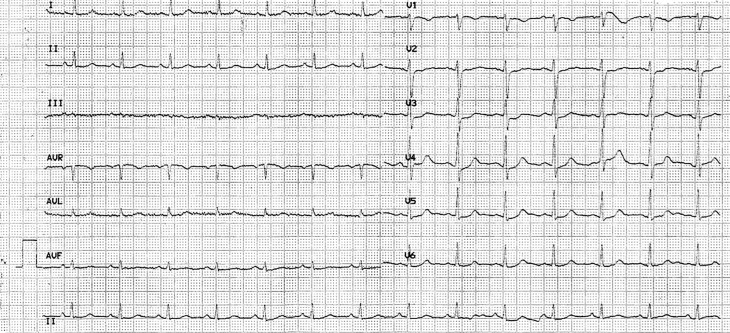
Figure 1 Electrocardiogram following return of spontaneous circulation.恢复自主循环(ROSC)后的心电图,示复苏后心律与缺血改变,是本例心脏骤停后心肌受累的客观记录。Neurological examination revealed no response to verbal or painful stimuli (Glasgow Coma Scale of 3T), pupils equal in size bilaterally and reactive to light, preserved corneal and oculocephalic reflexes, and a downward Babinski reflex bilaterally.
Arterial blood gas analysis on mechanical ventilation on 100% fraction of inspired oxygen (FiO 2 ) showed a pH of 7.34, a CO 2 pressure of 39.9 mmHg, an O 2 pressure of 131 mmHg, and a bicarbonate concentration of 20.8 mmol/L.
Laboratory workup included a complete blood count, and measurement of serum electrolytes, lactate, cardiac and liver enzyme levels. The results were the following: white blood cell count 9.8 × 10 9 /L with 41% polymorphonuclear cells; a hemoglobin level 10.4 g/dL; platelet count 336 × 10 6 /L; troponin 0.003 ng/mL; sodium concentration 144 mmol/L; potassium 3.5 mmol/L; chloride 99 mmol/L; bicarbonate 16 mmol/L; glucose 346 mg/dL; blood urea nitrogen 13 mg/dL; creatinine 1.0 mg/dL; aspartate aminotransferase 225 IU/L; alanine aminotransferase 238 IU/L; γ-glutamyl transpeptidase 12 IU/L; alkaline phosphatase 55 IU/L; and lactate 17.55 mmol/L. Her serum lidocaine level upon presentation to the ED was 5.30 µg/mL (therapeutic range = 1.50–5.00 µg/mL).
Imaging included a computerized tomography (CT) scan of the brain without contrast material as well as CT angiography of the chest to rule out intracranial bleed and massive pulmonary embolism, respectively, which could be a reason for the patient’s arrest. Positive findings included bilateral consolidations consistent with aspiration pneumonitis without any signs of intracranial bleeding, pulmonary embolism, or aortic dissection. The patient was started on antibiotic therapy.
The patient developed generalized myoclonic jerks that were attributed to possible anoxic brain injury following her cardiac arrest so she was started on valproic acid.
The patient was admitted to the intensive care unit. Magnetic resonance imaging of the brain was done three days later and showed signs of severe hypoxic-ischemic brain injury, which was confirmed by electroencephalogram (EEG) (electrocerebral silence on EEG).
The patient’s hospital stay was complicated by an increase in brain edema and pressure, electrolytes disturbances, multiple nosocomial infections with end-organ damage leading to the patient’s death secondary to septic shock two months later.
Lidocaine is a synthetic aminoethylamide, which is a widely used local anesthetic agent, usually well tolerated and considered much less cardiotoxic than other local anesthetics. Other uses include acute management of intractable ventricular arrhythmias. Lidocaine stabilizes the neuronal membrane by binding to and inhibiting voltage-gated sodium channels, thereby inhibiting the ionic fluxes required for the initiation and conduction of impulses and effecting local anesthesia. The onset of lidocaine action ranges from 45 to 90 seconds. The volume of its distribution is equal to 1.5±0.6 L/kg and is alterable by many patient factors (e.g., decreased congestive heart and liver failure). This drug crosses the blood-brain barrier with its major form (60–80%) in the plasma bound to alpha-1-acid glycoprotein. It has a 90% hepatic metabolism forming monoethylglycinexylidide and glycinexylidide, which may accumulate and cause central nervous system toxicity. Its half-life ranges between 1.5 and 2 hours. It is excreted in the urine (< 10% as unchanged drug and around 90% as metabolites). Maximal local cutaneous infiltration injectable dose is 4.5 mg/kg/dose not to exceed 300 mg.
Signs and symptoms of lidocaine toxicity tend to follow a progression of central nervous system excitement. The patient may initially experience perioral numbness, facial tingling, pressured or slurred speech, metallic taste, auditory changes, and hallucinations, which may also be accompanied by hypertension and tachycardia. As the condition evolves, seizures or central nervous system depression may develop, and severe cases may experience cardiac failure and even arrest. 8
The American Academy of Dermatology has published guidelines for liposuction indicating a maximum safe dose of lidocaine of 55 mg/kg. 9 However, this remains an area of significant controversy since the maximum recommended dose of local anesthetics is a multifactorial concept. 7 For an overdose to occur, the drug must gain access to the affected organs or tissues in the concentration needed. Patients predisposing factors include age (under six and over 65 years), lean body weight (disproportionate relationship with risk of toxicity), presence of pathology (e.g., liver, pulmonary, and cardiovascular diseases), genetics (e.g., atypical pseudocholinesterase for ester-type local anesthetics), mental attitude (anxiety decreases seizure threshold), and pregnancy (slightly increased risk in pregnant women). Drug predisposing factors include vasoactivity of drug (higher lipid solubility and protein binding decrease risk of toxicity while vasodilation increases its risk), route of administration (intravascular injection increases toxicity risk), rate of infusion, vascularity of administration site (increases the toxicity), and the presence of vasoconstrictor (decreases the risk). 10 , 11
Some experts state that 35 mg/kg is a more reasonable threshold of toxicity noting that the hepatic metabolism of lidocaine using CYP3A4 is saturable and once saturation occurs, absorption exceeds elimination and plasma lidocaine concentrations increase precipitously. 3
One study addressed the question of safe dosing limits for tumescent lidocaine infiltration with and without subsequent liposuction. 12 Preliminary estimates for maximum safe dosages of tumescent lidocaine were 28 mg/kg without liposuction and 45 mg/kg with liposuction. As a result of delayed systemic absorption, these dosages yield serum lidocaine concentrations below levels associated with mild toxicity and pose an insignificant risk of harm to patients.
Some studies reported that large doses of lidocaine (e.g., 35 mg/kg) are safe and prudent for tumescent infiltration. 13 , 14
Absorption of local anesthetic from the subcutaneous tissue is variable; thus, the timing for lidocaine toxicity symptom onset is unpredictable. 15 , 16 Although blood lidocaine levels typically peak 12 to 16 hours after the initial injection of infiltrate solution, peaks may occur within two hours of injection, particularly if tumescent lidocaine without epinephrine is used (e.g., for endovenous laser therapy). Thus, close postoperative monitoring in the office-based recovery area is necessary, and lipid emulsion should be immediately available for prompt treatment.
The patient described in this case report, weighing 70 kg, received a lidocaine dose of 5000 mg, equivalent to 71 mg/kg. This dosage exceeds the previously described toxic doses, and therefore, warrants the development of subsequent local anesthetic systemic toxicity.
The differential diagnosis of such case would also include other more frequent postoperative complications following liposuction including massive pulmonary thromboembolism, fat embolism syndrome, hypovolemic hypotension, and vasovagal syncope.
In 2011, a case of a patient successfully resuscitated with lipid emulsion therapy after prolonged and intractable lidocaine toxicity was reported 17 demonstrating the need to consider lipid emulsion therapy in the advanced cardiac life support algorithm for lidocaine toxicity.
In our case, instructions were given to administer 20% lipid emulsion in case of cardiovascular deterioration including ventricular arrhythmias or cardiac arrest during the 24 hours following the admission.
We describe a case of cardiac arrest secondary to the use of a toxic dose of lidocaine during a liposuction procedure in a physician’s clinic. This case raises a concern about the safety of performing such procedures in private clinics and is compatible with the previously discussed lidocaine toxic dose threshold.
声明:中文精读 · 仅供学术参考。内容来自公开文献检索,不代表本人观点,不构成诊疗建议。 医疗美容需在正规医疗机构由执业医师实施。
基于相同主题推荐 · 继续深挖
病例性质:急诊病例报告。一名患者在 医师办公室(office-based) 接受大腿动力辅助吸脂(PAL),皮下注射利多卡因剂量达 71 mg/kg ,术中无明显异常;术后约 2
病例系列纳入3名面部皮肤松弛伴容量缺失的年轻女性(24–26岁),采用序贯方案:单次单极射频(Thermage CPT,900发,深度4.5–5.0mm)后1个月起行2次多层PLL
由6名意大利多学科专家(皮肤科、整形外科、神经科)基于文献回顾(PubMed 1973–2025)与临床经验形成的专家共识,针对incobotulinumtoxin A(Bocou