眉提升手术长期疗效文献综述
2026年10月23日28 min read
Plastic and Reconstructive Surgery Global Open
结论与实践要点
本文为一篇遵循PRISMA规范的系统性文献综述,检索2000年至2025年8月英文数据库,最终纳入17篇额部眉提升(FEL)临床研究(多为内镜术式,含少量与开放术式或滑移眉提升的对照)。研究目的并非介绍新手术,而是批判性评估开放与内镜FEL的长期疗效,并探讨对额眉功能解剖认识的演变如何影响手术实践。
汇总结果显示,各研究技术标准化程度低、变量多;多数报告中眉内侧抬高最少、外侧最高,所有研究的长期(超过1年)最高抬高均未超过5.6 mm,且随访中抬高幅度随时间逐渐下降。合并分析显示内眦、瞳孔中、外眦平均垂直抬高分别约3.09、3.87、4.50 mm,内眦与外侧差异具统计学意义。作者指出,开放与内镜FEL均未见明确优效,且长期维持抬高(尤其外侧)效果有限,过度中央抬高可造成不自然的「惊讶」外观。
作为综述,其结论受纳入研究非标准化、随访困难与选择偏倚限制,且缺乏对统一参照点的稳定测量,证据等级有限。作者据此建议转向更个体化、以眉形改变(尤其外侧)为核心的上面部年轻化思路,并保留眉部动态表情能力。临床决策时应结合患者年龄、额部形态与期望,谨慎评估手术指征。
Background:Forehead eyebrow lift (FEL) techniques have changed significantly over the past decades. They have slowly moved away from open coronal or hairline incision lifts toward minimally invasive endoscopic approaches. However, incomplete knowledge of functional anatomy, dynamic eyebrow muscle activity, and basic aging changes has frequently resulted in failed procedures, relapses, and an unnatural appearance with excessive brow elevation. The purpose of this review was to evaluate the long-term efficacy of open or endoscopic FEL and to highlight how evolving understanding of forehead and eyebrow functional anatomy can influence the practice of FEL procedures.
Methods:A comprehensive patient/population, intervention, comparison, and outcome review of clinical studies published since 2000 in the English-language literature following preferred reporting items for systematic reviews and meta-analyses guidelines was performed using the PubMed, Embase, and Web of Science databases.
Results:A small number of studies were retrieved, describing techniques that were not well standardized and had many variables. In most reports, the medial eyebrow was the least elevated, whereas the highest elevation was achieved laterally. The highest long-term elevation in all studies did not exceed 5.6 mm, and long-term follow-up demonstrated a significant gradual decrease in elevation over time.
Conclusions:Open or endoscopic FEL techniques do not seem to be highly effective in maintaining long-term brow elevation, in particular laterally. It is likely time for a critical appraisal of their efficacy and for a different, more personalized conceptual approach.
Question: What is the long-term efficacy of open and endoscopic forehead eyebrow lift techniques, and how important are brow shape and dynamic muscle balance compared with vertical elevation?
Findings: This systematic review found that both techniques provide modest brow elevation, greatest laterally, but results are limited by relapse, variability, and an overemphasis on vertical lift. Brow shape and preservation of dynamic balance seem more critical to aesthetic success and patient satisfaction.
Meaning: Long-term success in forehead eyebrow lift relies more on reshaping the brow and maintaining natural expression than on vertical lift.
Upper face rejuvenation is traditionally addressed by forehead eyebrow lift (FEL), which reduces wrinkles, opens the periorbital area, and elevates the eyebrows, which are described to fall below the orbital rims with aging, significantly impacting the perception of facial beauty. 1 – 6 Surgical lift has decreased about 64% from 2000 to 2015, whereas rejuvenation with neurotoxin became exponentially popular (797%). 7 Nevertheless, demand for brow lifts increased by 18% from 2022 to 2023, and energy-based modalities are gaining ground. 8 – 10
FEL aims at adjusting depressor and elevator forehead forces by applying external, internal, or skin excision–based pull and fix techniques. 6 The procedure has undergone more transformations than any other facial aesthetic surgery. Paralleled by developing technologies and innovative fixation methods, 11 – 18 it has gradually moved since the 1990s from open to endoscopic lifts, which are currently performed in more than 50% of cases. 7 , 11 , 12 , 19 – 26 It has also evolved to address changing aesthetic trends from high brows positioned above the orbital rim and small eyebrows with a middle-positioned arch, to the more recently appreciated laterally peaked eyebrows and more subtle, natural-looking elevation. 9 , 27
Although many FEL techniques are reproducible and associated with minimal complications, exact brow reshaping remains largely subjective, and the best technique has yet to be determined. Criticisms against most FEL techniques include therapeutic failures and an unnaturally excessive, elevated appearance, which can be more deleterious to aesthetics than some ptosis, together with failure to maintain long-term results. 3 , 7 , 8 , 20 , 28 , 29
Debate about the longevity and effectiveness of various FEL techniques is still ongoing, with extensive discussions focusing on the advantages and limitations of different manipulations. 13 , 20 Subperiosteal dissection, common to most interventions, is also a subject of controversy. 30 The aim of this review was to determine the long-term efficacy of open and endoscopic FEL and to highlight how the evolving understanding of forehead and eyebrow functional anatomy can potentially impact the surgical practice of upper face rejuvenation.
A comprehensive patient/population, intervention, comparison, and outcome search of PubMed, Embase, and Web of Science databases of FEL studies published in the English-language literature from 2000 up to August 2025 was conducted following preferred reporting items for systematic reviews and meta-analyses (PRISMA) guidelines. Keywords used alone or in combination for the search were “brow lift,” “eyebrow lift,” “forehead lift,” “glabellar lift,” “frontal lift,” “mm,” “millimeters,” “centimeters,” “wrinkle improvement,” “wrinkle score,” “wrinkle scale,” “wrinkle severity,” “height,” and “position.” An additional unstructured search was conducted. Two investigators screened titles and abstracts and analyzed full texts of selected articles for eligibility. Disagreements were resolved by consensus or with the senior investigator.
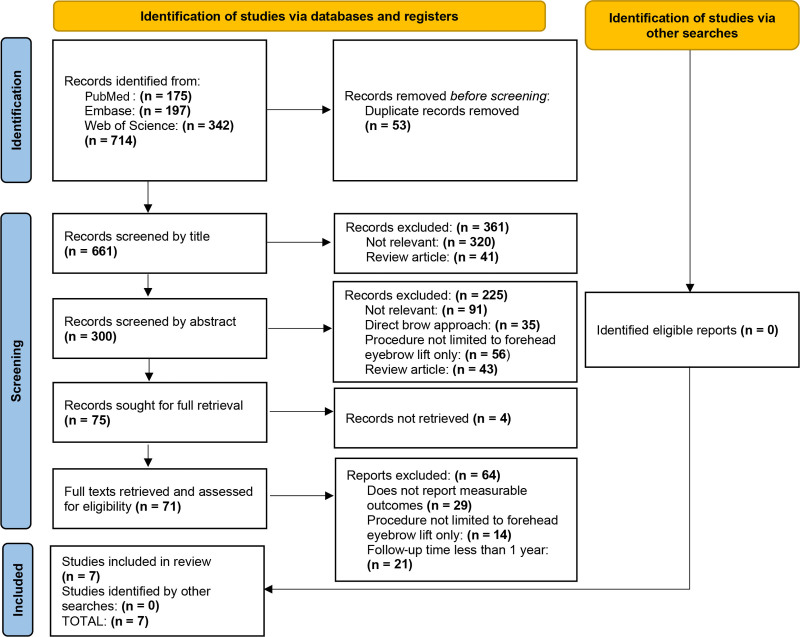
The PRISMA search algorithm is illustrated in Figure 1 , and inclusion and exclusion criteria are detailed in Table 1 . Only studies reporting FEL without simultaneous neurotoxin or filler injection, with a minimum follow-up of 1 year and documented eyebrow-level measurements, were retrieved for this review. Comparisons of elevations at medial canthus (MC), mid-pupillary (MP), lateral canthus (LC), and brow tail (BT) were performed using the paired-sample t test; a P value of less than 0.05 was considered statistically significant. Direct brow lifts, transblepharoplasty, or temporal lifts are excluded because they are intended to elevate the eyebrows only and do not simultaneously address the forehead.
Table 1. Inclusion and Exclusion Criteria and Literature Search Methodology
| Criteria | Inclusion | Exclusion |
|---|---|---|
| Study design | • Peer-reviewed randomized controlled, retrospective or prospective cohort, or comparative studies involving at least 10 patients with at least 1-y follow-up | • Reviews, case reports, comments, book chapters, and letters to the editors• Studies involving less than 10 patients and follow-up less than 1 y• Cadaver or experimental animal studies |
| Population | • Subjects undergoing surgical open coronal or endoscopic FEL | • Subjects undergoing only eyebrow lift by surgical approaches other than coronal, endoscopic, or mid-forehead endoscopic skin access incisions (direct or transpalpebral)• Subjects undergoing temporal lift or open mid-forehead lift• Subjects undergoing FEL with simultaneous botulinum toxin or fillers in the early perioperative period |
| Outcome | • Brow elevation measured quantitatively based on specific anatomical landmarks in millimeters | • Reports without objective measurements documenting brow elevation• Reports with incomplete demographic and outcome data |
| Methodological quality | • Clearly defined methodologies and measuring tools for determining brow elevation | • Studies with insufficient description of methodology and measurement tools |
| Publication date | • Studies published since 2000 to capture the most recent evidence related to FEL techniques | • Studies published before this timeframe |
| Language | • Studies with full text published in English | • Non-English publications |
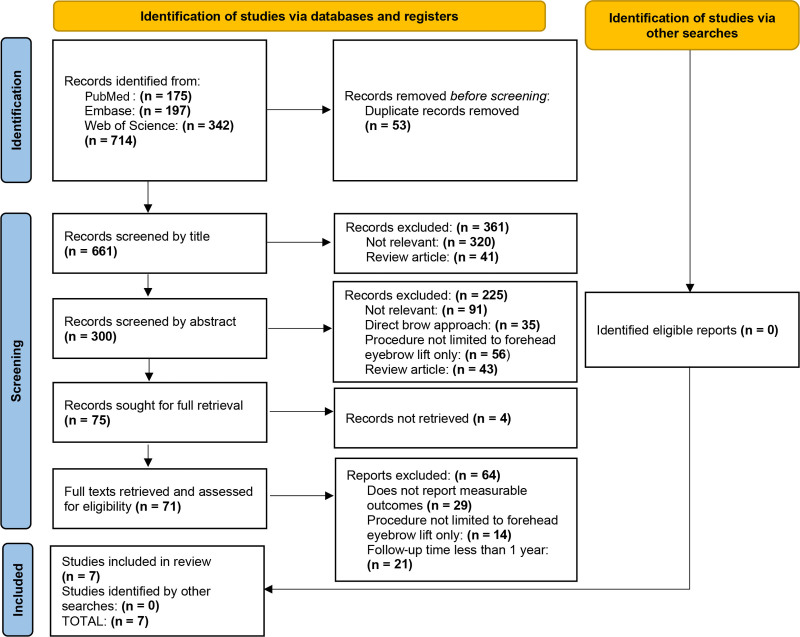
Fig. 1. PRISMA search algorithm.PRISMA检索流程图:展示本综述的文献筛选与纳入算法。
Seventeen reports met the inclusion criteria. Fifteen involved endoscopic lifts, 2 of which were comparative with open lifts and 1 with gliding brow lift (GBL). One additional study was about GBL, and another involved a nonendoscopic technique with limited-access incisions. Brow elevation was maintained beyond 1-year follow-up with all approaches. Despite some loss of elevation with time, higher brow elevation was observed with the open technique mostly at the MP. 2 In most studies, greater elevation was observed at the LC level, except in a few where it was at the MP level. In 1 report about endoscopic lift, 31 the least elevation was achieved laterally. Higher MC elevation than MP and LC was reported in 1 study following subperiosteal endoscopic lift without fixation 23 (Fig. 2 ) (Table 2 ). ( See table, Supplemental Digital Content 1 , which provides a summary of the studies retrieved for review, https://links.lww.com/PRSGO/E732.)
Table 2. Measurement Parameters of Brow Position
| Authors | Baseline Reference | Medial | Central | Lateral Limbus | Lateral | BT |
|---|---|---|---|---|---|---|
| Şibar et al 32 | Horizontal plane at level of pupils—vertical distance | Lower brow border | Lower brow border | Lower brow border | ||
| Boonipat et al 25 | Horizontal plane at level of pupils—vertical distance | Tip of medial brow | Upper brow border | Upper brow border | ||
| Guyuron et al 33 | Horizontal line passing through medial canthi—vertical distance | Lower brow border | Lower brow border | Lower brow border | ||
| Aslan Gülbitti et al 2 | Mid-pupil, medial and lateral canthi—vertical distance | Upper brow border | Upper brow border | Upper brow border | ||
| Papadopulos et al 31 | Mid-pupil, medial and lateral canthi—vertical distance | Upper brow border | Upper brow border | Upper brow border | ||
| Bitik 34 | MP line—vertical distance | Lower brow border | Lower brow border | Lower brow border | BT | |
| Graf et al 24 | MP line—vertical distance | Upper brow border | Upper brow border | Upper brow border | ||
| Gencer et al 8 | Intermedial canthi line—vertical distance | Lower brow border | Lower brow border | Lower brow border | Lateral end of brow | |
| Jones and Lo 35 | MP line—vertical distance | Upper brow border; medial eyebrow MC/medial limbus | Mid-pupil upper brow border | Lateral limbus upper brow border | LC upper brow border | Lateral eyebrow upper brow border |
| Orra et al 36 | MP line—vertical distance | Upper brow border | Upper brow border | Upper brow border | Lateral end of brow upper border | |
| Troilius 23 | MC; mid-pupil; LC—vertical distance | Upper brow border | Upper brow border | Upper brow border | ||
| Pascali et al 37 | MP line—vertical distance | Upper brow border | Upper brow border | Upper brow border | ||
| Badin et al 38 | MP line—vertical distance | Mid-brow to mid-pupil | Mid-point between pupil and LC | LC to mid-brow | ||
| Hönig et al 39 | Nasal alar crease, at the intersection between a line from the lower nasal base and a perpendicular line crossing the most lateral ala nasi—oblique distance | Highest point of mid-brow | Lateral end of brow | |||
| Massoud and Aboelatta 40 | Mid-pupil—vertical distance | Lowermost hair follicle | ||||
| LC—oblique distance | Lateral end of brow | |||||
| Iblher et al 41 | Perpendicular to ICP | L1: Upper brow border at 1/5 of ICP | L2: Upper brow border at 1/3 of ICP | L3: Upper brow border at 2/3 of ICP | L4: Upper brow border at 3/3 of ICP | L5: Upper brow border at 5/4 of ICP |
| Dayan et al 42 | Ratio of fixed subnasale-to-canthus distance and subnasale-to-brow distance | Subnasale—MC/subnasale—medial brow | Subnasale—MC/Subnasale—lateral brow |
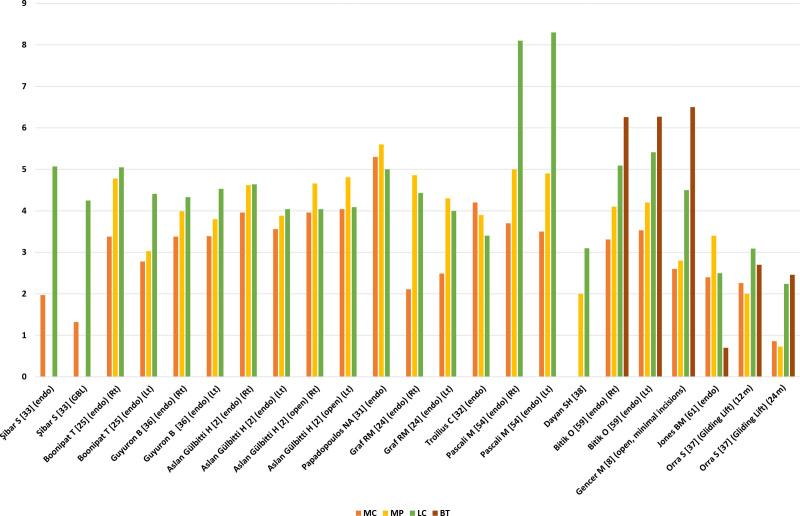
Fig. 2. Detailed brow elevation reported by studies retrieved for review. Brow measurements other than those perpendicular to a horizontal reference plane at the level of MC, MP, LC, and BT are excluded.纳入研究的眉抬高测量详图:按内眦、瞳孔中、外眦与眉尾等参照点展示眉位置变化(排除非垂直参照平面的测量)。Average vertical elevation observed at the MC, MP, and LC was 3.09 ± 1.02, 3.87 ± 1.19, and 4.50 ± 1.42 mm (95% confidence interval: 0.0136, 0.0163, 0.0186), respectively. Differences in elevation of MC–MP ( P = 0.0257) and MC–LC ( P = 0.0004) were significant, in contrast to MP–LC ( P = 0.1848). Measurement of BT elevation was conducted in 7 studies. Data from only 4 of these were suitable for statistical analysis comparing elevation. Differences in elevation of MC–BT ( P = 01607), MP–BT (0.2861), and LC–BT (0.7742) were not significant. ( See table, Supplemental Digital Content 2 , which displays the statistical analysis, https://links.lww.com/PRSGO/E733.)
Comparing endoscopic FEL with mesh fixation to GBL, maximal elevation was at the LC level with both techniques; however, higher elevation at MP, lateral limbus, and LC with lower loss of elevation from 3 to 12 months postoperatively was observed with mesh. 32 Comparing endoscopic lift with loop fixation to Endotine, lateral and mid-brow elevation measured from a fixed point at the alar base was insignificant at 12 months with both fixation methods; nevertheless, the authors claimed that Endotine fixation enhances soft tissue suspension by allowing better distribution of tension. 39 Compared with traditional temporal fascia sutures and mini-screws fixation, another study reported that concentric cable fixation may be an inexpensive alternative method to suspend the tail, and to a lesser extent, the body, with good long-term stability. 40 BT elevation was observed to be higher than brow elevation at LC with cross-frontal sutures following nonendoscopic blind subperiosteal dissection with minimal access incisions. 8 In male patients with a receding hairline, a report described an endoscopic brow lift with Endotine fixation, with placement of incisions at the forehead transverse crease. Visible scars could be minimized, whereas reasonable brow elevation without changing hairline position could still be achieved. The authors, however, did not conduct measurements at different time points to assess the stability of elevation over time. 25
Follow-up extending more than 5 years of Leibinger endoscopic cranial outer table screw fixation demonstrated a significant influence of time on MP eyebrow elevation, characterized by a decrease of almost 1 mm in elevation per year. 31 Significant loss of brow elevation from 1 to 12 months postoperatively (18.4%–24.8%) was also reported at MC, MP, and LC following endoscopic lift with 1-point fixation to the deep temporal fascia. 33 Of particular interest is the study of Orra et al 36 demonstrating overall loss of elevation from 12 to 24 months postoperatively following GBL; however, loss was significantly less severe at the level LC and BT. In this study, MC elevation was also higher than MP, similar to the study reporting subperiosteal endoscopic lift without fixation. 23 Significant progressive loss of medial and lateral brow elevation more than 5 years was also reported by Dayan et al 42 following open coronal FEL.
In contrast to wide belief, the anatomical position of the brows remains largely constant with aging, despite ethnic and gender variability in shape, slope, and position across all age groups and varying standards of beauty and evolving styling across cultures. 1 – 5 , 11 , 25 , 33 , 43 – 45 A study demonstrated stable brow position in 41% of subjects, elevated eyebrows in 28%, and ptosis in only 29%. 46 Brows tend to elevate in men, whereas they do not drop in women. Different brow regions are also affected in various ways. Medial and central brows tend to rise, whereas the lateral brow may remain stable or slightly drop. 1 , 9 , 44 Thus, brow elevation is not indicated in most patients. However, forehead and glabellar frown lines are other indications of FEL to achieve a smooth, youthful appearance. 11 , 13 , 15
Although medial and central eyebrow height may remain stable, the stability of the lateral brow is less clear. Brow position relative to LC remains significantly unchanged with age; however, LC descent with hooding, a significant hallmark of periorbital aging, masks real lateral descent. 1 , 4 It is also too simplistic to think that ptosis is due solely to soft tissue descent. 5 The effects of periorbital fat loss, subbrow fat pad deflation, loss of skin elasticity, widening of the orbital aperture, and supraorbital rim recession must not be underestimated. 5 , 33 , 47
Moreover, eyebrows are constantly under the influence of static and dynamic downward forces. 21 , 27 , 48 Their position remains unchanged whenever proportional resting elevator frontalis muscle tone compensation is maintained. 4 , 11 In unbalanced situations, brow asymmetry and drooping occur with a wide spectrum of shape and position modifications. 3 , 21 , 49 For ptosis due to insufficient compensation, FEL is indicated, whereas botulinum toxin is more appropriate for eyebrow elevation and deeper forehead lines caused by overcompensation. 3 In older patients, in whom wrinkles are secondary to hypertonic frontalis compensating for sagging upper eyelids, management warrants a different approach. 11 , 49
Open FEL, long considered the gold standard, consists of a transcoronal incision posterior to the hairline or pretrichial/pretrichial-trichophytic incision in patients with a receding hairline. 13 , 14 , 20 , 25 , 33 , 50 Subgaleal, or more often subperiosteal, dissection is carried to the orbital rim, and arcus marginalis is mobilized while preserving the neurovascular bundles. Limited transverse transection or cross-hatching of the frontalis muscle is performed, together with subtotal resection of the corrugator and procerus muscles. Following flap elevation to the desired position, excess tissue is then excised. 14 , 22 , 42 This approach is also indicated to adjust forehead length and hairline position. 11 , 51
Conflicting long-term outcomes of various open FEL techniques have been reported. The subperiosteal lift is described as highly efficient and associated with few relapses or asymmetries. 17 On the other hand, subgaleal lift, described to allow brow elevation with less suspension tension and to minimize risk of alopecia, widened scars, changes in sensitivity, and even necrosis, has been associated with almost complete loss of brow elevation over time. 17 , 18 , 23 , 29 , 50 , 52 , 53
Heralded as an innovative and high-tech breakthrough, and indicated for patients with normal or minimal forehead elongation, endoscopic FEL brought great hope for the reduction of complications experienced with open lift. 16 , 50 Standard dissection of endoscopic lift is subperiosteal medially and superficial to the deep temporal fascia laterally. 11 , 21 Unlike open techniques that rely on skin resection for elevation, the efficacy of endoscopic FEL relies on skin redraping and retraction, secured by tension-free fixation to the frontal bone and deep temporal fascia for at least 12 weeks, until sound periosteal adherence and scar maturation are complete. 9 , 15 , 19 – 21 , 29 , 37 , 47 , 54 – 57
The need for fixation has been described as regionally variable. It is not needed medially, where osteoperiosteal ligamentous attachments have adequate tensile strength. It is necessary for the central brow, but essential for the tail. It may not be needed whenever less than 4 mm vertical lift is required. 9 , 23 , 24 , 58 There has also been much debate about methods of subperiosteal forehead fixation. 19 Endogenous methods include lateral spanning suspension sutures, lateral fixation to the deep temporal fascia, external bolster fixation, fibrin glue, anterior port skin excision, and parasagittal bony fixation to cortical V-shaped bony tunnels. 8 , 9 , 15 , 29 Vertical fixation to the thick subplane layer of epicranial aponeurosis has also been described to eliminate the need for bone drilling. 59 Exogenous methods, on the other hand, use internal plate fixation, internal or external screw fixation, Mitek transcalvarial anchor fixation, Endotine multipoint fixation, and absorbable K-wires or screws. 8 , 9 , 15 , 29 , 54 , 55 , 60 Use of polypropylene mesh has also been reported. 23 , 60 , 61
Patients with a convex forehead, high hairline, redundant forehead skin, and thick sebaceous skin are not good candidates for endoscopic FEL. 30 , 55 , 58 Moreover, the complexity of endoscopic fixation techniques underscores procedural challenges and contributes to varying perceptions of this approach’s efficacy. Despite high early satisfaction and some favorable long-term outcomes, complications—including asymmetry, overcorrection, and transitory paralysis, together with a long learning curve, concerns regarding lift stabilization, and unpredictable gradual loss of elevation, have resulted in disappointment and a significant decrease in long-term patient satisfaction. 9 , 17 , 22 , 31 – 35 , 37 , 38 , 40 , 50 , 56 , 62 , 63
Though higher predictable outcomes have been reported with the open technique, neither endoscopic nor open lifts have been demonstrated to be conclusively superior. With both, cephalic forehead flap movement may be limited by inelastic supraorbital nerves, and both may result in unsatisfactory brow height and shape with poor maintenance of elevation over time. 2 , 32 , 33 , 50 , 62 , 64 , 65 High rates of relapse and disproportionate lateral sagging observed with subperiosteal techniques are likely due to the lack of frontalis muscle insertion, in addition to the lack of dense periosteal–subdermal attachments along the lateral eyebrow. 5 , 9 , 31 , 37 , 47 , 49 , 56 , 66 They may also be due to thick and heavy flaps and poor maintenance of the tension needed for distant fixation points. 23 , 24 Moreover, adhesion between the repositioned periosteum and underlying bone does not prevent skin gliding, and consequently, recurrent brow ptosis. 17
With this anatomic configuration, a shift to GFL and subcutaneous temporal lift is justifiable. 12 , 33 , 34 , 67 Subcutaneous dissection, carried out with or without endoscopic visualization, represents an advancement characterized by simplicity, minimal equipment requirements, limited scarring, no skin resection, and long-lasting results with few complications. Superior skin redundancy can be accommodated by undermining the hair-bearing scalp above the galea. For GBL, fixation is achieved with a hemostatic net. 12 , 17 , 33 , 47 , 68 – 71 Subcutaneous healing creates tight adhesion of the eyebrows in their new position, which maintains lateral elevation and greatly reduces the risk of relapse. 12 , 17 , 33 , 34
In addition to the lack of consensus and definition of the ideal brow position or shape for optimal attractiveness, failed procedures, relapses, and frequently observed unnatural excessive brow elevation may be explained by incomplete knowledge of functional forehead anatomy, dynamic eyebrow muscle activity, and basic aging changes. 1 , 3 , 4 , 11 , 23 , 49 There is also a lack of understanding of the effect of upper blepharoplasty on brow position. Despite claims that concomitant blepharoplasty does not have a bearing on the degree of brow elevation, eyebrow to eyelid crease harmony is likely to be altered. 23 , 42 , 50 , 72 – 74
Reduction of dynamic wrinkles is another target of FEL. Wrinkles develop at the convergence of bidirectional frontalis contraction in a transverse line dividing the forehead by 39% cranially and 61% caudally 13 , 27 , 75 ; their severity at rest is best described using the Carruthers et al 76 scale. However, with frontalis being the major eyebrow elevator that compensates for orbicularis activity, myotomy seems to be counterintuitive. 49
Contrary to eyebrow balance theory, strained eyebrow expressions increase motor recruitment in all muscles. Simultaneous activation of opposite muscle groups likely explains why attenuation of medial brow depressors results in greater elevation of central as well as medial brow, and why resection of procerus, depressor supercilii, and corrugator supercilii muscles results in significant progressive brow elevation. Furthermore, the observed gradual increase in brow elevation over time may also be explained by changing pattern of motor recruitment with advancing age. Even though recruitment decreases for the frontalis and corrugator muscles, while it increases for the orbicularis muscle, frontal muscle activity increases with aging. 1 , 3 , 5 , 23 , 24 , 44 , 49 , 77 The complexity of balanced muscle activation warrants further investigation. Whether ethnic differences exist also requires further investigation. 3
Endoscopic lift temporarily effaces wrinkles; they tend to recur a few years later. 35 Deep rhytides may be best addressed subcutaneously. 11 , 35 , 78 This plane of dissection allows release of fibrous bands that contribute to their formation. 79 However, alopecia, forehead anesthesia, scar visibility, and skin necrosis are potential complications of this approach and should be avoided or used cautiously in patients who smoke. 11
Besides the welcomed attenuation of wrinkles, whether the elevation of the medial, middle, and lateral brow aligns with the clinically desired outcome should be questioned. Ultimate success should not be predicated merely on brow elevation. Brow shape is likely more important to overall aesthetic appeal. 1 Reports describing statistically significant elevation must also be interpreted critically. In 1 report not included in this review, “significant” long-term elevation did not exceed 0.4 mm. 38 For women who can alter their eyebrow position by plucking, the justification of an intervention with such an outcome is doubtful.
Rather than a single aesthetic unit, the eyebrows should be defined in relation to other periorbital features and described as a component of an “attractive eye.” 27 Change in brow shape, mostly laterally, is likely a more visually discernible measure of “success” than simple elevation (Fig. 3 ). 28 In fact, patients are more concerned about upper eyelid aesthetics and lateral temporal laxity, in addition to rhytides, than about brow ptosis. Focusing solely on vertical vector brow lift may not address patients’ concerns or natural aging dynamics. 9 It can ultimately lead to poor outcomes with abnormal facial expression characterized by a “pulled” appearance, the most feared outcome and cause of reluctance to undergo surgery. 50 Brow shape and position alterations must be performed cautiously. Eyebrows move in diverse directions to express emotions. Although brow elevation may convey positive emotion changes, overexaggeration might convey unintended emotions and create a surprised look; it can also contribute to an aged appearance. 1 , 27 , 28 , 49 , 56 , 80 – 82 Moreover, maintaining the natural ability of brow expression of nonverbal emotion is a vital component of social communication; it must not be underestimated. 44 , 80 Limiting muscle excision deserves serious consideration.
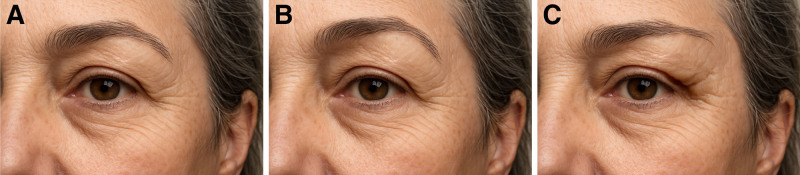
Fig. 3. Effect of change in brow position or shape on aesthetic perception. A, Original brow position. B, Brow elevation mostly medially and centrally, as opposed to (C) maintaining medial and mid-brow position with shape modification by elevating the BT. Medial and mid-brow elevation does not make the patient look younger. In contradistinction, change in bow shape by BT elevation is visually more discernible and more aesthetically pleasing. (Figure generated with Chat GPT and modified by Liquify Photoshop function.)眉位置或形态改变对美学感知的影响示意图:对比单纯内侧/中央抬高与通过抬高眉尾改变眉形的视觉效果,后者在视觉上更易辨识且更美观。In addition to nonstandardized interventions, difficulties in follow-up and selection bias, which are common in aesthetic studies, and the lack of consistent measurement of brow position relative to common reference points have limited the number of studies that could be subjected to statistical t test analysis. A simple universal measuring system is definitely needed with readily available reference landmarks. Furthermore, inaccuracy in determining subtle changes in brow position, particularly in women who usually pluck their brows, is another limitation, compounded by inaccuracies in photographic standardization for computerized measurements.
Various open or endoscopic FEL techniques do not seem to be highly effective in maintaining long-term brow elevation, in particular laterally. Although the type of fixation may be a determining factor in outcome longevity, loss of elevation invariably occurs over time. On the other hand, outcomes may sometimes be characterized by higher elevation at the MP level, resulting in an unnaturally and excessively elevated brow appearance that is more deleterious to aesthetics than mild ptosis. Regardless of apprehension concerning coronal or hairline incisions, and the appeal of high-tech endoscopic techniques, it is likely time for a critical appraisal of the indication and long-term efficacy of FEL. In view of the demonstrated mostly stable or elevated medial and central brow, and the stable or slight drop of the lateral brow with aging, a different, more personalized conceptual approach is warranted. Rather than simple elevation, change in brow shape, primarily laterally, seems to be more effective for improving aesthetic appearance. Preservation of the complex dynamic balance of the eyebrows to maintain the natural ability for nonverbal emotion expression also warrants further consideration.
The authors have no financial interest to declare in relation to the content of this article.
ChatGPT was used to generate Figure 3.
补充视频 / 附件(原文未随文提供原图,可于出版方页面查看)gox-14-e7578-s001.pdf补充视频 / 附件(原文未随文提供原图,可于出版方页面查看)gox-14-e7578-s002.pdf
声明:中文精读 · 仅供学术参考。内容来自公开文献检索,不代表本人观点,不构成诊疗建议。 医疗美容需在正规医疗机构由执业医师实施。