双探头同步多区冷冻溶脂治疗的安全性与受试者满意度研究
2026年10月24日22 min read
Dermatologic Surgery
结论与实践要点
本文是一项前瞻性、无对照的器械研究,评估双/多探头同步冷冻溶脂(即在同一次治疗中于多个部位同时施加冷量)的可行性与安全性。冷冻溶脂的机制是脂肪细胞对冷选择性敏感、发生冷诱导凋亡后被巨噬细胞清除。研究纳入 35 名 BMI 正常(平均 24.9)的受试者,平均每人 20.8 个治疗循环。
结果提示:主要有效性终点以「盲法医生识别基线/治疗后图像差异」衡量,75% 被正确识别;脂肪层厚度平均仅减少 0.33 cm,属轻度改变。这说明同步多区治疗提升的是效率与覆盖范围,而非单次减脂幅度——它更适合局部精雕而非大幅减重。安全性方面无严重事件,满意度 82.8%、疼痛可控。
临床提示:冷冻溶脂的适应证是「BMI 正常者的局限性顽固脂肪」,而非肥胖或皮肤松弛;同步多区虽高效,但单次冷暴露总量增加,须关注个体耐受与罕见的延迟性脂肪增生(paradoxical adipose hyperplasia)。受限于无对照与 12 周短随访,疗效的持久性与长期安全仍需更大样本验证,且应合理管理患者预期。
Supplemental Digital Content is Available in the Text.
According to procedural statistics published by the American Society of Plastic Surgeons, a total of 682,932 noninvasive fat reduction procedures were performed in 2022, an increase of 77% from 2019. 1 During the same period, liposuction procedures saw only a 23% increase, demonstrating a possible inclination among individuals for treatments that offer results with lower cost, fewer side effects, and a shorter recovery time. 1 Cryolipolysis, a process by which controlled cooling extracts heat from subcutaneous tissues to induce selective adipocyte cell death, is the most frequently used noninvasive body contouring treatment. 2
Cryolipolysis is an effective and safe alternative to liposuction, with high rates of participant satisfaction. 3 – 6 Measures of effectiveness based on clinical assessment of photographs have ranged from 60% to 94% among participants receiving cryolipolysis. 6 – 12 Ultrasound has been used as an objective method for assessing the effectiveness of cryolipolysis. Studies identified in a systematic literature review cited a mean 0.2- to 0.51-cm reduction in fat layer thickness, depending on the body area treated. 13
Participants often desire cryolipolysis treatment on multiple body areas, necessitating serial treatment sessions to achieve results. 14 To potentially increase treatment efficiency and reduce time attending a clinic for treatment, a new cryolipolysis system was developed to accommodate the simultaneous use of 2 applicators. Previous studies have shown high rates of satisfaction and comfort with the dual-applicator system 3 , 15 ; however, evaluation is needed to determine participant safety, effectiveness, and satisfaction/comfort when up to 4 applicators from 2 devices are used simultaneously.
The objectives of this study were to assess the safety, effectiveness, and participant satisfaction with multiple simultaneous cryolipolysis treatments on the torso using a dual-applicator system.
This was a multicenter, prospective, open-label interventional study conducted at 4 clinical sites in the United States in healthy participants between the ages of 22 and 65 years with a body mass index (BMI) ≤30 kg/m 2 who desired fat reduction in the torso area. Eligible participants had a stable body weight (within 5%) in the preceding month and agreed to maintain their weight within 5% during the study period. Candidates were excluded from the study if they had any of the following in the intended treatment area: recent surgical procedure, fat reduction and/or body contouring procedure, subcutaneous injections, history of hernia, and dermatologic conditions (e.g., moderate to excessive skin laxity, scars) that may interfere with treatment or evaluation. Candidates were also excluded if they had an implanted device, were taking medications or supplements that caused weight loss, had a history of a bleeding disorder or were taking medications that may increase the risk of bruising, were pregnant or intended to become pregnant during the study period, had lactated within the past 6 months, or had a known sensitivity to cold or a history of cryoglobulinemia, paroxysmal cold hemoglobinuria, or cold agglutinin disease.
The study, conducted between June 16, 2020 and August 24, 2022, was carried out in accordance with ISO Good Clinical Practice and received institutional review board approval. All participants provided written informed consent for participation in the study as well as for their photographs and data to be published.
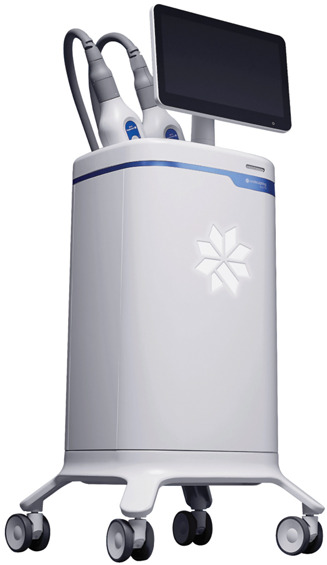
Clinical study sites used a dual-applicator cryolipolysis system (CoolSculpting Elite; Allergan Aesthetics, an AbbVie Company, Irvine, CA). Participants received 2 treatment sessions to the torso (i.e., abdomen, flanks, and/or bra/back area) 6 weeks apart. Each treatment session consisted of multiple treatment cycles (timed segments of tissue cooling delivered by an applicator) and treatment rounds (simultaneous delivery of multiple treatment cycles by any number of applicators [e.g., dual applicator, triple applicator, or quadruple applicator] to 1 or more body areas), with a minimum of 8 treatment cycles conducted over the 2 treatment sessions. Treatment cycles were delivered at −11°C for a duration of 35 or 45 minutes, followed by a 2-minute manual massage of the treatment area. The applicator size (i.e., Curve 120 [C120], Curve 150 [C150], Curve 240 [C240]) and the number of treatment cycles and rounds per treatment session were chosen by study investigators based on participant need. Follow-up office visits occurred 4 weeks after each of the 2 treatment sessions, 6 weeks after treatment session 1 (when treatment session 2 was delivered), and 12 weeks after treatment session 2.
The primary effectiveness end point was the correct identification of the pretreatment image by ≥2 of 3 blinded, independent physician reviewers when shown images of the treated torso (i.e., abdomen, flanks, and/or bra/back area) taken at baseline and 12 weeks after treatment session 2. The correct identification of the pretreatment versus 12-week images of individual treated areas was also evaluated. Success was defined as the correct identification of ≥70% of pretreatment images when displayed alongside the post-treatment image in a randomized sequence. Images of the treated areas were taken using a standardized 2-dimensional or 3-dimensional photograph capture system (e.g., QuantifiCare LifeViz Body; QuantifiCare, Suwanee, GA). To ensure consistency in photographs, participants were asked to fast on study visit days involving photography.
The primary safety end point was the frequency of adverse device effects (ADEs), including serious ADEs.
During follow-up visits, participants completed survey questionnaires composed of 5-point Likert scale questions, and free-text responses, to measure their satisfaction with multiple cryolipolysis treatments. Participants were also given an exit survey upon study completion. The percentage of positive responses was recorded. In addition, using a scale of 0 (no pain) to 10 (worst pain possible), participant comfort was assessed 10 minutes after the start of the procedure and as needed during treatment. Mean maximum pain scores were documented.
Ultrasound imaging was collected at baseline, 4 weeks after treatment session 1, and 12 weeks after treatment session 2 using a portable ultrasound system (HM70A; Samsung, Mountain View, CA) to determine fat layer thickness. Standardized techniques for obtaining images were used to ensure consistency throughout the study. Changes in the fat layer thickness between baseline and follow-up ultrasound images were noted.
The correct identification of the pretreatment images from a series of photographs taken 4 weeks after treatment session 1, as displayed in a randomized sequence, was an exploratory effectiveness end point.
The evaluable population for the primary effectiveness analysis included participants who received ≥8 treatment cycles over 2 treatment sessions with a weight change ≤5% of their total body weight between assessments at baseline and 12 weeks after treatment session 2. The safety population consisted of all study participants who received ≥1 cryolipolysis treatment cycle.
Summary statistics were provided for all analyses. Percentages and 2-sided 95% confidence intervals were reported for the primary effectiveness analysis. Paired t -tests and p values were calculated for the change from baseline in fat layer thickness.
A total of 35 participants received ≥1 cryolipolysis treatment session and 29 participants completed the study per protocol. Five participants did not receive treatment session 2 (2 because of an US FDA treatment hold, 2 because of adverse events, and 1 because of insufficient subcutaneous fat in the treatable area after treatment session 1) and 1 participant did not complete the week 12 follow-up visit.
Of the 35 participants who received ≥1 treatment session, most (77.1%) were female, the mean (SD) age was 40.4 (10.3) years, and the mean (SD) BMI was 24.9 (2.6) kg/m 2 (Table 1 ). All Fitzpatrick skin types were represented in the study population.
TABLE 1. Baseline Demographics and Clinical Characteristics
| Treated Participants ( N = 35) | |
|---|---|
| Age (yr), mean (SD) | 40.4 (10.3) |
| Female, n (%) | 27 (77.1) |
| Body mass index (kg/m 2 ), mean (SD) | 24.9 (2.6) |
| Fitzpatrick skin type, n (%) | |
| I | 1 (2.9) |
| II | 9 (25.7) |
| III | 13 (37.1) |
| IV | 8 (22.9) |
| V | 3 (8.6) |
| VI | 1 (2.9) |
Of the 35 participants enrolled in the study, 35 (100.0%) received treatment to the flanks, 34 (97.1%) received treatment to the abdomen, and 21 (60.0%) received treatment to the back/bra area (see Supplemental Digital Content , Table 1, http://links.lww.com/DSS/B601).
Overall, participants received a mean total of 20.8 (range, 9.0–33.0) treatment cycles delivered over ≤2 treatment sessions, with a mean of 11.7 (range, 6.0–20.0) and 10.5 (range, 2.0–20.0) cycles delivered in treatment sessions 1 and 2, respectively. Participants received a mean of 8.3 (range, 2.0–16.0) treatment cycles to the flanks, 9.4 (range, 4.0–18.0) treatment cycles to the abdomen, and 5.4 (range, 1.0–13.0) treatment cycles to the back/bra area over 2 sessions. Treatment cycles were most frequently delivered using the C150 applicator (55.6%), followed by the smaller C120 (40.7%) and the larger C240 (3.7%) applicators.
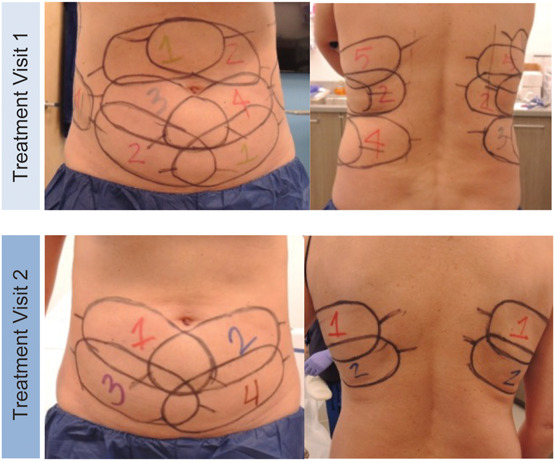
Participants received a mean total of 8.7 treatment rounds, with a mean of 4.8 and 4.6 treatment rounds delivered in treatment sessions 1 and 2, respectively. Dual-applicator (53.1%) cryolipolysis was most frequently used, followed by quadruple-applicator (20.7%) treatment and triple-applicator treatment (11.5%; see Supplemental Digital Content , Figure 1, http://links.lww.com/DSS/B601). Collectively, during treatment session 1, 150 rounds (89.3% of all rounds delivered) were delivered simultaneously with multiple applicators and 18 rounds (10.7%) were delivered with a single applicator. Similarly, during treatment session 2, 110 rounds (80.3%) were delivered simultaneously with multiple applicators and 27 rounds (19.7%) were delivered by a single applicator. The placement of markings and applicators on representative participants is shown in Figures 1 and 2 .
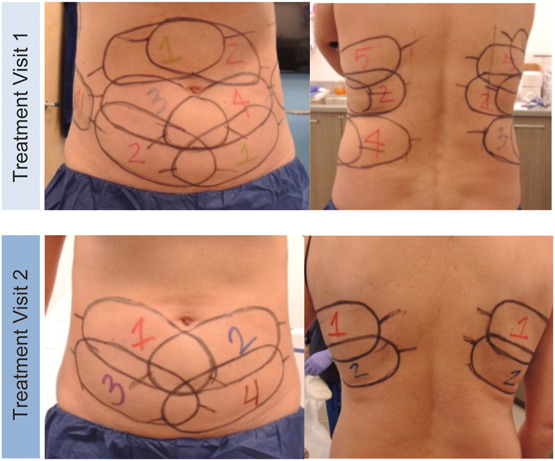
Figure 1. Markings on representative participant during treatment sessions 1 and 2 to indicate planned placement of cryolipolysis applicators. Clinicians reassessed participant before treatment session 2 and marked accordingly.治疗第 1、2 次 session 的冷冻溶脂探头规划标记示意。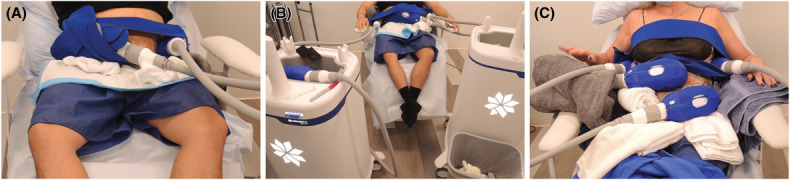
Figure 2. Images of representative participants receiving dual-applicator cryolipolysis (A), triple-applicator cryolipolysis (B), and quadruple-applicator cryolipolysis (C).双探头(A)、三探头(B)、四探头(C)冷冻溶脂治疗中的图像。
The primary effectiveness end point was met, with 75% (21/28) of pretreatment images of the torso correctly identified by ≥2 of 3 independent physician reviewers when compared with images taken 12 weeks after the final treatment session. For individual treatment areas, 85.7% (24/28), 74.1% (20/27), and 50.0% (9/18) of the pretreatment photographs of the flank, abdomen, and back/bra area, respectively, were correctly identified (Figure 3 ). Images of treatment progression in a representative participant are shown in Figure 4 . One participant was excluded from photograph review because of extensive tattoos in the treatment areas and additional tattoos in the treatment area before the final visit, which may have hindered evaluation.
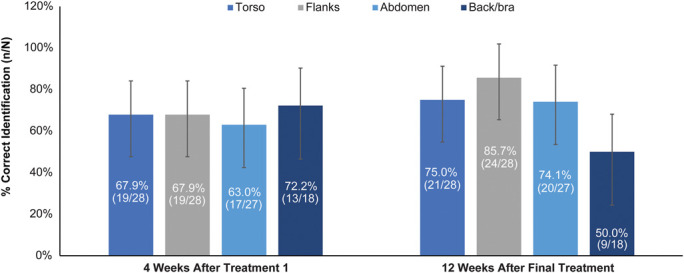
Figure 3. Correct photographic identification of baseline versus 4 weeks after treatment session 1 (exploratory) and baseline versus 12 weeks after final treatment by ≥2 of 3 blinded, independent physician reviewers. One participant was excluded from photograph review because of extensive tattoos in the treatment areas and additional tattoos in the treatment area before the final visit, which may have hindered evaluation.盲法独立医生对基线 vs 治疗后图像的识别(探索性 4 周与最终 12 周)。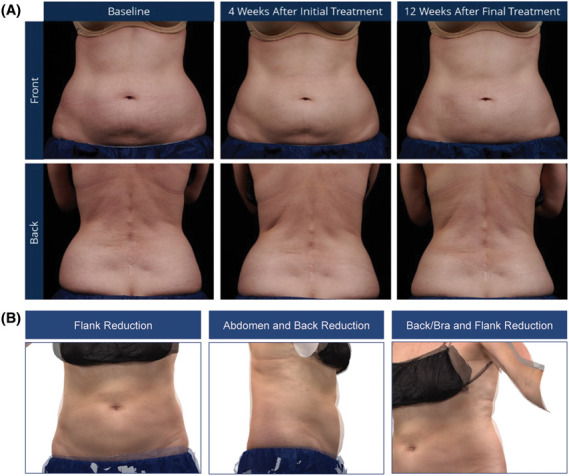
Figure 4. (A) Images of a 38-year-old female participant with body mass index (BMI) of 21.3 kg/m2, at baseline, 4 weeks after the first treatment session, and 12 weeks after the final treatment session; participant received 16 treatment cycles on the flanks and abdomen. (B) Baseline and 12 weeks after the final treatment session images (flank, abdomen, and back/bra areas) overlayed of a 50-year-old female participant with BMI of 24.9 kg/m2; participant received 24 treatment cycles on the flank, abdomen, and back/bra areas throughout the study.代表性受试者治疗前/后图像(A 38 岁女性腹部/侧腰;B 50 岁女性叠加图)。
In the exploratory analysis, 67.9% (19/28) of pretreatment images of the torso were correctly identified by ≥2 of 3 independent physician reviewers when compared with images taken 4 weeks after treatment session 1. For individual treatment areas, 67.9% (19/28), 63.0% (17/27), and 72.2% (13/18) of the pretreatment photographs of the flank, abdomen, and back/bra area, respectively, were correctly identified.
Ultrasound measurements demonstrated significant reductions in mean (SD) subcutaneous fat layer thickness across all treatment areas from baseline to 4 weeks after treatment session 1 (−0.16 cm [0.17 cm]); p < .05) and baseline to 12 weeks after the final treatment (−0.33 cm [0.33 cm]; p < .05) (see Supplemental Digital Content , Figure 2, http://links.lww.com/DSS/B601). Ultrasound images from a representative participant are shown in Figure 5 .
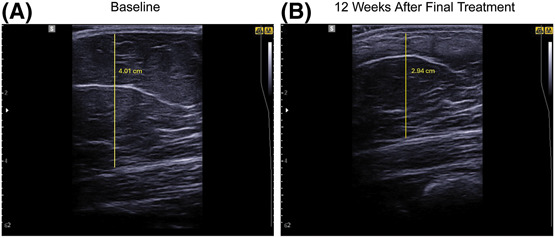
Figure 5. Ultrasound images from a representative participant at baseline (A) and 12 weeks after final treatment (B) of the lower abdomen. Changes to the fat layer were determined by measuring the layer thickness from the skin to a feature common to the baseline and follow-up images, as represented by the yellow line in the figure panels below.代表性受试者下腹部超声:基线(A)与最终治疗后 12 周(B)脂肪层厚度变化。
Sixteen ADEs were reported in 11 of the 35 participants (31%) treated, the majority (14/16) of which were mild, with the remainder (2/16) being moderate in severity. No serious ADEs were reported. The most common ADEs were vasovagal reaction and subcutaneous induration, each reported in 3 (8.6%) participants (Table 2 ).
TABLE 2. Frequency of Adverse Device Events
| Adverse Event | Participants, n (%) |
|---|---|
| Vasovagal reaction | 3 (8.6) * |
| Postprocedure pain/discomfort | 2 (5.7) |
| Subcutaneous induration | 3 (8.6) † |
| Clinically significant erythema | 2 (5.7) |
| Hyperpigmentation | 2 (5.7) |
| Burn ‡ | 1 (2.9) |
| Prolonged swelling | 1 (2.9) |
Overall participant satisfaction improved over time and was highest 12 weeks after treatment session 2 (see Supplemental Digital Content , Figure 3, http://links.lww.com/DSS/B601). The overall participant satisfaction rate 4 weeks after treatment session 1 was 55.2%, which increased to 72.4% 6 weeks after treatment session 1, and to 82.8% 12 weeks after treatment session 2. Most participants reported changes in the fit and feel of their clothing (86.2%), more confidence (82.8%), an improved appearance (82.8%), and visible fat reduction (82.8%) 12 weeks after their final treatment. Participants also reported high satisfaction rates with the time required for the procedure (see Supplemental Digital Content , Figure 4, http://links.lww.com/DSS/B601).
During the exit survey, 76.9% of participants were satisfied with the results of their treatment plan and 88.5% were satisfied with the time it took from the initial treatment to visible results.
Most participants found the multiple-applicator cryolipolysis procedure comfortable (see Supplemental Digital Content , Figure 4, http://links.lww.com/DSS/B601). Mean maximum pain scores recorded during the procedures were 2.6 (on a scale of 10) during treatment session 1 and 4.1 during treatment session 2.
In this multicenter, prospective study to assess treatment outcomes with multiple-applicator cryolipolysis of the torso, 75% of photographs were correctly identified by ≥2 of 3 blinded, independent reviewers 12 weeks after the final treatment, meeting the primary study objective. In addition, participants noted high rates of overall satisfaction and comfort with treatment plans comprising multiple simultaneous applicator placements. The use of multiple applicators simultaneously decreased during treatment visit 2 and the use of a single applicator increased, potentially because of less available treatable tissue after the first treatment visit, resulting in less space for positioning of multiple applicators, thereby reducing the number of rounds using >1 applicator on the second visit.
Twelve weeks after the final treatment, participant satisfaction was similar to that observed in previous studies. 3 – 6 , 15 In a multinational prospective study, participants receiving cryolipolysis treatment to the abdomen and flanks reported a satisfaction rate of 89.6%, 4 which was comparable with the 82.8% satisfaction rate in the current study. Similarly, among participants receiving cryolipolysis treatment with the same device as that in the current study, satisfaction rates of 84.0% 3 and 83.3% 15 have been reported. Despite visible results in the current study at 4 weeks after the initial treatment in both independent photograph review and fat layer reduction on ultrasound, overall, most participants (>50%) were satisfied with treatment, although some participants reported that they were unable to perceive a noticeable change at this time point. Participant satisfaction, an exploratory end point in the current study, depends on many factors, including their expectations of treatment results. Participants underwent more treatment cycles in the current study than in previous studies, 15 which may have prompted higher expectations of treatment results 4 weeks after the initial treatment. In the current study, overall satisfaction rates increased from 55.2% 4 weeks after the first treatment to 72.4% 6 weeks after the first treatment, with an overall satisfaction rate of 82.8% 12 weeks after final treatment.
The effectiveness of multiple-applicator cryolipolysis was comparable with previous studies of single-applicator cryolipolysis on the flanks 5 – 8 and abdomen. 5 , 6 , 9 In previous studies, blinded, independent physician reviewers correctly identified pretreatment photographs in 79%, 81%, and 94% of participants who received treatment to the flanks and in 77% of participants who received treatment to the abdomen. 7 – 9 In addition, a retrospective multicenter study noted investigator-assessed improvement in 85.5% of photographs 12 weeks after cryolipolysis treatment to the abdomen and flanks. 6 Blinded, independent reviewers in a multicenter study using the same dual-applicator cryolipolysis system as the current study correctly identified 88.0% of pretreatment versus 12-week post–final treatment images of the midsection (flanks and abdomen combined). 15 In the present study, 85.7% and 74.1% of pretreatment versus 12-week post–final treatment photographs of the flanks and abdomen, respectively, were correctly identified by reviewers. Improved treatment effectiveness was observed after additional treatment and time after treatment. The overall correct photograph identification rate 4 weeks after treatment session 1 was lower than that observed 12 weeks after the final treatment session. This may indicate that while some improvement was observable in photographs at the earlier time point, additional time provided increased visible improvements, which is expected given the mechanism of action of cryolipolysis.
The correct identification rate was lower for the back/bra area compared with other individual treatment areas. This was the first study that evaluated treatment to this area, and photography methods have not been optimized and may not have been ideal to capture changes in the back/bra fat area alone. However, 12-week post–final treatment ultrasound images revealed a mean reduction of fat layer thickness in all treated areas, including the back/bra area. Post-treatment changes to the contour of the flank area may have affected the appearance of the fat bulges above the flank, thus potentially altering the appearance of the back/bra area in photographs. In addition, the study photography was designed to capture changes to the torso as a whole; however, individual body areas were also evaluated using these photographs.
With a mean total of 20.8 treatment cycles delivered over 2 treatment sessions with the simultaneous use of multiple applicators, the dual-applicator cryolipolysis system was safe with no serious ADEs. The frequency of ADEs was similar to that reported in a previous study, in which a comparable number of treatment cycles were delivered. 4 Vasovagal reaction, which was not reported in the Tan and colleagues study, 4 occurred in this study in 3 participants (8.6%) and may have been because of fasting required before study visits (to help maintain consistency in before and after photographs), the number of cryolipolysis-naive participants, and/or the use of multiple applicators applying vacuum suction to different body areas simultaneously. To reduce the risk of vasovagal reaction, it may be advisable to avoid fasting before treatment or to start cryolipolysis-naive participants with a round of 1 to 2 treatment cycles to get them accustomed to the treatment sensation before receipt of quadruple-applicator cryolipolysis.
After completion of treatment session 1, almost 80% of participants reported being comfortable with multiple applicators applied simultaneously; this percentage decreased to 65.4% after completion of treatment session 2. It is possible that the decrease in reported comfort may have been because of the higher mean maximum pain scores during treatment session 2 compared with treatment session 1; however, pain scores remained relatively low throughout both treatment sessions.
Limitations of this study include the lack of a control group and randomization. In addition, participant satisfaction was assessed for the entire torso rather than for each body area. A standardized, internally validated method to obtain ultrasound images and fat layer measurements was followed by all study investigators to mitigate the variability that may occur as a result of operator technique. In addition, it was expected that most ADEs would be identified during or shortly after each procedure and would be mild and transient in nature; however, because of the short study duration, it is possible that rare ADEs with a delayed onset, such as paradoxical adipose hyperplasia, may have occurred outside of the study period. Finally, participants for this study were selected based on their need for multisculpting. This may have added bias into the study because these participants have different treatment goals and expectations and may have reported less satisfaction with treatment results, particularly if one body area met expectations, but another area did not.
In this prospective clinical study, simultaneous use of multiple applicators with 1 or more dual-applicator cryolipolysis systems demonstrated high effectiveness, safety, and participant satisfaction after treatment to the torso. Visible improvements in the treated areas identified by blinded, independent photograph review were noted both 4 weeks after the initial treatment and 12 weeks after the final treatment. These results were confirmed by a significant decrease in the baseline fat layer visualized using ultrasound at both time points. No new safety signals were reported. The simultaneous use of multiple applicators for cryolipolysis treatments to the torso has the potential to improve treatment efficiency while also delivering consistent effectiveness outcomes.
声明:中文精读 · 仅供学术参考。内容来自公开文献检索,不代表本人观点,不构成诊疗建议。 医疗美容需在正规医疗机构由执业医师实施。
基于相同主题推荐 · 继续深挖
冷冻溶脂(cryolipolysis)为非侵入性减脂;本研究评估双/多探头同步多区治疗的安全性与满意度。

多中心、前瞻性、开放性、非随机可行性研究,纳入 11 例拟行腹部整形术的女性受试者(33–49 岁,均值 41.5 岁;BMI 均值 29.1),在体内直接比较 EMMS 与冷冻溶
背景:冷冻溶脂为非侵入性、耐受良好的皮下减脂手段;新型双治疗头系统可同时治疗多个部位、提升治疗效率。