肋弓内推缩腰术:RibXcar 单皮质截骨与 IncurvationXribs 成角变形两种术式的人体临床比较
2026年10月26日28 min read
Plastic and Reconstructive Surgery Global Open
Plastic and Reconstructive Surgery Global Open
结论与实践要点
本研究为一项人体临床病例系列,纳入 50 例 18–38 岁、体重指数不超过 28 的女性,按术式分为超声引导下单皮质截骨缩腰的 RibXcar 组(26 例)与基于骨成角变形(局部穿刺削弱骨内聚后借约 30 毫米汞柱加压束腰诱导塑性变形)的 IncurvationXribs 组(24 例),均重塑第 11–12 浮肋,随访 6 个月,主要终点为腰围变化及并发症。
两组在 6 个月时腰围均较基线显著下降(RibXcar 10.5 cm,IncurvationXribs 10.38 cm,均 P<0.001),第 11、12 肋成角下降幅度亦均显著(多数 P<0.001),但组间差异均无统计学意义(P>0.05)。术后第 10 天视觉模拟疼痛评分 IncurvationXribs 组更低(4.0 对 7.0,P<0.001);并发症方面 RibXcar 组 2 例(慢性疼痛 1 例、双皮质骨折 1 例),IncurvationXribs 组 0 例。手术时间 IncurvationXribs 更长(52.5 对 35 分钟),多变量分析显示手术时间是区分两组的关键变量,其余变量未见独立关联。
需特别说明:文中引述的 Chamay 犬长骨持续受压变形实验(图 1 力学模型)属历史动物力学研究,仅作为骨弹性与塑性变形机制的背景解释,并非本文人体结局;本文 50 例均为人体临床资料。研究局限性包括样本量小、随访仅 6 个月,尚不足以评估远期复发与迟发并发症,未来仍需更大样本与更长随访验证。
Background:Demand for aesthetic waist reduction is rising, underscoring the need for techniques that optimize outcomes while minimizing risk. Current approaches rely on rib removal or angular reduction via monocorticotomy. We describe an alternative based on an incurvation concept used in pediatric bone deformation, aiming to lower risks associated with removal or fracture.
Methods:Fifty women seeking waist reduction via remodeling of floating ribs (11–12) were studied in 2 cohorts: RibXcar (n = 26; January to July 2022) and IncurvationXribs (n = 24; December 2022 to January 2023). Follow-up was 6 months. Angular rib measurements were obtained by computed tomography, and waist circumference was recorded at baseline and 6 months. Postoperative pain at day 10 (visual analog scale) and complications over 6 months were assessed.
Results:Both techniques achieved significant waist reduction at 6 months with comparable effectiveness. IncurvationXribs was associated with lower postoperative pain and no complications. In the RibXcar group, 2 complications occurred (chronic pain and a bicortical fracture).
Conclusions:RibXcar and IncurvationXribs produced similar waist reduction outcomes at 6 months. However, IncurvationXribs demonstrated less early postoperative pain and fewer complications, suggesting that it may offer a favorable safety profile for aesthetic waist contouring.
Question: Is IncurvationXribs waist reduction surgery an effective technique for waist narrowing for aesthetic purposes? Is it better than RibXcar for this purpose?
Findings: Waist reduction was significant in both groups 6 months after surgery, and the 2 techniques were equally effective. However, the IncurvationXribs group (group 2) reported less postoperative pain and had no complications compared with the RibXcar group (group 1) (2 complications).
Meaning : IncurvationXribs was effective in narrowing the waist 6 months after surgery ( P < 0.001). However, it was not statistically significantly better than RibXcar ( P > 0.05).
Rib surgery for aesthetic purposes is increasingly becoming part of surgical treatment plans for patients who wish to have a narrow and beautiful waist, improving the transition from the thorax to the hip, accentuating the contour of the hips, and producing aesthetically appealing results. Rib removal and remodeling techniques using monocortical fractures have been described for waist sculpting, thereby removing the blocking effect or resistance exerted by the ribs on surrounding tissues to reduce the waistline. Requests for this surgery are increasingly in demand, especially with current evidence regarding its safety when associated with technologies, such as ultrasound, which provide accurate information about the fracture site and the location of the surrounding anatomical structures, thus preventing vascular lesions, nerve damage, or soft-tissue injuries. 1 – 4 Although current evidence indicates that rib remodeling using monocortical fractures is safe and effective in narrowing the waist, negative reactions to the term “fracture” can sometimes lead to public apprehension, particularly on social media, and generate fear in patients due to its negative connotations. 5
This raises the question of whether it is possible to produce such an effect, reshaping the ribs, without fracturing or removing them. In this context, we describe a new approach that is similar to a technique used in children for bone deformation (incurvation).
This study presents a bone deformation technique (IncurvationXribs) and compares it with what we consider the safest and most effective waist reduction procedure currently available: RibXcar. The outcomes of both techniques were assessed 6 months postsurgery.
We conducted a case series of 50 women aged 18–38 years evaluated for aesthetic waist reduction. Eligibility required 3-dimensional computed tomography (CT) without abnormalities of the floating ribs; exclusion criteria included planned adjunct liposuction, prior rib surgery, Goldman surgical risk greater than II, body mass index (BMI) greater than 28, or abdominal/dorsolumbar skin laxity (Matarasso ≥ 2). All participants provided written informed consent, and the study complied with the Declaration of Helsinki. The local ethics committee approved the conduct of this study. Patients underwent 1 of 2 techniques: ultrasound-guided monocorticotomy (RibXcar; n = 26, January to July 2022) or incurvation-based remodeling (IncurvationXribs; n = 24, December 2022 to January 2023). A six-month follow-up was used to compare effectiveness and characterize complications (including chronic pain, consolidation disorders, pneumothorax, and hemothorax).
The primary outcome was the change in waist circumference. With the patient standing, the tape was placed at the point equidistant between ribs 11 and 12 and projected to the abdominal midline; measurements were recorded preoperatively and at 6 months. Postoperative pain was assessed on day 10 using a 10-point visual analog scale (VAS) and monitored for 6 months; chronic pain was defined as pain lasting more than 3 months. ( See figure, Supplemental Digital Content 1 , which displays the visual analog pain scale sent to patients to determine pain level, https://links.lww.com/PRSGO/E855.) Normality was tested with the Shapiro–Wilk test; within-group comparisons used paired Student t tests or Wilcoxon signed-rank tests as appropriate, and between-group comparisons used independent-samples t tests or Mann-Whitney U tests (α = 0.05). Depending on distribution, data are reported as mean ± SD or median (interquartile range [IQR]). For logistic regression, we ran a multivariable binary logistic model (technique: IncurvationXribs = 1 versus RibXcar = 0) with operative time, R11/R12 angles (left/right), age, BMI, and baseline waist as predictors, reporting adjusted odds ratios (95% CI; α = 0.05). Assumptions (logit linearity, collinearity) and model performance (area under the curve, Hosmer–Lemeshow) were checked; analyses were performed using SPSS v29.
With the patient in a right lateral decubitus position and the stretcher tilted at the level of ribs 11 and 12, these ribs were palpated. Preoperative site marking was then performed for each technique. For IncurvationXribs, ribs 11 and 12 were marked, as well as sequential points every 3 cm from the vertebrae to the anterior portion where the punctures were to be made. ( See Video 1 [online] , which displays the preoperative site marking and implementation of the IncurvationXribs technique.)
补充视频 / 附件(原文未随文提供原图,可于出版方页面查看)gox-14-e7754-s001.mp4Video 1. This video shows preoperative site marking and implementation of the IncurvationXribs technique.
The procedure was performed in 3 steps:
补充视频 / 附件(原文未随文提供原图,可于出版方页面查看)gox-14-e7754-s002.mp4Video 2. This video shows how the application of botulinum toxin in muscle fascicles using ultrasound guidance is performed.
With the patient in left lateral decubitus and the table tilted at ribs 11–12, ultrasound was used to identify landmarks. After perpendicular puncture with an 18G needle, desperiostization was performed using a needle and an inactive piezotome tip. A monocortical fracture was created with a piezotome set at 80% power (water jet off), delivering multiple 6-second pulses while externally irrigating the entry site with 0.9% NaCl at 10°C. Ultrasound confirmed the fracture line, followed by gentle continuous manual angulation with the dominant index finger; the contralateral side was treated similarly. Final angulation and monocortical fracture were verified sonographically. 3
A total of 50 female patients were divided into 2 groups and assessed following waist reduction surgery using 2 procedures: RibXcar (group 1: 26 patients) and IncurvationXribs (group 2: 24 patients). Patients’ ages ranged from 18 to 38 years, with a mean age of 31.5 years in group 1 and 29.5 years in group 2. The mean BMI was 23.7 kg/m 2 in group 1 and 23.2 kg/m 2 in group 2. All patients had a Goldman surgical risk classification of grade I (100%). The mean operative time was 35 minutes in group 1 and 52.5 minutes in group 2. Patients in group 2 had no postoperative complications, such as surgical site infections, pneumothorax, hemothorax, or other respiratory complications. Group 1 had 1 case of chronic pain 15 days postsurgery, which was managed with pregabalin (75 mg/d) and was resolved by the fourth postoperative month. Additionally, 1 case of pain by a bicortical fracture was reported that required only follow-up, as it did not cause major discomfort and improved after 3 months with the use of a waistband (Table 1 ).
Table 1. Descriptive Data by Type of Surgery
| Surgery | ||
|---|---|---|
| RibXcar (Group 1) | IncurvationXribs (Group 2) | |
| Mean | SD | |
| Age, y | ||
| Weight, kg | ||
| Height, cm * | 163.3 | 2.4 |
| BMI, * kg/m 2 | 23.7 | 1.0 |
| Operative time, min † | ||
| Complications ‡ | 2.0 |
Six months postsurgery, group 1 showed an angular reduction of 11.50 degrees (Table 2 ) ( P < 0.001), whereas group 2 showed an angular reduction of 11.04 degrees (Table 3 ) ( P < 0.001) for the left rib 11. However, these differences were not statistically significant between them (Table 4 ) ( P > 0.05). For the right rib 11, 6 months postsurgery, group 1 showed an angular reduction of 9.0 degrees (Table 2 ) ( P < 0.001), whereas group 2 showed an angular reduction of 8.92 degrees (Table 3 ) ( P < 0.05). These differences were also not statistically significant between them (Table 4 ) ( P > 0.05).
Table 2. Comparison of Pre- and Postoperative Angular and Waist Measurements in the RibXcar Group
| Variables | n | Mean | SD | Median | IQR | t | Z | P /Effect Size |
|---|---|---|---|---|---|---|---|---|
| Angulation before surgery R11 (left) | 26 | 174.50 | 5.00 | −4.52 | <0.001 | |||
| Angulation 6 mo after surgery R11 (left) | 163.00 | 6.00 | ||||||
| Angulation before surgery R11 (right) | 26 | 172.50 | 5.00 | −4.52 | <0.001 | |||
| Angulation 6 mo after surgery R11 (right) | 163.50 | 5.00 | ||||||
| Angulation before surgery R12 (left) | 26 | 175.96 | 2.358 | 66.10 | <0.001/0.69 | |||
| Angulation 6 mo after surgery R12 (left) | 167.04 | 2.358 | ||||||
| Angulation before surgery R12 (right) | 26 | 173.73 | 2.308 | 55.18 | <0.001/0.85 | |||
| Angulation 6 mo after surgery R12 (right) | 164.54 | 2.420 | ||||||
| Waist measurements before surgery | 26 | 71.50 | 4.00 | −4.48 | <0.001 | |||
| Waist measurements 6 mo after surgery | 61.00 | 5.00 |
Table 3. Comparison of Pre- and Postoperative Angular and Waist Measurements in the IncurvationXribs Group
| Variables | n | Mean | SD | Median | IQR | t | Z | P /Effect Size |
|---|---|---|---|---|---|---|---|---|
| Angulation before surgery R11 (left) | 24 | 174.25 | 2.345 | 67.08 | <0.001/0.81 | |||
| Angulation 6 mo after surgery R11 (left) | 163.21 | 2.284 | ||||||
| Angulation before surgery R11 (right) | 24 | 172.25 | 2.345 | 52.65 | <0.001/0.83 | |||
| Angulation 6 mo after surgery R11 (right) | 163.33 | 2.496 | ||||||
| Angulation before surgery R12 (left) | 24 | 178.00 | 6.00 | −4.34 | <0.001 | |||
| Angulation 6 mo after surgery R12 (left) | 168.50 | 5.00 | ||||||
| Angulation before surgery R12 (right) | 24 | 174.50 | 2.919 | 51.27 | <0.001/0.82 | |||
| Angulation 6 mo after surgery R12 (right) | 165.88 | 3.167 | ||||||
| Waist measurements before surgery | 24 | 71.38 | 1.996 | 38.72 | <0.001/1.31 | |||
| Waist measurements 6 mo after surgery | 61.00 | 2.126 |
Table 4. Comparison of Measurement Variations by Study Group
| Variables | Groups | n | Median | IQR | Z | P |
|---|---|---|---|---|---|---|
| Variation R11 (left) | IncurvationXribs | 24 | 11.00 | 2.000 | −0.18 | 0.86 |
| RibXcar | 26 | 11.00 | 2.000 | |||
| Variation R11 (right) | IncurvationXribs | 24 | 9.00 | 2.000 | −0.53 | 0.60 |
| RibXcar | 26 | 9.00 | 2.000 | |||
| Variation R12 (left) | IncurvationXribs | 24 | 9.00 | 2.000 | −0.08 | 0.93 |
| RibXcar | 26 | 9.00 | 1.000 | |||
| Variation R12 (Right) | IncurvationXribs | 24 | 8.00 | 1.000 | −2.30 | 0.06 |
| RibXcar | 26 | 9.00 | 2.000 | |||
| Waist variation | IncurvationXribs | 24 | 10.00 | 2.000 | −0.43 | 0.67 |
| RibXcar | 26 | 10.00 | 3.000 |
For the left rib 12, 6 months postsurgery, group 1 showed an angular reduction of 8.92 degrees (Table 2 ) ( P < 0.001), whereas group 2 showed an angular reduction of 9.5 degrees (Table 3 ) ( P < 0.001). Similarly, for the right rib 12, 6 months postsurgery, group 1 showed an angular reduction of 9.19 degrees (Table 2 ) ( P < 0.001), whereas group 2 showed an angular reduction of 8.62 degrees (Table 3 ) ( P < 0.001), and these differences were not statistically significant (Table 4 ) ( P > 0.05).
Six months postsurgery, a waist reduction of 10.5 cm was obtained in group 1 (Table 2 ) ( P < 0.001), whereas a reduction of 10.38 cm was found in group 2 (Table 3 ) ( P < 0.001). However, this difference between them was not statistically significant (Table 4 ) ( P > 0.05). Regarding postoperative pain, the visual analog pain scale at day 10 showed that those who had undergone RibXcar had a mean pain score of 7.0, whereas those who had undergone IncurvationXribs had a mean pain score of 4.0 (Table 5 ) ( P < 0.001).
Table 5. Comparison of Visual Analog Scale Variations by Study Group
| Variables | Groups | N | Median | IQR | Z | P |
|---|---|---|---|---|---|---|
| Visual analog scale | IncurvationXribs | 24 | 4.000 | 2.000 | −6.02 | <0.001 |
| RibXcar | 26 | 7.000 | 2.000 |
Logistic regression analysis using a binary logistic model (dependent variable: technique IncurvationXribs = 1 versus RibXcar = 0) showed that operative time emerged as the only independent predictor of technique assignment. After adjustment, R11/R12 angular variations, age, weight, height, BMI, and baseline waist circumference were not independently associated with technique; overall discrimination and calibration were acceptable (Table 6 ).
Table 6. Logistic Regression: Test of Equality of Group Means
| Variable | Wilks Lambda | F | df1 | df2 | P |
|---|---|---|---|---|---|
| Age, y | 0.999 | 0.070 | 1 | 48 | 0.792 |
| Weight, kg | 0.997 | 0.160 | 1 | 48 | 0.691 |
| Height, cm | 0.928 | 3.752 | 1 | 48 | 0.059 |
| BMI, kg/m 2 | 0.952 | 2.414 | 1 | 48 | 0.127 |
| Operative time, min | 0.145 | 282.306 | 1 | 48 | <0.001 |
| R11 variation: left | 0.999 | 0.032 | 1 | 48 | 0.860 |
| R11 variation: right | 0.994 | 0.271 | 1 | 48 | 0.605 |
| R12 variation: left | 1.000 | 0.001 | 1 | 48 | 0.976 |
| R12 variation: right | 0.893 | 5.727 | 1 | 48 | 0.021 |
| Waist-circumference change | 0.994 | 0.296 | 1 | 48 | 0.589 |
In the test of equality of group means, operative time was the principal discriminator between techniques (Wilks λ = 0.145; F (1, 48) = 282.31; P < 0.001). A difference was also observed for right R12 variation (Wilks λ = 0.893; F (1, 48) = 5.73; P = 0.021). The remaining variables—age, weight, height, BMI, R11 variation (left/right), left R12 variation, and waist-circumference change—did not differ significantly between groups (all P > 0.05; height P ≈ 0.059).
The classification function coefficients (Fisher model) showed the largest loadings for operative time and rib-variation variables (R11 and R12), consistent with their contribution to group separation. Overall, these findings indicate that the techniques differ primarily in operative time, whereas angular variations and waist reduction do not exhibit statistically robust differences between methods in this dataset (Table 7 ).
Table 7. Logistic Regression: Classification Function Coefficients
| Variable | IncurvationXribs | RibXcar |
|---|---|---|
| Age, y | 1.755 | 1.750 |
| Weight, kg | 6.675 | 7.257 |
| Height, cm | 29.376 | 29.002 |
| Operative time, min | 7.662 | 5.936 |
| R11 variation: left | 32.337 | 29.784 |
| R11 variation: right | 31.901 | 30.990 |
| R12 variation: left | 3.666 | 4.709 |
| R12 variation: right | 26.373 | 25.470 |
| Waist-circumference change | 1.370 | 0.421 |
| Constant | −3315.546 | −3170.201 |
Rib remodeling is a highly effective option for waist narrowing; among its methods, ultrasound-guided monocortical fracture (RibXcar) is notably safe and reproducible. Although corticotomy is required, complications related to periosteal disruption, for example, bicortical fracture, chronic pain, buckling, and pseudoarthrosis, can be minimized with proper technique and ultrasound guidance. Successful consolidation of a monocortical fracture also depends on adherence to postoperative instructions and stabilization (eg, consistent brace use) to prevent trauma and reduce complications. 3
When children fall, bones often deform without fracturing, plastic bowing, because pediatric bone is more porous, has lower tensile strength, and a thicker periosteum. Leveraging this property, we developed a technique that locally weakens the rib via sustained punctures along its course, reducing tensile resistance. 6 – 8 A constant external force from a waistband then induces and maintains plastic incurvation, producing stable angulation to narrow the waist. 9
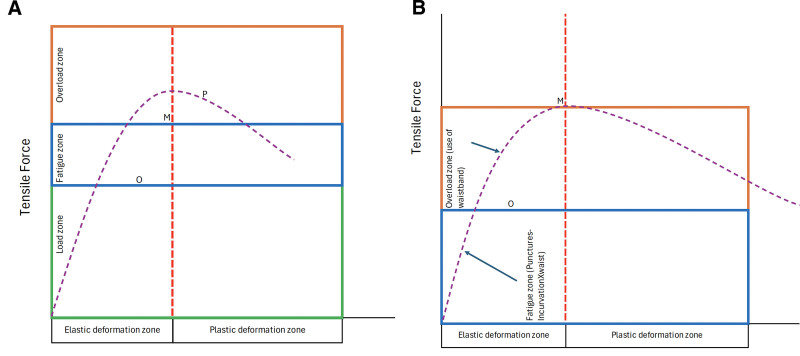
To fully understand the incurvation process, 3 key variables must be considered: the tensile force, the time during which the force is applied, and the deformation itself. A crucial study by Chamay 10 describes this process. In this experimental study, sustained pressure was exerted on the long bones of dogs to assess bone deformation, and histopathology was used to assess the changes (Fig. 1 A).
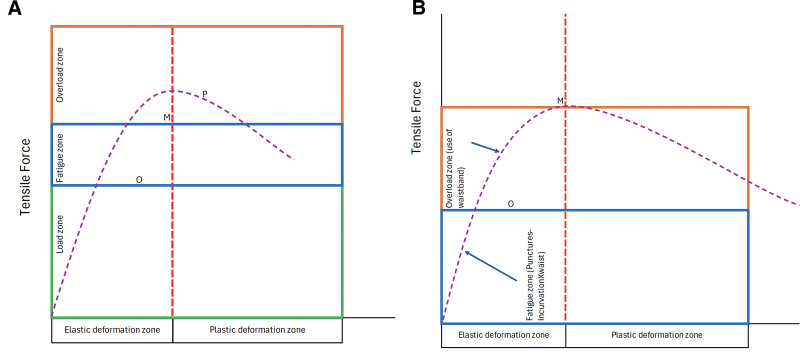
Fig. 1. Descriptive deformation plots. A, Bone incurvation model—original model, showing the relationship between pressure force and deformation: M, limit between the elastic deformation zone and the plastic deformation zone; 0, transition from the load zone to the fatigue zone. B, Bone incurvation model with respect to the IncurvationXribs technique, showing the relationship between pressure force and deformation: M, limit between the elastic deformation zone and the plastic deformation zone; 0, transition from load zone to fatigue zone.骨成角变形力学模型示意图(A 原始模型,B 结合 IncurvationXribs 的模型),标注弹性变形区与塑性变形区分界点 M;该模型源于 Chamay 犬长骨实验,属机制背景而非本文人体数据。The study delineates the rib’s deformation kinetics: an initial elastic incurvation (reversible under load removal), followed by plastic incurvation (irreversible remodeling). The transition occurs at Chamay’s 10 “point M,” where the applied compressive load exceeds bone hysteresis. Consistent with Hooke law, deformation is proportional to force up to this elastic limit; beyond it, permanent deformation ensues (Fig. 1 B). 10 , 11
The osteon or Haversian canal is a compact structural unit that provides rigidity to the bone, as it includes lamellae and cells such as osteocytes and osteoblasts that provide this property, making the bone a nonmalleable structure due to their cohesive forces when in equilibrium. 12 We created a difference in the cohesive forces, disrupting the equilibrium through continuous punctures that weaken the union of the structures that compact the bone, thereby predisposing the bone to deformation using continuous pressure forces (high-waist band). 10 – 12
Another critical parameter in the incurvation process is the magnitude and time dependence of the applied compressive load. As described by Chamay, 10 physiological compression generates a load-bearing area that dissipates stress without structural effect; however, sustained or escalating forces can induce fatigue, concentrating stress at osteonal interfaces. Beyond the yield threshold (“point M”), hysteresis is exceeded and the response shifts from elastic (reversible) bending to plastic (permanent) incurvation, with loss of osteonal cohesion and microcrack formation, culminating in stable bone deformation (Fig. 1 B). 10 – 14
In 1968, Ascenzi and Bonucci 15 observed the mechanical characteristics of the osteon (direction of the collagen bundles) using an electron microscope. They identified the fissures and disruptions of collagen fibers, forming an angle of 30–35 degrees with the axial plane of the osteon. This later provided an understanding of the structural changes occurring in the osteon that cause the deformation or fracture of a bone. 14 – 18
Surface lines developing after the inflection point can be shown as oblique lines when maintained in a state of tension, and when a fracture occurs, it can be located in the central part of these lines. 10 – 14 , 16 Following plastic incurvation, necrosis and microfractures occur due to collagen homeostasis disruption.
There are mechanisms through which these structures can be repaired. According to Wolff law, bone adapts after being subjected to a continuous force, strengthening in response to such events. Similarly, when a tensile force exceeds the fatigue limit and reaches an overload, it can subsequently trigger a repair through cortical bone ossification, especially where the lines and microfractures occurred. 13 – 19
Muscles continuously load the ribs; for ribs 10–12, the posterior pull is mainly from the latissimus dorsi and lower serratus. To counter muscle memory, we inject botulinum toxin at their distal rib insertions, lowering resistance without impairing ventilation (intercostals, transversus, diaphragm, and proximal spinal insertions remain intact). Thus, rib descent is preserved. Unlike RibXcar (monocortical fracture), IncurvationXribs achieves remodeling via osteonal weakening and progressive, pressure-induced reshaping along the M-line. 20 – 24
In incurvation surgery, angulation is achieved not through fracture but through controlled bone deformation caused by loss of cohesive strength within the rib structure. However, when applied across the entire rib surface, this technique is influenced by the muscle memory effect, which can counteract the intended deformation. To mitigate this effect, botulinum toxin is used to reduce muscle influence, thereby enhancing the deforming action and achieving the desired angulation. 24
A key determinant of procedural success is strict adherence to a compression waistband to sustain the tensile load required for plastic incurvation. We used a belt delivering a constant approximately 30 mm Hg, adjustable upward over time (Fig. 2 ). Owing to the intercostal space between ribs 11 and 12, both groups achieved significant reductions in waist circumference, with no between-group differences. Angular changes during follow-up likewise showed comparable efficacy, without statistically significant intergroup differences ( P > 0.05).
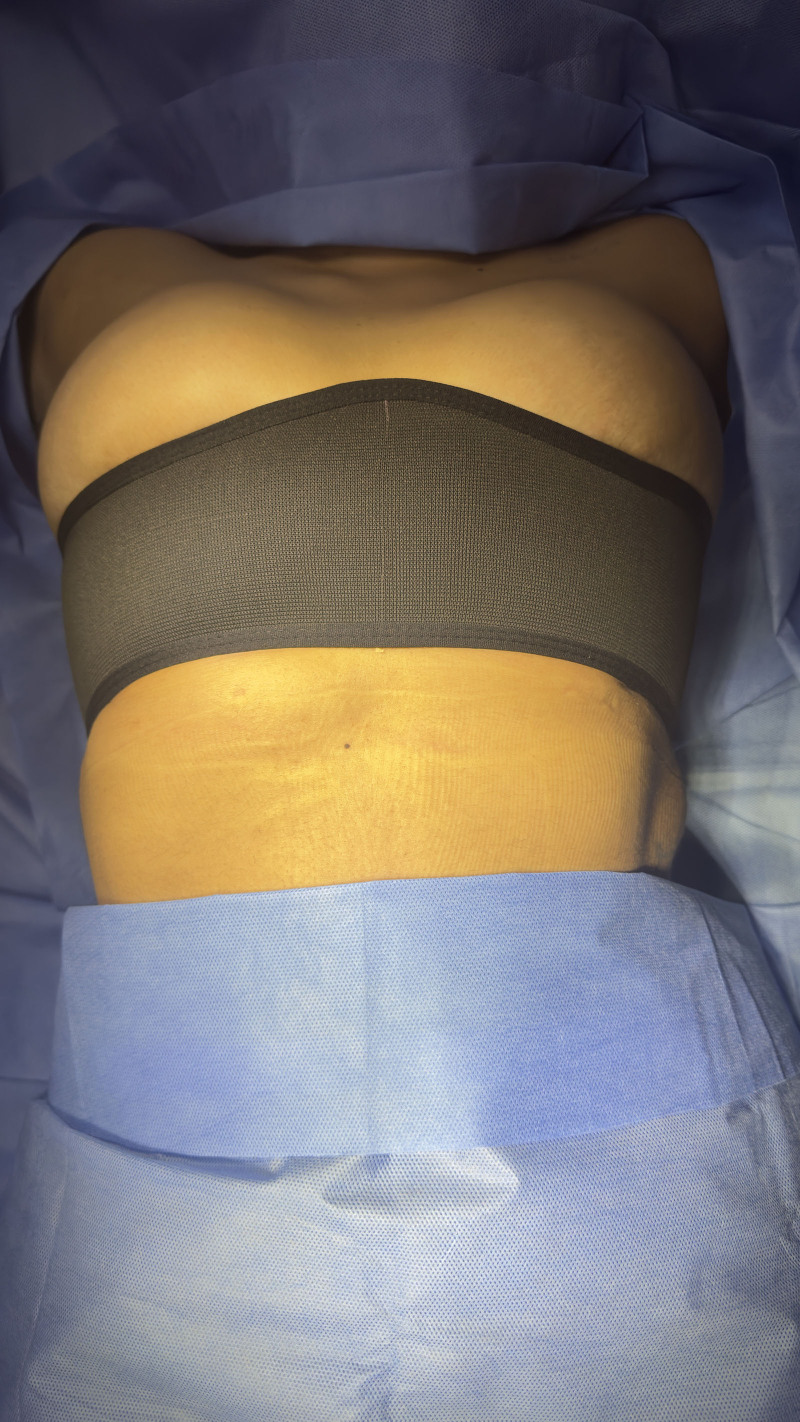
Fig. 2. High-compression waistband applying a pressure of 30 mm Hg.高加压束腰实物,持续施加约 30 毫米汞柱压力,用于维持塑性成角所需的张力负荷。Thus, angular variations observed during follow-up showed no difference in efficacy between the evaluated groups. The absence of significant differences in the comparative studies suggests that neither procedure (RibXcar and Incurvation) demonstrated superior effectiveness compared with the other (Table 4 ).
Pain and key outcome components were evaluated. Ten days postoperatively, visual analog scale scores were significantly lower with IncurvationXribs than with RibXcar ( P < 0.001), indicating superior early comfort (Table 5 ). In our experience, the components of a good outcome in incurvation surgery involve the following parameters.
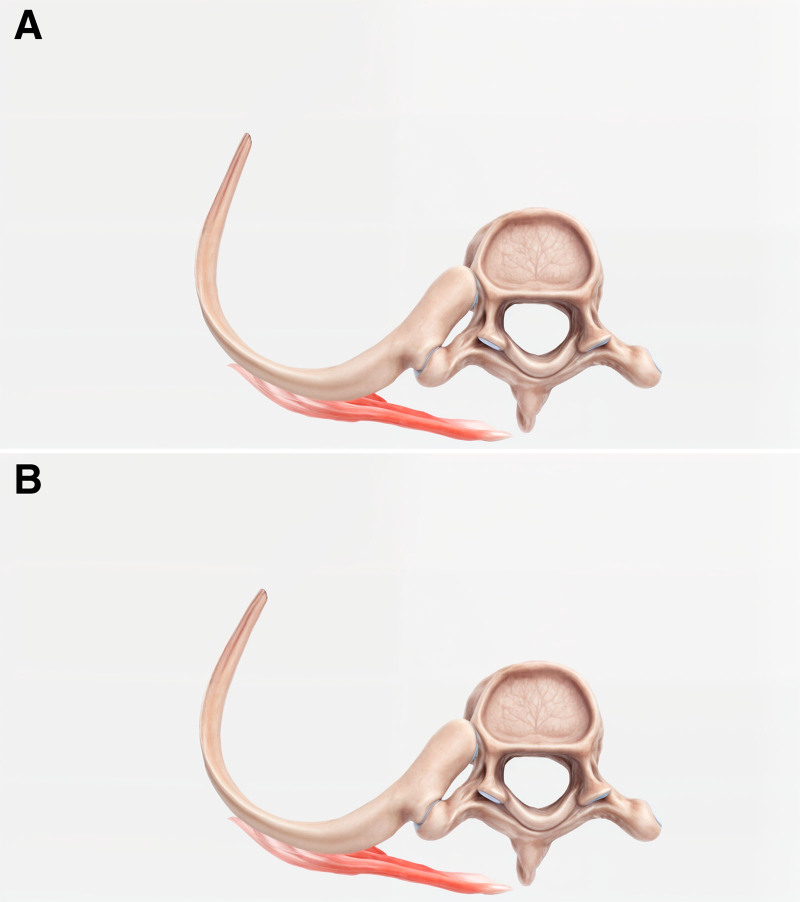
Fig. 3. Representative schematic illustration of the IncurvationXribs rib remodeling technique. A, Rib before incurvation deformation. B, Rib with internal angular deformation, showing the angular site of the rib and costal displacement.IncurvationXribs 肋骨重塑示意(A 变形前,B 内侧成角变形与肋骨内移),强调通过削弱骨内聚而非骨折实现缩腰。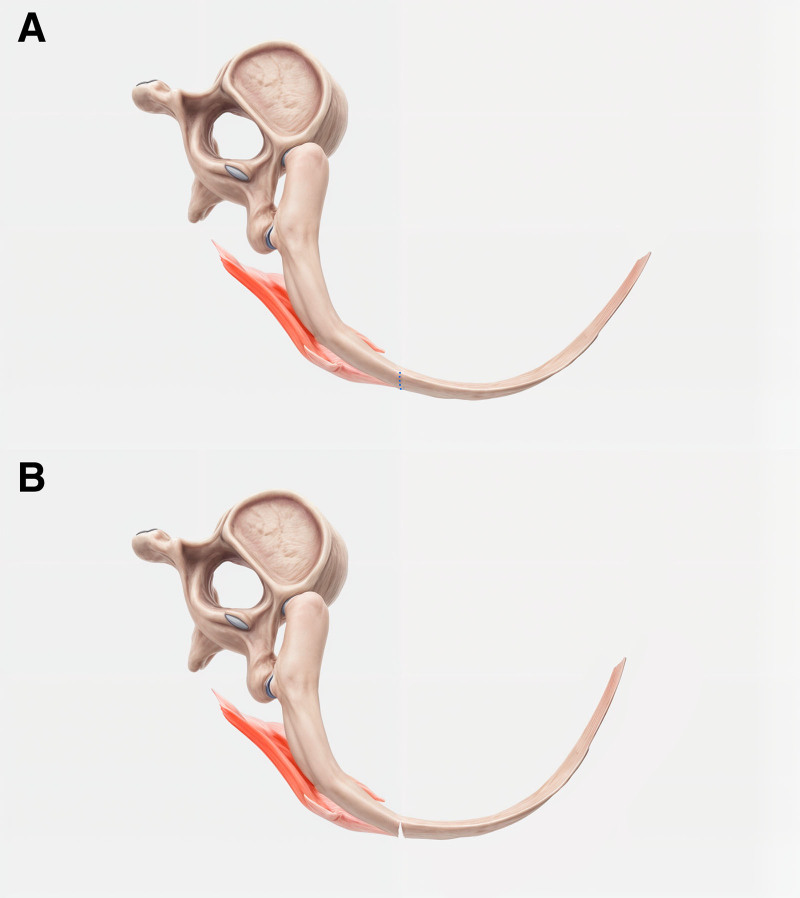
Fig. 4. Representative schematic illustration of the RibXcar rib remodeling technique. A, Rib before RibXcar deformation. B, Rib with internal angulation, showing the site of monocortical fracture (outer cortex) and inward costal displacement.Overall, both the discriminant and logistic analyses indicate that the techniques differ primarily in operative time, whereas angular variations (R11–R12) and waist reduction do not show statistically robust differences. Operative time as the sole independent predictor likely reflects procedural complexity, learning curve, or intraoperative workflow rather than biomechanical divergence. Potential selection bias and collinearity should be considered. Future studies with larger samples, randomization or matching, and longer follow-up are warranted to assess recurrence and late events (Tables 6 , 7 ).
With respect to operative time and complications, RibXcar showed shorter operative times than IncurvationXribs, primarily due to the additional time required for sustained punctures in group 2. Regarding adverse events, group 1 presented 2 (chronic pain >15 d and a bicortical fracture), both managed per protocol with favorable outcomes; group 2 reported no complications. However, the small sample size and brief follow-up limit the ability to establish statistically significant differences between groups (Figs. 5 , 6 ). At 6 months, CT confirmed adequate angulation and satisfactory results (Fig. 7 ).
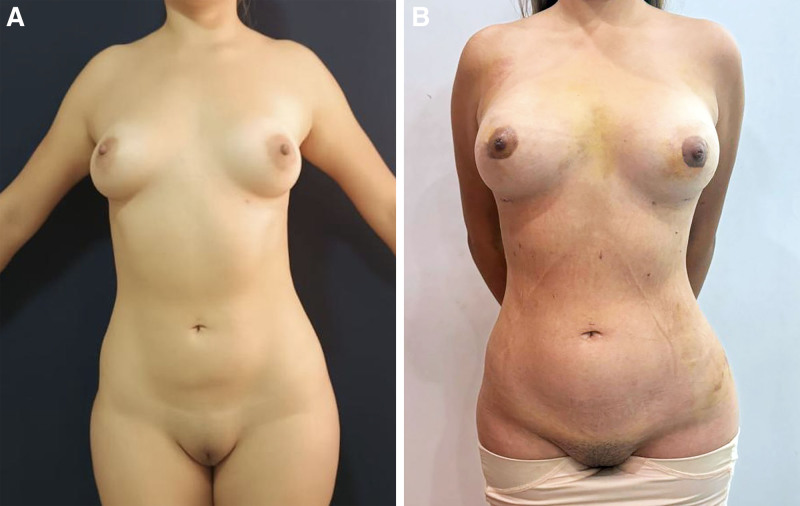
Fig. 5. Comparative photographic results of the IncurvationXribs rib remodeling technique in a 26-year-old woman. A, Preoperative frontal view. B, Six months after surgery.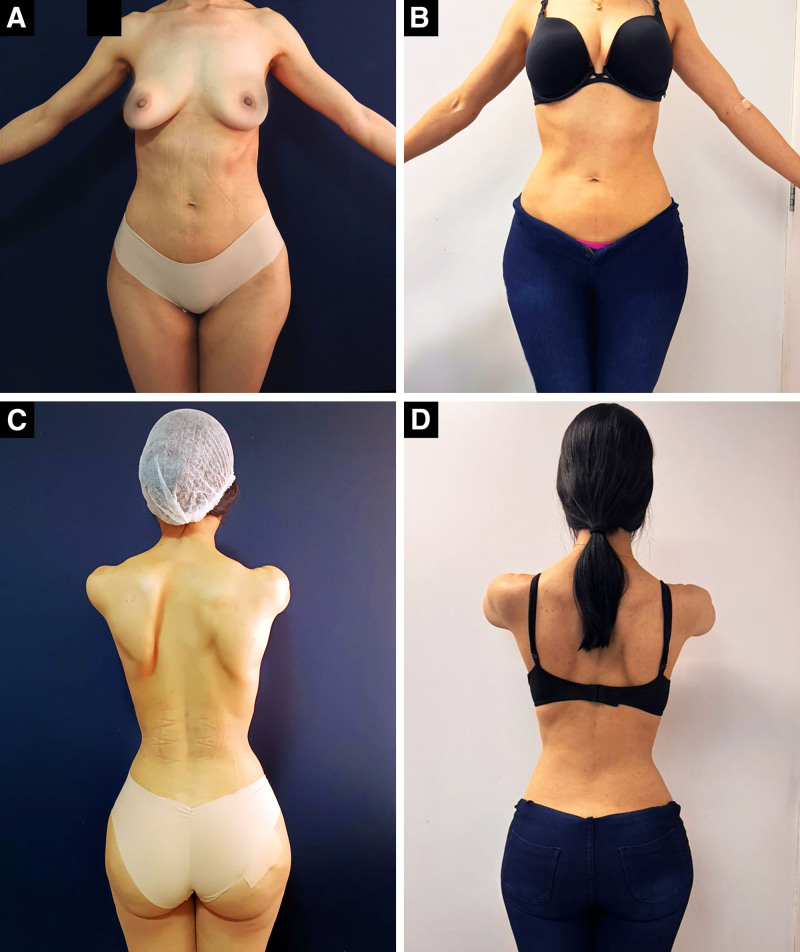
Fig. 6. Comparative photographic results of the IncurvationXribs rib remodeling technique in a 30-year-old woman. A, Preoperative frontal view. B, Six months after surgery. C, Preoperative posterior view. D, Six months after surgery.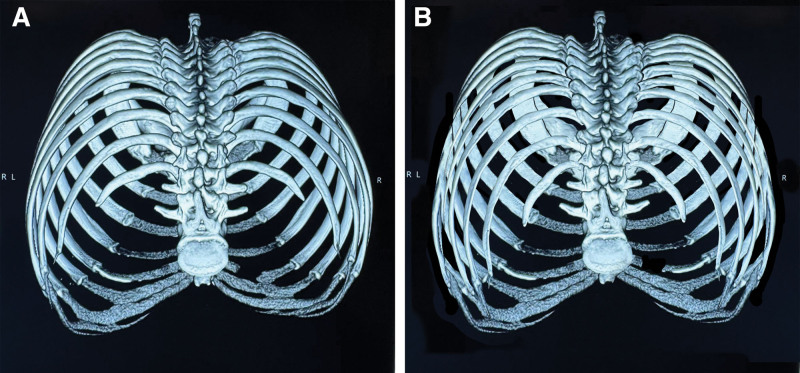
Fig. 7. CT images of a patient before and after the IncurvationXribs rib remodeling technique. A, Preoperative CT image. B, CT image 6 months postoperatively.IncurvationXribs 术前与术后 6 个月计算机断层扫描对照,证实成角满意且未见骨折线(与截骨组不同)。
Waist reduction surgery through bone deformation (IncurvationXribs) can efficiently reduce angulation and ensure waist reduction 6 months after surgery, with no significant differences compared with the RibXcar technique. Patients reported experiencing less pain 10 days after surgery, with possibly fewer complications. A greater number of patients with a longer follow-up period is required to obtain further comparative information.
The authors have no financial interest to declare in relation to the content of this article.
声明:中文精读 · 仅供学术参考。内容来自公开文献检索,不代表本人观点,不构成诊疗建议。 医疗美容需在正规医疗机构由执业医师实施。
基于相同主题推荐 · 继续深挖
单中心回顾性队列,2011–2022 年共 258 例(剔除 3 例数据不全),确诊性别不安、女性出生指派,中位年龄 24 岁(16–61),由认证整形外科医师行双侧手术。
回顾性连续系列 200 例男性(2020–2024),均行包含胸锯肌三角定义的高清脂雕,由同一资深医师完成,最小随访 8 个月(平均 19 个月,最长 4 年)。
研究为 50 例 18–38 岁女性(RibXcar 组 26 例,IncurvationXribs 组 24 例),均接受第 11–12 浮肋重塑以缩腰,随访 6 个月。